



83891-03-6

Chemical Structure
Norfluoxetine
- CAS No.: 83891-03-6
- Formula:C16H16F3NO
- Molecular Weight:295.30
IUPAC Name: 3-phenyl-3-(4-(trifluoromethyl)phenoxy)propan-1-amine
InChIKey: WIQRCHMSJFFONW-UHFFFAOYSA-N
SMILES: FC(F)(F)C(C=C1)=CC=C1OC(C2=CC=CC=C2)CCN
Biological Activity: Norfluoxetine is the active metabolite of the antidepressant Fluoxetine (HY-B0102); it is also a TREK-2 K2P potassium channel inhibitor with an IC50 of 2.7 μM. Norfluoxetine also inhibits placental aromatase (CYP19A1) (Ki = 2.1 µM), reduces placental estrogen secretion, and reduces serotonin transporter (SERT) activity. Norfluoxetine has neuroimmune activity, induces apoptosis in primary microglia (apoptosis), and inhibits the release of pro-inflammatory factors. Norfluoxetine inhibits neuronal high-threshold voltage-gated Ca2+ currents with an EC50 of 20.4 μM. Norfluoxetine can be used in research related to depression, ischemic stroke, and epilepsy[1][2][3][4].
| Cat. No. | Product Name | Purity | Description | Pricing | |||||||||||||||||||
|---|---|---|---|---|---|---|---|---|---|---|---|---|---|---|---|---|---|---|---|---|---|---|---|
|
|
Norfluoxetine | 98.71% | Norfluoxetine is the active metabolite of the antidepressant Fluoxetine (HY-B0102); it is also a TREK-2 K2P potassium channel inhibitor with an IC50 of 2.7 μM. Norfluoxetine also inhibits placental aromatase (CYP19A1) (Ki = 2.1 µM), reduces placental estrogen secretion, and reduces serotonin transporter (SERT) activity. Norfluoxetine has neuroimmune activity, induces apoptosis in primary microglia (apoptosis), and inhibits the release of pro-inflammatory factors. Norfluoxetine inhibits neuronal high-threshold voltage-gated Ca2+ currents with an EC50 of 20.4 μM. Norfluoxetine can be used in research related to depression, ischemic stroke, and epilepsy. | ||||||||||||||||||||
|
loading...
/
|
|||||||||||||||||||||||
|
|
Norfluoxetine-d5 hydrochloride | 99.30% | Norfluoxetine-d5 hydrochloride is the d5 deuterated-labeled Norfluoxetine hydrochloride (HY-W011235). Norfluoxetine hydrochloride is the active metabolite of the antidepressant Fluoxetine (HY-B0102); it is also a TREK-2 K2P potassium channel inhibitor with an IC50 of 2.7 μM. Norfluoxetine hydrochloride also inhibits placental aromatase (CYP19A1) (Ki = 2.1 µM), reduces placental estrogen secretion, and reduces serotonin transporter (SERT) activity. Norfluoxetine hydrochloride has neuroimmune activity, induces apoptosis in primary microglia (apoptosis), and inhibits the release of pro-inflammatory factors. Norfluoxetine hydrochloride inhibits neuronal high-threshold voltage-gated Ca2+ currents with an EC50 of 20.4 μM. Norfluoxetine hydrochloride can be used in research related to depression, ischemic stroke, and epilepsy. | ||||||||||||||||||||
|
loading...
/
|
|||||||||||||||||||||||
-
Similarity Score 1.00
 HY-133171(R)-Norfluoxetine
-
Similarity Score 1.00
 HY-133171A(S)-Norfluoxetine
-
Similarity Score 0.98
 HY-124357Seproxetine hydrochloride
-
Similarity Score 0.98
 HY-W011235RNorfluoxetine hydrochloride (Standard)
-
Similarity Score 0.90
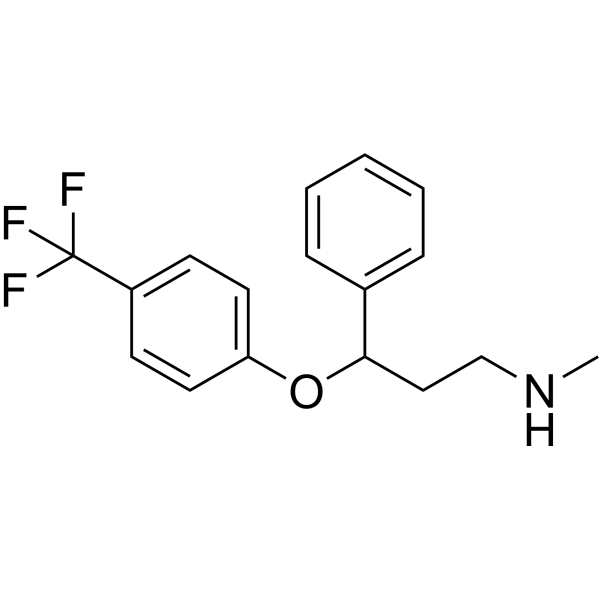 HY-B0102Fluoxetine
-
Similarity Score 0.89
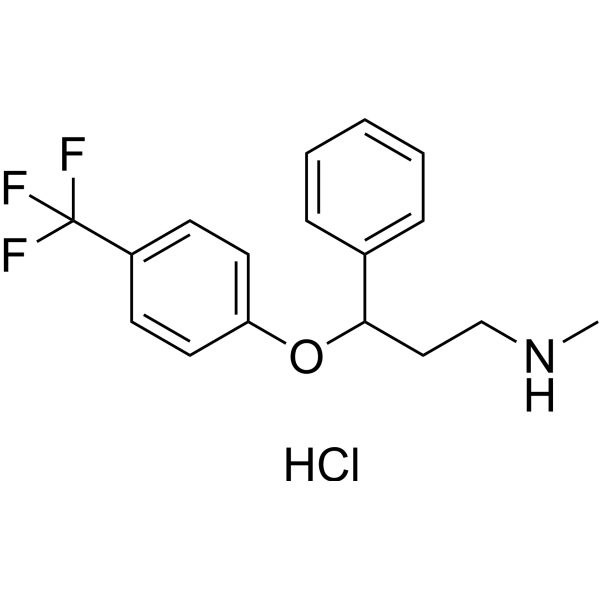 HY-B0102AFluoxetine hydrochloride
-
Similarity Score 0.89
 HY-B0102B(S)-Fluoxetine hydrochloride
-
Similarity Score 0.89
 HY-B0102C(R)-Fluoxetine hydrochloride
-
Similarity Score 0.88
 HY-135556ANorfluoxetine oxalate
-

Explore the MedChemAI to find more analogs


References
- [1]. Proks P, et al. Norfluoxetine inhibits TREK-2 K2P channels by multiple mechanisms including state-independent effects on the selectivity filter gate. The Journal of general physiology. 2021 Aug 02;153(8):e202012812. [Content Brief]
- [2]. Dhami KS, et al. Fluoxetine and its metabolite norfluoxetine induce microglial apoptosis. Journal of neurochemistry. 2019 Mar;148(6):761-778. [Content Brief]
- [3]. Kecskeméti V, et al. Norfluoxetine and fluoxetine have similar anticonvulsant and Ca2+ channel blocking potencies. Brain research bulletin. 2005 Sep 30;67(1-2):126-32. [Content Brief]
- [4]. Hudon Thibeault AA, et al. Fluoxetine and its active metabolite norfluoxetine disrupt estrogen synthesis in a co-culture model of the feto-placental unit. Mol Cell Endocrinol. 2017 Feb 15;442:32-39. [Content Brief]



