



87-39-8
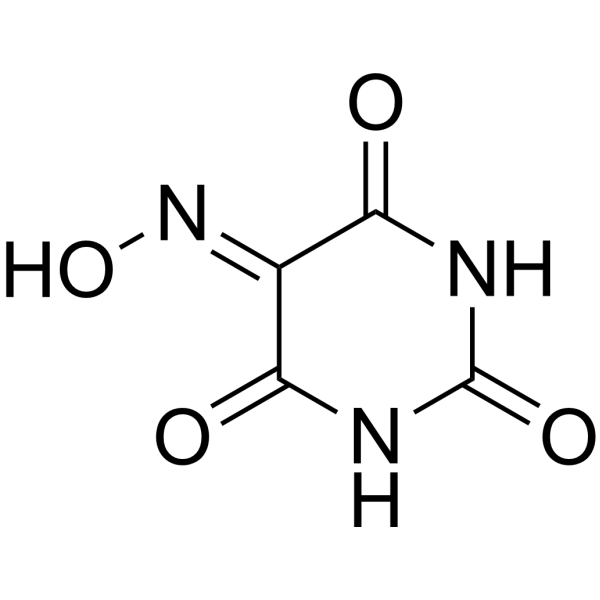
Chemical Structure
Violuric acid
- CAS No.: 87-39-8
- Formula:C4H3N3O4
- Molecular Weight:157.08
IUPAC Name: 5-(hydroxyimino)pyrimidine-2,4,6(1H,3H,5H)-trione
InChIKey: JMUJZTASUDOAGC-UHFFFAOYSA-N
SMILES: ON=C1C(NC(NC1=O)=O)=O
Biological Activity: Violuric acid is an orally active redox catalyst with anti-hypoxic, hepatoprotective, and other activities. Violuric acid transfers electrons from NAD (P) H to oxidized glutathione or peroxides, increases reduced glutathione, GSH/GSSG, thiol, and NAD+/NADH levels, and simultaneously reduces protein disulfides. Violuric acid extends the replicative lifespan of normal and progeroid human cells, restores cell cycle progression, decreases SAβG activity, downregulates the expression of p16, p21, and γH2A.X, and upregulates the expression of lamin B1. Violuric acid improves the performance of hematopoietic stem cells and extends the lifespan of mice and Caenorhabditis elegans. Violuric acid can be used for severe aplastic anemia, Bloom syndrome, and aging-related research[1][2][3].
| Cat. No. | Product Name | Purity | Description | Pricing | |||||||||||||||||||
|---|---|---|---|---|---|---|---|---|---|---|---|---|---|---|---|---|---|---|---|---|---|---|---|
|
|
Violuric acid | 99.98% | Violuric acid is an orally active redox catalyst with anti-hypoxic, hepatoprotective, and other activities. Violuric acid transfers electrons from NAD (P) H to oxidized glutathione or peroxides, increases reduced glutathione, GSH/GSSG, thiol, and NAD+/NADH levels, and simultaneously reduces protein disulfides. Violuric acid extends the replicative lifespan of normal and progeroid human cells, restores cell cycle progression, decreases SAβG activity, downregulates the expression of p16, p21, and γH2A.X, and upregulates the expression of lamin B1. Violuric acid improves the performance of hematopoietic stem cells and extends the lifespan of mice and Caenorhabditis elegans. Violuric acid can be used for severe aplastic anemia, Bloom syndrome, and aging-related research. | ||||||||||||||||||||
|
loading...
/
|
|||||||||||||||||||||||
-
Similarity Score 0.83
 HY-116823Alloxan
-
Similarity Score 0.71
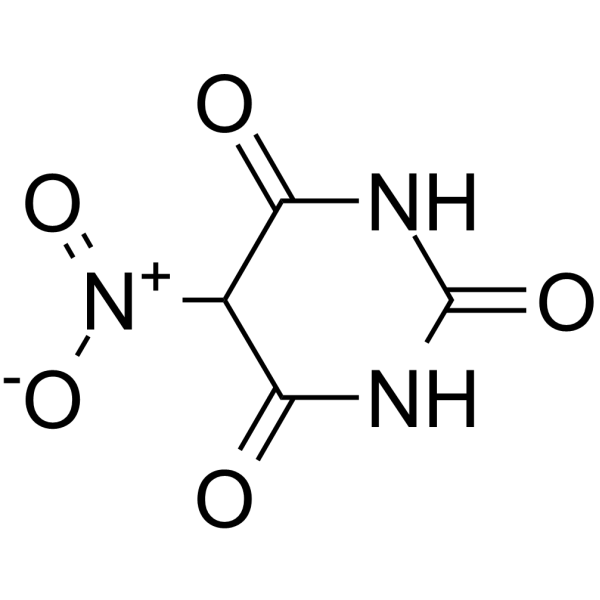 HY-W0020085-Nitrobarbituric acid
-
Similarity Score 0.70
 HY-779622-Thiobarbituric acid
-
Similarity Score 0.69
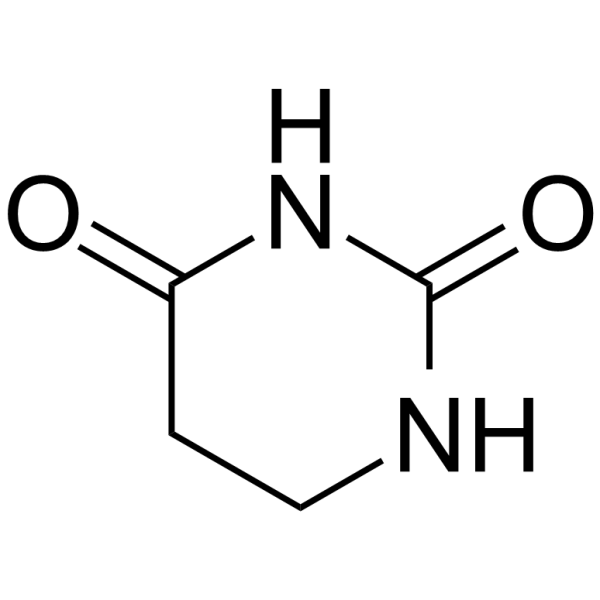 HY-W012926Dihydrouracil
-
Similarity Score 0.69
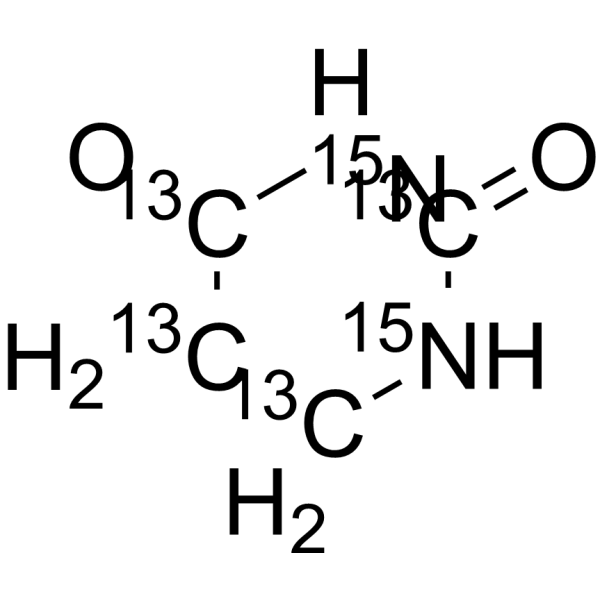 HY-W012926SDihydrouracil-13C4,15N2
-
Similarity Score 0.69
 HY-W779020Dihydrouracil-13C,15N2
-
Similarity Score 0.68
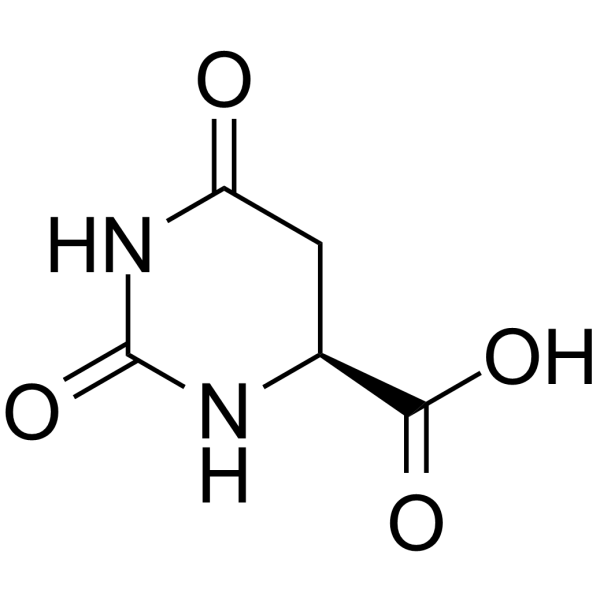 HY-W015495L-Dihydroorotic acid
-
Similarity Score 0.68
 HY-N6787R5,6-Dihydro-5-methyluracil (Standard)
-
Similarity Score 0.68
 HY-1341605,6-Dihydro-5-Fluorouracil
-

Explore the MedChemAI to find more analogs


References
- [1]. Vatolin PS, et al. Novel Small Molecule Stimulants of Hematopoietic Stem Cells and Their Mode of Action. Blood. 2018 Nov 29;132:1302.
- [2]. Sergei V, et al. New drugs for pharmacological extension of replicative life span in normal and progeroid cells. NPJ Aging. 2019;5(1).
- [3]. Krasnov KA, et al. INVESTIGATION OF BIOTRANSFORMATION PROCESSES AND PHARMACOLOGICAL ACTIVITY OF VIOLURIC ACIDS AND THEIR METABOLITES IN IN VIVO EXPERIMENTS. Extreme medicine. 2026;28(2):277-86.



