



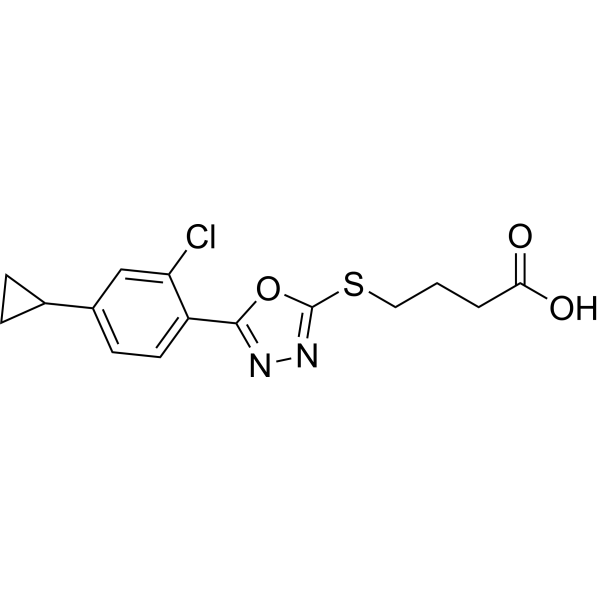
CCG-232964

Based on 1 Customer Validation
CCG-232964 is an orally active inhibitor of Rho/MRTF/SRF. CCG-232964 inhibits LPA-induced CTGF gene expression.
For research use only. We do not sell to patients.
- CAS No.: 2349373-70-0
- Formula: C15H15ClN2O3S
- Molecular Weight:338.81
-
Storage:Powder -20°C, 3 years , 4°C, 2 years ; In solvent -80°C, 6 months , -20°C, 1 month

To place orders, for customer services and technical support, please contact: MedChemExpress USA
Tel: 609-228-6898 E-mail: [email protected] [email protected]


-
 Biological Activity
-
Chemical Information
-
Solvent & Solubility
- Protocols
- Purity & Documentation
- References
-
 Help & FAQs




Biological Activity
Description


Chemical Information
-
CAS No. 2349373-70-0
-
Appearance Solid
-
Molecular Weight 338.81
-
Formula C15H15ClN2O3S
-
SMILES
O=C(O)CCCSC1=NN=C(C2=CC=C(C3CC3)C=C2Cl)O1
-
Shipping
Room temperature in continental US; may vary elsewhere.
-
Storage
Powder -20°C 3 years 4°C 2 years In solvent -80°C 6 months -20°C 1 month


Solvent & Solubility
In Vitro:
DMSO : 100 mg/mL (295.15 mM; Need ultrasonic; Hygroscopic DMSO has a significant impact on the solubility of product, please use newly opened DMSO)
Please refer to the solubility information to select the appropriate solvent. Once prepared, please aliquot and store the solution to prevent product inactivation from repeated freeze-thaw cycles.
Storage method and period of stock solution: -80°C, 6 months; -20°C, 1 month. When stored at -80°C, please use it within 6 months. When stored at -20°C, please use it within 1 month.
Please refer to the solubility information to select the appropriate solvent. Once prepared, please aliquot and store the solution to prevent product inactivation from repeated freeze-thaw cycles.
Storage method and period of stock solution: -80°C, 6 months; -20°C, 1 month. When stored at -80°C, please use it within 6 months. When stored at -20°C, please use it within 1 month.
Concentration (start) × Volume (start) = Concentration (final) × Volume (final)


Purity & Documentation
References


Complete Stock Solution Preparation Table
Please refer to the solubility information to select the appropriate solvent. Once prepared, please aliquot and store the solution to prevent product inactivation from repeated freeze-thaw cycles.
Storage method and period of stock solution: -80°C, 6 months; -20°C, 1 month. When stored at -80°C, please use it within 6 months. When stored at -20°C, please use it within 1 month.
| Optional Solvent | Concentration Solvent Mass | 1 mg | 5 mg | 10 mg | 25 mg |
|---|---|---|---|---|---|
| DMSO | 1 mM | 2.9515 mL | 14.7575 mL | 29.5151 mL | 73.7877 mL |
| 5 mM | 0.5903 mL | 2.9515 mL | 5.9030 mL | 14.7575 mL | |
| 10 mM | 0.2952 mL | 1.4758 mL | 2.9515 mL | 7.3788 mL | |
| 15 mM | 0.1968 mL | 0.9838 mL | 1.9677 mL | 4.9192 mL | |
| 20 mM | 0.1476 mL | 0.7379 mL | 1.4758 mL | 3.6894 mL | |
| 25 mM | 0.1181 mL | 0.5903 mL | 1.1806 mL | 2.9515 mL | |
| 30 mM | 0.0984 mL | 0.4919 mL | 0.9838 mL | 2.4596 mL | |
| 40 mM | 0.0738 mL | 0.3689 mL | 0.7379 mL | 1.8447 mL | |
| 50 mM | 0.0590 mL | 0.2952 mL | 0.5903 mL | 1.4758 mL | |
| 60 mM | 0.0492 mL | 0.2460 mL | 0.4919 mL | 1.2298 mL | |
| 80 mM | 0.0369 mL | 0.1845 mL | 0.3689 mL | 0.9223 mL | |
| 100 mM | 0.0295 mL | 0.1476 mL | 0.2952 mL | 0.7379 mL |


CCG-232964 Related Classifications
HY-130011 Related Classifications
 Powered by Bioz