



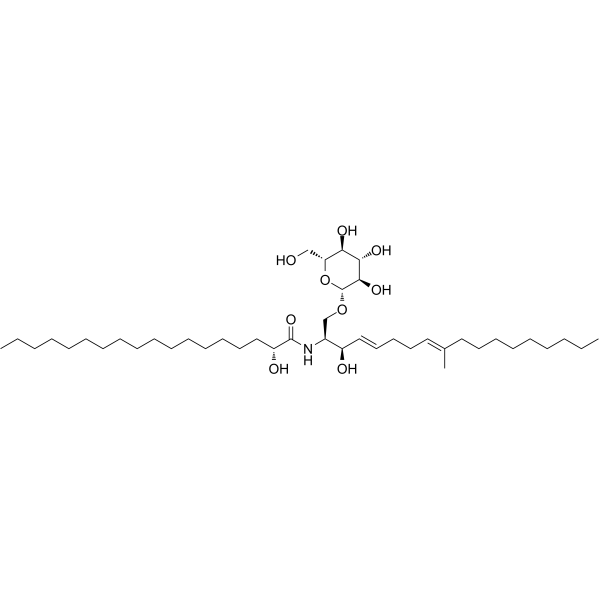
Cerebroside D

Based on 1 Customer Validation
Cerebroside D, a glycoceramide compound, improves experimental colitis in mice with multiple targets against activated T lymphocytes.
For research use only. We do not sell to patients.
- Purity : 95%
- CAS No.: 113773-89-0
- Formula: C43H81NO9
- Molecular Weight:756.10
-
Storage:
-20°C, protect from light
* In solvent : -80°C, 6 months; -20°C, 1 month (protect from light)

To place orders, for customer services and technical support, please contact: MedChemExpress USA
Tel: 609-228-6898 E-mail: [email protected] [email protected]


-
 Biological Activity
-
Chemical Information
- Protocols
- Purity & Documentation
- References
-
 Help & FAQs


All Endogenous Metabolite Isoforms
More

Biological Activity
Description
IC50 & Target
[1]|
Microbial Metabolite |


Chemical Information
-
CAS No. 113773-89-0
-
Appearance Solid
-
Molecular Weight 756.10
-
Formula C43H81NO9
-
Color White to off-white
-
SMILES
CCCCCCCCCCCCCCCC[C@@H](O)C(N[C@H]([C@H](O)/C=C/CC/C=C(C)/CCCCCCCCC)CO[C@@H]1O[C@@H]([C@H]([C@@H]([C@H]1O)O)O)CO)=O
-
Structure Classification
-
Initial Source
Lactifluus volemus
-
Shipping
Room temperature in continental US; may vary elsewhere.
-
Storage
-20°C, protect from light
* In solvent : -80°C, 6 months; -20°C, 1 month (protect from light)


Purity & Documentation
-
Data Sheet (265 KB)
-
SDS (251 KB)
- English - EN (251 KB)
- Français - FR (251 KB)
- Deutsch - DE (251 KB)
- Norwegian - NO (251 KB)
- Español - ES (251 KB)
- Swedish - SV (251 KB)
- Italian - IT (251 KB)
- Korean - KR (251 KB)
- Portuguese - PT (251 KB)
-
Handling Instructions (2659 KB)
References

Calculators
Concentration (start) × Volume (start) = Concentration (final) × Volume (final)


Cerebroside D Related Classifications
HY-N10196 Related Classifications
 Powered by Bioz