



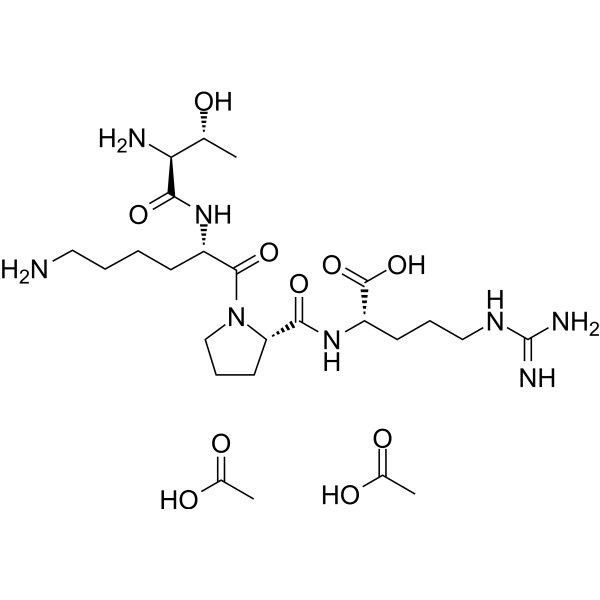
Tuftsin diacetate
Based on 4 publication(s) in Google Scholar
Tuftsin diacetate, a tetrapeptide, is a macrophage/microglial activator.
Nur für Forschungszwecke. Wir verkaufen nicht an Patienten.
- CAS. Nr.: 72103-53-8
- Formel: C25H48N8O10
- Molecular Weight:620.70
-
Speicherung:
Please store the product under the recommended conditions in the Certificate of Analysis.

To place orders, for customer services and technical support, please contact: MedChemExpress USA
Tel: 609-228-6898 E-mail: [email protected] [email protected]


-
 Biologische Aktivität
-
Chemical Information
-
Lösungsmittel & Löslichkeit
- Reinheit & Dokumentation
- Verweise
-
 Help & FAQs


Publications Citing Use of MedChemExpress (MCE) Tuftsin diacetate
MoreAlle Endogenous Metabolite Isoform-spezifische Produkte anzeigen
More

Biologische Aktivität
|
Human Endogenous Metabolite |
Tuftsin is a tetrapeptide, Thr-Lys-Pro-Arg, which resides in the Fc-domain of the heavy chain of immunoglobulin G. Tuftsin possesses a broad spectrum of activities related primarily to the immune system function and exerts on phagocytic cells, notably on macrophages. Tuftsin's capacity to augment cellular activation is mediated by specific receptors that are identified, characterized, and recently isolated from rabbit peritoneal granulocytes[1]. Tuftsin, a macrophage/microglial activator, dramatically improves the clinical course of experimental autoimmune encephalomyelitis (EAE), a well-established animal model for MS. Tuftsin administration correlates with upregulation of the immunosuppressive Helper-2 Tcell (Th2) cytokine transcription factor GATA-3. Tuftsin promotes phagocytic activity for cells of monocytic origin, such as neutrophils, macrophages and microglia, all of which are thought to express Tuftsin receptors[2].
MedChemExpress (MCE) has not independently confirmed the accuracy of these methods. They are for reference only.


Chemical Information
-
CAS. Nr. 72103-53-8
-
Molecular Weight 620.70
-
Formel C25H48N8O10
-
Sequence
Thr-Lys-Pro-Arg
-
Sequence Shortening
TKPR
-
Versand
Room temperature in continental US; may vary elsewhere.
-
Speicherung
Please store the product under the recommended conditions in the Certificate of Analysis.


Publications (4)
-
Journal Impact Factor
-
Most Recent
-
-
ACS Appl Mater Interfaces
The P2X7-Mediated Mitochondrial ROS as an Emerging Core Target of Tuftsin Nanoparticles in Severe Acute Pancreatitis Therapy via Regulating Mitophagy. [Abstract]2025 Feb 5;17(5):7521-7538. PMID: 39854589 -
Biochem Pharmacol
Tuftsin ameliorates splenic inflammatory injury by promoting neuropilin-1 in severe acute pancreatitis. [Abstract]2022 May;199:115030. PMID: 35381211 -


Lösungsmittel & Löslichkeit
H2O
Peptide Solubility and Storage Guidelines:
1. Calculate the length of the peptide.
2. Calculate the overall charge of the entire peptide according to the following table:
| Contents | Assign value | |
| Acidic amino acid | Asp (D), Glu (E), and the C-terminal -COOH. | -1 |
| Basic amino acid | Arg (R), Lys (K), His (H), and the N-terminal -NH2 | +1 |
| Neutral amino acid | Gly (G), Ala (A), Leu (L), Ile (I), Val (V), Cys (C), Met (M), Thr (T), Ser (S), Phe (F), Tyr (Y), Trp (W), Pro (P), Asn (N), Gln (Q) | 0 |
3. Recommended solution:
| Overall charge of peptide | Details |
| Negative (<0) |
1. Try to dissolve the peptide in water first. 2. If water fails, add NH4OH (<50 μL). 3. If the peptide still does not dissolve, add DMSO (50-100 μL) to solubilize the peptide. |
| Positive (>0) |
1. Try to dissolve the peptide in water first. 2. If water fails, try dissolving the peptide in a 10%-30% acetic acid solution. 3. If the peptide still does not dissolve, try dissolving the peptide in a small amount of DMSO. |
| Zero (=0) |
1. Try to dissolve the peptide in organic solvent (acetonitrile, methanol, etc.) first. 2. For very hydrophobic peptides, try dissolving the peptide in a small amount of DMSO, and then dilute the solution with water to the desired concentration. |


Reinheit & Dokumentation
Verweise
[1]. Fridkin M, et al. Tuftsin: its chemistry, biology, and clinical potential. Crit Rev Biochem Mol Biol. 1989;24(1):1-40. [Content Brief]
[2]. Wu M, et al. Tuftsin promotes an anti-inflammatory switch and attenuates symptoms in experimentalautoimmune encephalomyelitis. PLoS One. 2012;7(4):e34933. [Content Brief]

Calculators
Konzentration (Stammlösung) × Volumen (Stammlösung) = Konzentration (Ziellösung) × Volumen (Ziellösung)


Tuftsin diacetate Related Classifications
HY-P0240A Related Classifications
 Powered by Bioz