



A947
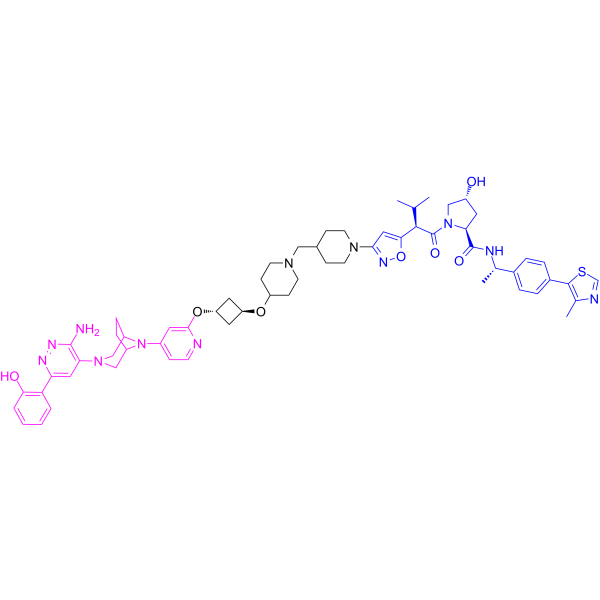
A947 is a VHL-based SMARCA2 PROTAC degrader with a DC50 of 39 pM and a Kd of 93 nM for human SMARCA2. A947 recruits SMARCA2 to the VHL E3 ubiquitin ligase for ubiquitination modification, mediates its degradation via the proteasome, and exerts selective degradation effects on SMARCA4 and PBRM1. A947 induces G1 cell cycle arrest, inhibits transcription, and exerts growth inhibitory effects in SMARCA4G12C-mutant cancer cells. A947 acts synergistically with MCL1 inhibitors to induce apoptosis in SMARCA4G12C-mutant cancer cells. A947 can be used in studies related to SMARCA4G12C-mutant non-small cell lung cancer and non-small cell lung cancer.
(Pink: SMARCA2 Target protein ligand; Blue: VHL ligand (HY-159465); Black: linker).
Nur für Forschungszwecke. Wir verkaufen nicht an Patienten.
- CAS. Nr.: 2378056-80-3
- Formel: C61H76N12O7S
- Molecular Weight:1121.40
-
Speicherung:
Please store the product under the recommended conditions in the Certificate of Analysis.

To place orders, for customer services and technical support, please contact: MedChemExpress USA
Tel: 609-228-6898 E-mail: [email protected] [email protected]


-
 Biologische Aktivität
-
Chemical Information
- Protokoll
- Reinheit & Dokumentation
- Verweise
-
 Help & FAQs


Alle PROTACs Isoform-spezifische Produkte anzeigen
MoreAlle SWI/SNF Complex Isoform-spezifische Produkte anzeigen
More

Biologische Aktivität
Beschreibung
|
SMARCA2 39 pM (DC50) |
SMARCA2 93 nM (Kd) |
SMARCA4 65 nM (Kd) |
In Vitro
A947 (0.0001-1000 nM; 20 h) potently and selectively degrades SMARCA2 over SMARCA4 in SW1573 cells, with a DC50 of 39 pM for SMARCA2 and a DC50 of 1.1 nM for SMARCA4[1].
A947 (dose-response range; 18 h) selectively degrades SMARCA2 in SW1573 cells, with minimal effect on SMARCA4, PBRM1, and other non-target proteins, as measured by immunoblotting after 18 h treatment[1].
A947 (500 nM; incubated after 1 h pretreatment with inhibitors/ligands)-mediated SMARCA2 degradation in SW1573 cells requires specific binding to SMARCA2 and VHL, and relies on ubiquitination and proteasome-mediated protein breakdown[1].
A947 (0.001-1000 nM; 24 h) selectively degrades all tested SMARCA2 isoforms over SMARCA4 isoforms ectopically expressed in TOV112D cells after 24 h treatment[1].
A947 (0.001-1000 nM; 24 h) equally efficiently degrades human, murine, and rat SMARCA2 orthologs ectopically expressed in both human TOV112D and murine LA-4 cells after 24 h treatment[1].
A947 (500 nM; 5 min, 30 min) treatment of SW1573 cells induces specific ubiquitination of SMARCA2 and SMARCA4, with no detectable ubiquitination of non-target core BAF complex or accessory proteins[1].
A947 (100 nM; 8 h) treatment of SW1573 cells selectively reduces the abundance of SMARCA2, SMARCA4, and PBRM1, with no impact on the abundance of other proteins in the proteome[1].
A947 (100 nM; 96 h) treatment of SMARCA4-mutant HCC2302 cells for 96 h induces transcriptional changes that strongly correlate with inducible SMARCA2 shRNA knockdown, confirming the on-target effect of SMARCA2 degradation[1].
A947 (1 μM) undergoes active, SLC transporter-mediated uptake by primary human hepatocytes, as demonstrated by time-dependent uptake at 37 °C that is inhibited by a pan-SLC inhibitor and abolished at 4 °C[2].
A947 (10 nM; 8 h initial treatment, 48 h or 168 h re-treatment post-washout) is retained in NCI-H1944 cells for prolonged periods post-washout, sustaining SMARCA2 degradation for up to 168 hours, as evidenced by minimal target protein re-synthesis until competition with a VHL ligand restores SMARCA2 levels[2].
A947 (5 μM; 3 h) is highly stable in vitro in human and male Wistar Han rat hepatocytes, with <10% metabolism observed after 3 h of incubation at 5 μM, primarily via linker cleavage[2].
A947 (5 μM; 1 h) is highly stable in vitro in human and rat liver microsomes, with <10% metabolism observed after 1 h of incubation at 5 μM, primarily via linker cleavage, and oxidative metabolism dependent on cytochrome P450 enzymes[2].
A947 directly inhibits human CYP3A4/5 (IC50 ~0.54 µM with midazolam substrate) and CYP2C19 (IC50 ~3 µM) in vitro in human liver microsomes[2].
A947 (dose-response range; 7 days) selectively inhibits the viability of SMARCA4-mutant lung cancer cell lines (median IC50 = 7 nM) compared to SMARCA4-wild-type cell lines (median IC50 = 86 nM), with no effect on SMARCA2-deficient cell lines after 7 days of treatment[1].
A947 (dose-response range; 5 days) synergizes with MCL1 inhibitors (AMG-176 (Tapotoclax) (HY-101565)) to inhibit the viability of SMARCA4G12C-mutant lung cancer cell lines after 5 days of treatment, with no synergy observed in SMARCA4-wild-type cell lines[1].
MedChemExpress (MCE) has not independently confirmed the accuracy of these methods. They are for reference only.
-
Cell Line:SW1573 cells
-
Concentration:0.0001 nM; 0.001 nM; 0.01 nM; 0.1 nM; 1 nM; 10 nM; 100 nM; 1000 nM
-
Incubation Time:20 h
-
Result:Potently degraded SMARCA2 with a DC50 of 39 pM, achieving 96% maximal degradation at 10 nM.
Degraded SMARCA4 with a DC50 of 1.1 nM, achieving 92% maximal degradation at 100 nM.
Exhibited a 28-fold selectivity for SMARCA2 degradation over SMARCA4.
-
Cell Line:SW1573 cells
-
Concentration:Dose-response range
-
Incubation Time:18 h
-
Result:Degraded SMARCA2 in a dose-dependent manner.
Caused minimal impact on SMARCA4, PBRM1, SMARCC1, VHL, and HDAC1 at lower concentrations.
Induced maximal SMARCA2 degradation at higher doses, while SMARCA4 degradation required higher concentrations.
-
Cell Line:SW1573 cells
-
Concentration:500 nM
-
Incubation Time:incubated after 1 h pretreatment with inhibitors/ligands
-
Result:Had its SMARCA2 degradation blocked by pretreatment with free SMARCA2/4 ligand, free VHL ligand, MLN-7243, or MG-132.
Confirmed requirement for binding to both SMARCA2 and VHL, and dependence on ubiquitination and proteasome activity for degradation.
-
Cell Line:TOV112D cells
-
Concentration:0.0001 nM; 0.001 nM; 0.01 nM; 0.1 nM; 1 nM; 10 nM; 100 nM; 1000 nM
-
Incubation Time:24 h
-
Result:Exhibited consistent selective degradation of all tested SMARCA2 isoforms over SMARCA4 isoforms.
Maintained the 28-fold degradative selectivity observed in endogenous protein assays.
-
Cell Line:TOV112D (human) cells, LA-4 (murine) cells
-
Concentration:0.0001 nM; 0.001 nM; 0.01 nM; 0.1 nM; 1 nM; 10 nM; 100 nM; 1000 nM
-
Incubation Time:24 h
-
Result:Potently degraded human, murine, and rat SMARCA2 orthologs in both human TOV112D and murine LA-4 cells.
Showed similar degradation efficacy across species.
-
Cell Line:SMARCA4-mutant NCI-H1944 lung cancer cells
-
Concentration:0.01 nM; 0.1 nM; 1 nM; 10 nM; 100 nM; 1000 nM
-
Incubation Time:7 days
-
Result:Dose-dependently inhibited NCI-H1944 cell viability.
Showed potent activity dependent on SMARCA2 degradation, as binding-defective analogs A857 and A858 were significantly weaker.
-
Cell Line:panel of 30 lung cancer cell lines (SMARCA4-mutant, SMARCA4-wild-type, and SMARCA2-deficient)
-
Concentration:Dose-response range
-
Incubation Time:7 days
-
Result:Inhibited SMARCA4-mutant cell lines most sensitively, with a median IC50 of 7 nM.
Inhibited SMARCA4-wild-type cell lines significantly less sensitively, with a median IC50 of 86 nM.
Had no impact on the viability of SMARCA2-deficient cell lines.
-
Cell Line:SMARCA4-mutant lung cancer cell lines (HCC2302, NCI-H1793, RERF-LC-AI, NCI-H1944), SMARCA4-wild-type (Calu-6) cell line, SMARCA2-deficient (A427) cell line
-
Concentration:4 nM, 20 nM, 100 nM, 500 nM
-
Incubation Time:48 h
-
Result:Induced G1 arrest across SMARCA4-mutant models (HCC2302, NCI-H1793, RERF-LC-AI, NCI-H1944).
Caused no G1 arrest in SMARCA4-wild-type (Calu-6) or SMARCA2-deficient (A427) control cell lines.
Caused no acute cytotoxicity.
-
Cell Line:SMARCA4-mutant lung cancer cell lines, SMARCA4-wild-type lung cancer cell lines
-
Concentration:dose-response range
-
Incubation Time:5 days
-
Result:Exhibited synergistic growth inhibition with both AMG-176 (0.000229-500 nM) and S63845 (0.000229-500 nM) in all tested SMARCA4-mutant models, with excess volume values indicating synergy across multiple concentration pairs.
Showed no synergy in SMARCA4-wild-type models.
-
Cell Line:SMARCA4-mutant NCI-H1944 cells, SMARCA4-mutant NCI-H838 cells
-
Concentration:100 nM
-
Incubation Time:48 h
-
Result:Combined with AMG-176 (1 μM) significantly increased apoptotic cell death in both NCI-H1944 and NCI-H838 cells compared to single-agent treatment.
Showed minimal apoptotic effect as a single agent, as did single-agent AMG-176.
-
Cell Line:NCI-H1944 non-small cell lung cancer cells
-
Concentration:10 nM (8 h initial treatment); 10 nM (re-treatment post-washout)
-
Incubation Time:8 h (initial treatment); 48 h or 168 h (re-treatment post-washout)
-
Result:Degraded SMARCA2 protein by ~85% after 8 h of treatment at 10 nM.
Showed minimal SMARCA2 re-synthesis at 48 h and 168 h post-washout after extensive washout.
Further degraded SMARCA2 protein when re-treated with 10 nM post-washout.
Parmacokinetics
| Species | Dose | Route | CL | Vdss | T1/2 |
|---|---|---|---|---|---|
| Mice[1] | 40 mg/kg | i.v. | <16 mL/min/kg | >6 L/kg | >6 h |
In Vivo
A947 (40 mg/kg; i.v.; every other week) achieves greater than 95% SMARCA2 protein degradation and 60% tumor growth inhibition in SMARCA4G12C mutant HCC2302 xenografts[1].
A947 (40 mg/kg; i.v.; every other week) achieves greater than 95% SMARCA2 protein degradation but no significant tumor growth inhibition in SMARCA4 wild-type Calu-6 xenografts[1].
A947 (20-40 mg/kg; i.v.; once weekly, every other week; 15-29 days) induces dose-dependent, sustained tumor growth inhibition in NSCLC xenograft mice, with comparable efficacy observed for once-weekly and every-other-week dosing at 40 mg/kg, accompanied by potent suppression of SMARCA2 and its transcriptional target KRT80[2].
A947 (1-20 mg/kg; i.v.; single bolus) rapidly distributes to mouse liver, kidney, and lung, with significantly higher and more sustained tissue exposure compared to blood[2].
A947 (10 mg/kg; i.v.; single dose) accumulates and persists in NSCLC xenograft tumors, with tumor concentrations increasing relative to blood over time to maintain pharmacodynamically relevant levels[2].
MedChemExpress (MCE) has not independently confirmed the accuracy of these methods. They are for reference only.
-
Animal Model:Crl:NU-Foxn1nu (NU/NU Nude); CB17/Icr-Prkdcscid/IcrIcoCrl (Fox Chase CB17) (female, 6-8 weeks old, SMARCA4 mutant HCC515 xenograft model)[1]
-
Dosage:40 mg/kg (PK/PD studies); 40 mg/kg (efficacy studies)
-
Administration:i.v.; single dose (PK/PD studies); i.v.; every other week (efficacy studies)
-
Result:Reduced tumor SMARCA2 protein levels by 96% within 4 hours, with maximal reduction at 24 hours.
Showed SMARCA2 levels had a slight rebound over 14 days but did not return to baseline.
Maximally suppressed KRT80 and PLAU transcript levels by 96 hours post-dose.
Achieved near-complete tumor growth inhibition (TGI) with no appreciable body weight loss.
Reduced tumor SMARCA2 protein levels by over 95% at study end.
Strongly suppressed KRT80 transcript levels at study end.
-
Animal Model:Crl:NU-Foxn1nu (NU/NU Nude); CB17/Icr-Prkdcscid/IcrIcoCrl (Fox Chase CB17) (female, 6-8 weeks old, SMARCA4 mutant HCC2302 xenograft model)[1]
-
Dosage:40 mg/kg
-
Administration:i.v.; every other week
-
Result:Achieved 60% tumor growth inhibition with no appreciable body weight loss.
Reduced tumor SMARCA2 protein levels by over 95% at study end.
Suppressed KRT80 transcript levels at study end.
-
Animal Model:Crl:NU-Foxn1nu (NU/NU Nude); CB17/Icr-Prkdcscid/IcrIcoCrl (Fox Chase CB17) (female, 6-8 weeks old, SMARCA4 wild-type Calu-6 xenograft model)[1]
-
Dosage:40 mg/kg
-
Administration:i.v.; every other week
-
Result:Did not result in statistically significant tumor growth inhibition.
Reduced tumor SMARCA2 protein levels by over 95% at study end.
Caused moderate degradation of SMARCA4 (58% decrease) and PBRM1 (57% decrease) at study end.
-
Animal Model:Sprague Dawley (male, 7-12 weeks old, 229-331 g)[2]
-
Dosage:4 mg/kg
-
Administration:i.v.; single dose
-
Result:Showed a biphasic elimination pattern in blood and plasma, with >90% clearance within the first 12 hours, followed by a slow terminal phase with a half-life of 72-75 hours.
Reached maximum concentration (Cmax) in blood and plasma of 1.23 µg/g and 1.22 µg/g, respectively, at 0.25 hours.
Maintained detectable radioactivity at 3-6 ng/g in plasma and blood at 336 hours.
Distributed widely to tissues, with highest Cmax values observed in adrenal glands (17.1 µg/g), kidneys (22.3 µg/g), liver (32 µg/g), lungs (11.6 µg/g), thyroid (18 µg/g), and spleen (20.6 µg/g) at 0.25 hours.
Saw tissue-to-plasma ratios increase over time, reaching up to 1440 in the thyroid at 336 hours.
Achieved biliary excretion as the major elimination route, accounting for 54.2% of the administered dose in bile duct-cannulated rats over 168 hours; fecal excretion accounted for 77.3% in intact rats over 336 hours.
Had parent A947 as the major radioactive component in most tissues and bile at 24 hours.
Exhibited high protein binding, with unbound percentages ranging from 0.0125% in pancreas to 0.22% in prostate.
-
Animal Model:CD-1 (male, 20-35 g)[2]
-
Dosage:1 mg/kg; 20 mg/kg
-
Administration:i.v.; single bolus
-
Result:Showed biphasic elimination in blood, with >90% clearance within the first 4 hours, followed by a slow terminal phase with a half-life of 10-15 hours.
Achieved tissue exposure much higher than blood exposure: tissue-to-blood AUC ratios were 243 (kidney), 50.3 (liver), and 25.6 (lung) for the 1 mg/kg dose; and 159.6 (kidney), 127.2 (liver), and 49.7 (lung) for the 20 mg/kg dose.
Reached Cmax values in tissues peaking at 4 hours post-dose, reaching 4.91 µM (kidney), 1.87 µM (liver), and 0.843 µM (lung) for 1 mg/kg, and 94.3 µM (kidney), 91.4 µM (liver), and 38.9 µM (lung) for 20 mg/kg.
-
Animal Model:C.B-17 SCID (Inbred) (female, 16-20 g, subcutaneous xenograft of HCC2302 lung adenocarcinoma cells)[2]
-
Dosage:20 mg/kg; 40 mg/kg
-
Administration:i.v.; once weekly; 15 days; i.v.; once weekly; 29 days; i.v.; every other week; 29 days
-
Result:Showed dose-dependent tumor growth inhibition: at 20 mg/kg once weekly, tumor volume was ~380 mm3 at day 20 (vs. ~520 mm3 for vehicle); at 40 mg/kg once weekly, tumor volume remained ~200 mm3 at day 20.
Achieved similar tumor growth inhibition with 40 mg/kg every other week as once weekly dosing, with tumor volumes reaching ~300 mm3 at day 28 (vs. ~600 mm3 for vehicle).
Induced pharmacodynamic effects including 97% SMARCA2 protein suppression and 46% KRT80 mRNA suppression at 20 mg/kg once weekly, and 98-99% SMARCA2 protein suppression and 61-70% KRT80 mRNA suppression at 40 mg/kg (once weekly or every other week).
-
Animal Model:C.B-17 SCID (Inbred) (female, 16-20 g, xenograft of Calu-6 cells)[2]
-
Dosage:10 mg/kg
-
Administration:i.v.; single dose
-
Result:Saw tumor-to-blood concentration ratios increase over time, reaching 10 at 48 hours, 28 at 96 hours, and 320 at 168 hours post-dose.
Maintained tumor A947 concentrations of 154 nM at 48 hours, 92 nM at 96 hours, and 77 nM at 168 hours, while plasma concentrations were 15.3 nM, 3.11 nM, and 0.24 nM at the same time points.
Achieved an estimated ratio of free drug concentrations in tumor relative to plasma (Kp,uu) of 1 at 48 hours, 3 at 96 hours, and 33.1 at 168 hours.


Chemical Information
-
CAS. Nr. 2378056-80-3
-
Molecular Weight 1121.40
-
Formel C61H76N12O7S
-
SMILES
NC1=C(C=C(C(C=CC=C2)=C2O)N=N1)N3C[C@H](CC4)N(C5=CC=NC(O[C@H](C6)C[C@@H]6OC(CC7)CCN7CC8CCN(C9=NOC([C@@H](C(C)C)C(N(C[C@@H]%10O)[C@@H](C%10)C(N[C@H](C%11=CC=C(C(SC=N%12)=C%12C)C=C%11)C)=O)=O)=C9)CC8)=C5)[C@H]4C3
-
Versand
Room temperature in continental US; may vary elsewhere.
-
Speicherung
Please store the product under the recommended conditions in the Certificate of Analysis.


Reinheit & Dokumentation
Verweise
[1]. Cantley J, et al. Selective PROTAC-mediated degradation of SMARCA2 is efficacious in SMARCA4 mutant cancers. Nature communications. 2022 Nov 10;13(1):6814. [Content Brief]
[2]. Zhang D, et al. Tissue distribution and retention drives efficacy of rapidly clearing VHL-based PROTACs. Communications medicine. 2024 May 16;4(1):87. [Content Brief]

Calculators
Konzentration (Stammlösung) × Volumen (Stammlösung) = Konzentration (Ziellösung) × Volumen (Ziellösung)


A947 Related Classifications
HY-148381 Related Classifications
 Powered by Bioz