



DB1976
Based on 8 publication(s) in Google Scholar
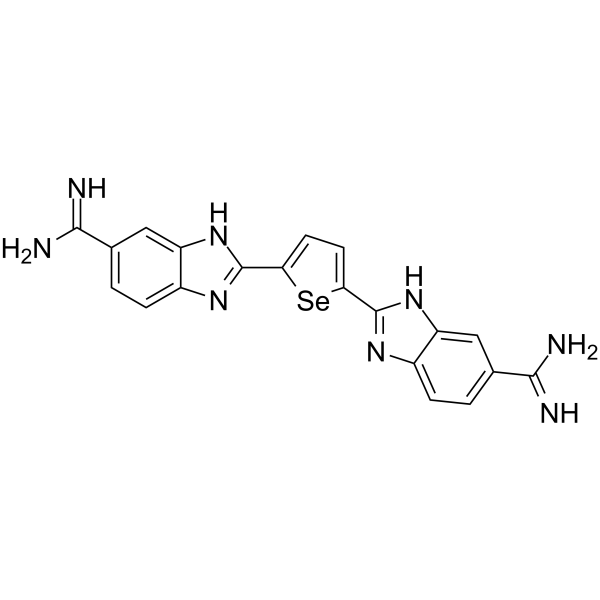
DB1976 is a selenophene analog of DB270 and a potent and cell-permeable fully efficacious transcription factor PU.1 inhibitor. DB1976 potently inhibits PU.1 binding (IC50 of 10 nM) and strongly inhibits the PU.1/DNA complex (with high DB1976-λB affinity, KD of 12 nM) in vitro. DB1976 has apoptosis-inducing effect.
The free form of the compound is prone to instability, it is advisable to consider the stable salt form (DB1976 dihydrochloride) that retains the same biological activity.
Nur für Forschungszwecke. Wir verkaufen nicht an Patienten.
- CAS. Nr.: 1557397-51-9
- Formel: C20H16N8Se
- Molecular Weight:447.35
-
Speicherung:
Please store the product under the recommended conditions in the Certificate of Analysis.

To place orders, for customer services and technical support, please contact: MedChemExpress USA
Tel: 609-228-6898 E-mail: [email protected] [email protected]
Other In-stock Forms of DB1976


-
 Biologische Aktivität
-
Chemical Information
- Protokoll
- Reinheit & Dokumentation
- Verweise
-
 Help & FAQs


Publications Citing Use of MedChemExpress (MCE) DB1976
More- Signal Transduct Target Ther. 2025 Feb 10;10(1):59. [Abstract]
- Nat Immunol. 2023 Nov;24(11):1839-1853. [Abstract]
- J Nanobiotechnology. 2025 Dec 5. [Abstract]
- Adv Healthc Mater. 2026 Jan 24:e05502. [Abstract]
- Int J Biol Macromol. 2025 Sep;322(Pt 1):146515. [Abstract]
- Cell Rep. 2024 Mar 26;43(3):113964. [Abstract]
- Respir Res. 2023 Jan 25;24(1):32. [Abstract]
- Neurochem Int. 2024 Feb:173:105674. [Abstract]


Biologische Aktivität
Beschreibung
IC50 & Target
IC50: 10 nM (Transcription factor PU.1)[1]
In Vitro
DB1976 is a classic heterocyclic dication (a single heteroatom) with strong affinity and selectivity for AT-rich sequences commonly found in cognate DNA binding sites for PU.1[2].
DB1976 inhibits PU.1-dependent transactivation of the reporter in a dose-dependent manner with an IC50 value of 2.4 μM in PU.1-negative HEK293 cells[3].
DB1976 treatment leads to a profound decrease in the growth of PU.1 URE–/– AML cells (IC50 of 105 μM), while showing little effect on normal hematopoietic cells at similar concentrations (IC50 of 334 μM)[3].
DB1976 treatment leads to a 1.6-fold increase in apoptotic cells in murine PU.1 URE–/– AML cells, and observed similar effects in human MOLM13 cells[3].
DB1976 treatment leads to a significant decrease in the number of viable cells (primary human AML cells) (mean decrease of 81%) and clonogenic capacity (mean decrease of 36%) compared with vehicle-treated cells. The apoptotic cell fraction increased on average by 1.5-fold with DB1976[3].
MedChemExpress (MCE) has not independently confirmed the accuracy of these methods. They are for reference only.


Chemical Information
-
CAS. Nr. 1557397-51-9
-
Molecular Weight 447.35
-
Formel C20H16N8Se
-
SMILES
N=C(C1=CC=C2N=C(C3=CC=C(C4=NC5=CC=C(C(N)=N)C=C5N4)[Se]3)NC2=C1)N
-
Versand
Room temperature in continental US; may vary elsewhere.
-
Speicherung
Please store the product under the recommended conditions in the Certificate of Analysis.


Publications (8)
-
Journal Impact Factor
-
Most Recent
-
Signal Transduct Target Ther
Spatiotemporal transcriptomics elucidates the pathogenesis of fulminant viral myocarditis. [Abstract]2025 Feb 10;10(1):59. PMID: 39924580 -
Nat Immunol
APOE4 impairs the microglial response in Alzheimer's disease by inducing TGFβ-mediated checkpoints. [Abstract]2023 Nov;24(11):1839-1853. PMID: 37749326 -
J Nanobiotechnology
Folate-modified biomimetic nanovesicles loaded with a PU.1 inhibitor alleviate atherosclerosis by suppressing inflammation. [Abstract]2025 Dec 5. PMID: 41345629 -
Adv Healthc Mater
One Stone, Four Birds: Multiple Modulation of Infarct Microenvironment-Based ROS-Responsive Hydrogel for Cardiac Repair. [Abstract]2026 Jan 24:e05502. PMID: 41580910 -
Int J Biol Macromol
EgG1Y162 protein from Echinococcus granulosus modulates the immune functions of mouse splenic lymphocytes and regulates Th9 cells. [Abstract]2025 Sep;322(Pt 1):146515. PMID: 40769342 -
Cell Rep
Nuclear microRNA-mediated transcriptional control determines adult microglial homeostasis and brain function. [Abstract]2024 Mar 26;43(3):113964. PMID: 38489263 -
Respir Res
2023 Jan 25;24(1):32. PMID: 36698141 -
Neurochem Int
M2a macrophages regulate fibrosis and affect the outcome after stroke via PU.1/mTOR pathway in fibroblasts. [Abstract]2024 Feb:173:105674. PMID: 38184171


Reinheit & Dokumentation
Verweise
[1]. Munde M, et al. Structure-dependent inhibition of the ETS-family transcription factor PU.1 by novel heterocyclic diamidines. Nucleic Acids Res. 2014 Jan;42(2):1379-90. [Content Brief]
[2]. Stephens DC, et al. Pharmacologic efficacy of PU.1 inhibition by heterocyclic dications: a mechanistic analysis. Nucleic Acids Res. 2016 May 19;44(9):4005-13. [Content Brief]
[3]. Antony-Debré I, et al. Pharmacological inhibition of the transcription factor PU.1 in leukemia. J Clin Invest. 2017 Dec 1;127(12):4297-4313. [Content Brief]

Calculators
Konzentration (Stammlösung) × Volumen (Stammlösung) = Konzentration (Ziellösung) × Volumen (Ziellösung)


DB1976 Related Classifications
HY-135797 Related Classifications
 Powered by Bioz