



Lanuginosine

Based on 1 Customer Validation
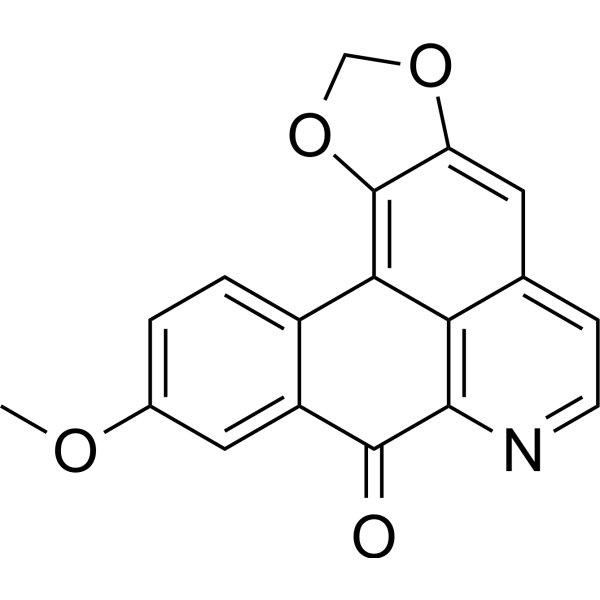
Lanuginosine is an alkaloid. Lanuginosine can be isolated from the stems of Xylopia laevigata (Annonaceae) and the leaves of Magnolia grandiflora. Lanuginosine induces Apoptosis. Lanuginosine inhibits AChE (IC50: 10.9 μM). Lanuginosine inhibits Aβ aggregation. Lanuginosine exhibits anticancer activity against hepatocellular carcinoma, human promyelocytic leukemia, human chronic myeloid leukemia, melanoma, and brain tumors. Lanuginosine can be used in the research of Alzheimer's disease.
Nur für Forschungszwecke. Wir verkaufen nicht an Patienten.
- Reinheit : 98.27%
- CAS. Nr.: 23740-25-2
- Formel: C18H11NO4
- Molecular Weight:305.28
-
Speicherung:Powder -20°C, 3 years , 4°C, 2 years ; In solvent -80°C, 6 months , -20°C, 1 month

To place orders, for customer services and technical support, please contact: MedChemExpress USA
Tel: 609-228-6898 E-mail: [email protected] [email protected]


-
 Biologische Aktivität
-
Chemical Information
-
Lösungsmittel & Löslichkeit
- Protokoll
- Reinheit & Dokumentation
- Verweise
-
 Help & FAQs




Biologische Aktivität
Beschreibung
IC50 & Target
10.9 μM (AChE)[1]
Cellular Effect
|
Cell Line

|
Type | Value | Description | References |
|---|---|---|---|---|
| B-cell | IC50 |
7.29 μM
Compound: 20
|
Inhibition of LPS-induced BALB/c mouse B cell proliferation
Inhibition of LPS-induced BALB/c mouse B cell proliferation
|
[PMID: 17081761] |
| HepG2 | IC50 |
0.8 μg/mL
Compound: atherospermidine
|
Cytotoxicity against human HepG2 cells
Cytotoxicity against human HepG2 cells
|
[PMID: 11575948] |
| HepG2 2.2.15 | IC50 |
2.2 μg/mL
Compound: atherospermidine
|
Cytotoxicity against human HepG2(2.2.15) cells
Cytotoxicity against human HepG2(2.2.15) cells
|
[PMID: 11575948] |
| T-cell | IC50 |
4.16 μM
Compound: 20
|
Inhibition of ConA-induced BALB/c mouse T cell proliferation
Inhibition of ConA-induced BALB/c mouse T cell proliferation
|
[PMID: 17081761] |
In Vitro
Lanuginosine (72 h) shows cytotoxic activity against B16-F10, HepG2, HL-60, and K562 tumor cell lines[1].
Lanuginosine (10-20 μg/mL; 24 h) induces apoptosis in HepG2 cells[1].
Lanuginosine is cytotoxic to U251 cells (a brain tumor cell line) with an IC50 of 4 μg/mL[2].
Lanuginosine (Compound 12) is an AChE inhibitor (IC50: 10.9 μM)[3].
MedChemExpress (MCE) has not independently confirmed the accuracy of these methods. They are for reference only.
-
Cell Line:HepG2
-
Concentration:10 μg/mL, 20 μg/mL
-
Incubation Time:24 h
-
Result:Increased apoptotic cells, and significantly increased necrotic cells (AO/EB staining).
Displayed apoptotic morphology (chromatin condensation and nuclear fragmentation).
Showed significant phosphatidylserine externalization.


Chemical Information
-
CAS. Nr. 23740-25-2
-
Appearance Solid
-
Molecular Weight 305.28
-
Formel C18H11NO4
-
Color Yellow to brown
-
SMILES
O=C1C2=CC(OC)=CC=C2C3=C4OCOC4=CC5=CC=NC1=C53
-
Structure Classification
-
Versand
Room temperature in continental US; may vary elsewhere.
-
Speicherung
Powder -20°C 3 years 4°C 2 years In solvent -80°C 6 months -20°C 1 month


Lösungsmittel & Löslichkeit
In Vitro:
DMSO : 0.5 mg/mL (1.64 mM; ultrasonic and warming and adjust pH to 2 with 1 M HCl and heat to 60°C; Hygroscopic DMSO has a significant impact on the solubility of product, please use newly opened DMSO)
Please refer to the solubility information to select the appropriate solvent. Once prepared, please aliquot and store the solution to prevent product inactivation from repeated freeze-thaw cycles.
Storage method and period of stock solution: -80°C, 6 months; -20°C, 1 month. When stored at -80°C, please use it within 6 months. When stored at -20°C, please use it within 1 month.
Please refer to the solubility information to select the appropriate solvent. Once prepared, please aliquot and store the solution to prevent product inactivation from repeated freeze-thaw cycles.
Storage method and period of stock solution: -80°C, 6 months; -20°C, 1 month. When stored at -80°C, please use it within 6 months. When stored at -20°C, please use it within 1 month.
Konzentration (Stammlösung) × Volumen (Stammlösung) = Konzentration (Ziellösung) × Volumen (Ziellösung)


Reinheit & Dokumentation
-
Data Sheet (278 KB)
-
SDS (251 KB)
- English - EN (251 KB)
- Français - FR (251 KB)
- Deutsch - DE (251 KB)
- Norwegian - NO (251 KB)
- Español - ES (251 KB)
- Swedish - SV (251 KB)
- Italian - IT (251 KB)
- Korean - KR (251 KB)
- Portuguese - PT (251 KB)
-
Handling Instructions (2659 KB)
Verweise
[1]. Menezes LR, et al. Cytotoxic Alkaloids from the Stem of Xylopia laevigata. Molecules. 2016 Jul 8;21(7):890. [Content Brief]
[2]. Mohamed SM, et al. Cytotoxic and antiviral activities of aporphine alkaloids of Magnolia grandiflora L. Nat Prod Res. 2010 Sep;24(15):1395-402. [Content Brief]
[3]. Jiang K, et al. Bioactive Isoquinoline Alkaloids with Diverse Skeletons from Fissistigma polyanthum. J Nat Prod. 2023 Aug 24. [Content Brief]


Complete Stock Solution Preparation Table
Please refer to the solubility information to select the appropriate solvent. Once prepared, please aliquot and store the solution to prevent product inactivation from repeated freeze-thaw cycles.
Storage method and period of stock solution: -80°C, 6 months; -20°C, 1 month. When stored at -80°C, please use it within 6 months. When stored at -20°C, please use it within 1 month.
| Optional Solvent | Concentration Solvent Mass | 1 mg | 5 mg | 10 mg | 25 mg |
|---|---|---|---|---|---|
| DMSO | 1 mM | 3.2757 mL | 16.3784 mL | 32.7568 mL | 81.8920 mL |


Lanuginosine Related Classifications
HY-119398 Related Classifications
 Powered by Bioz