



HY-15401
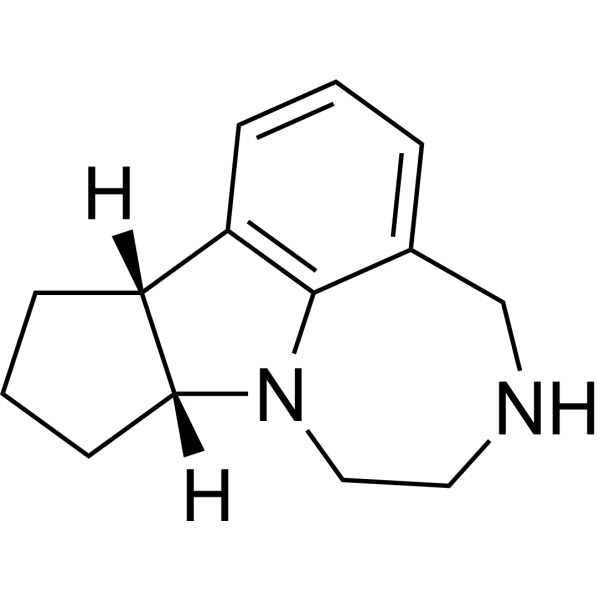
WAY 163909 is an orally active, blood-brain barrier permeable 5-HT2C receptor-selective agonist. WAY 163909 exhibits an EC50 of 8 nM and a Ki of 10.5 nM for h5-HT2C. Instead of triggering apoptosis, WAY 163909 induces anorectic, antipsychotic-like, antidepressant-like, anti-aggressive and anti-compulsive effects. WAY 163909 alleviates ketamine-induced hypothermia, but impairs sexual function at high doses. With rapid antidepressant-like properties, WAY 163909 can be used in research related to obesity, schizophrenia, depression, obsessive-compulsive disorder, and anesthesia-induced hypothermia.
For research use only. We do not sell to patients.
- CAS No.: 428868-32-0
- Formula: C14H18N2
- Molecular Weight:214.31
-
Storage:
Please store the product under the recommended conditions in the Certificate of Analysis.

To place orders, for customer services and technical support, please contact: MedChemExpress USA
Tel: 609-228-6898 E-mail: [email protected] [email protected]


-
 Biological Activity
-
Chemical Information
- Protocols
- Purity & Documentation
- References
-
 Help & FAQs


All 5-HT Receptor Isoforms
More

Biological Activity
Description
IC50 & Target
[2]|
5-HT2C Receptor 8 nM (EC50) |
In Vitro
WAY 163909 (1-10 μM) has high metabolic clearance in dogs, moderate clearance in rats and monkeys, and low clearance in human liver microsomes, with no meaningful metabolism by small intestinal microsomes across tested species[1].
WAY 163909 (1-10 μM) results significant depletion of in incubations with cDNA-expressed CYP2D6 but not other tested CYP isoforms[1].
WAY 163909 is not mutagenic in the Ames assay and does not induce chromosomal aberrations in human peripheral blood lymphocytes[1].
MedChemExpress (MCE) has not independently confirmed the accuracy of these methods. They are for reference only.
In Vivo
WAY 163909 (0.1-30 mg/kg; i.p., p.o., s.c.; once daily; 21 days) exhibits atypical antipsychotic-like activity in rodent models, with selective effects on mesolimbic dopamine pathways and no extrapyramidal side effect liability up to 30 mg/kg i.p[1].
WAY 163909 (10 mg/kg; i.p.; three time points: 15 min post-pretest, 5 h pre-test, 1 h pre-test) reduces immobility and increases swimming behavior in SD rats in the forced swim test, mirroring the profile of SSRIs[2].
WAY 163909 (0.33-3.0 mg/kg; s.c.; single dose 30 min pre-test) selectively reduces aggressive behavior in resident rats in the resident-intruder model, with an ID50 of 0.33 mg/kg s.c[2].
WAY 163909 (10 mg/kg; i.p.; daily; 14 days) reduces noncontact penile erections in male SD rats, indicating sexual dysfunction liability at doses higher than those needed for antidepressant-like effects[2].
WAY 163909 (0.3-3 mg/kg; i.p.; single injection; 15 minutes pre-ketamine) pretreatment at 1 mg/kg and 3 mg/kg significantly attenuates ketamine-induced hypothermia in male Swiss-Webster mice via activation of 5-HT2C receptors, with the 1 mg/kg dose being the most effective[3].
MedChemExpress (MCE) has not independently confirmed the accuracy of these methods. They are for reference only.


Chemical Information
-
CAS No. 428868-32-0
-
Molecular Weight 214.31
-
Formula C14H18N2
-
SMILES
[H][C@@]12[C@@](N3CCNCC4=CC=CC2=C43)([H])CCC1
-
Shipping
Room temperature in continental US; may vary elsewhere.
-
Storage
Please store the product under the recommended conditions in the Certificate of Analysis.


Purity & Documentation
References
[1]. Dunlop J, et al. Pharmacological profile of the 5-HT(2C) receptor agonist WAY-163909; therapeutic potential in multiple indications. CNS Drug Rev. 2006;12(3-4):167-177. [Content Brief]
[2]. Rosenzweig-Lipson S, et al. Antidepressant-like effects of the novel, selective, 5-HT2C receptor agonist WAY-163909 in rodents. Psychopharmacology (Berl). 2007;192(2):159-170. [Content Brief]

Calculators
Concentration (start) × Volume (start) = Concentration (final) × Volume (final)


HY-15401 Related Classifications
HY-15401 Related Classifications
 Powered by Bioz