



Avapritinib
Based on 15 publication(s) in Google Scholar
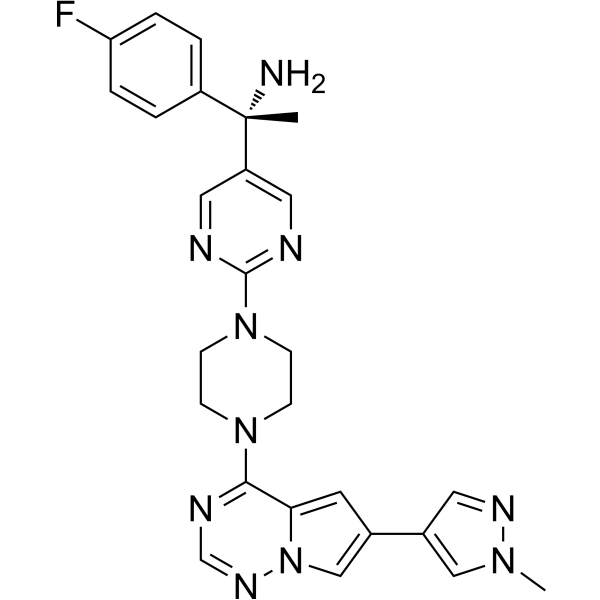
Avapritinib (BLU-285) is a highly potent, selective, and orally active KIT and PDGFRA activation loop mutant kinases inhibitor with IC50s of 0.27 and 0.24 nM for KIT D816V and PDGFRA D842V, respectively. Avapritinib (BLU-285) binds the active conformation of the kinase and shows antitumor activity. Avapritinib (BLU-285) attenuates the transport function of both ABCB1 and ABCG2.
Nos produits utilisent uniquement pour la recherche. Nous ne vendons pas aux patients.
- Pureté : 99.83%
- CAS No.: 1703793-34-3
- Formule: C26H27FN10
- Masse moléculaire:498.56
-
Stockage:Powder -20°C, 3 years , 4°C, 2 years ; In solvent -80°C, 1 year , -20°C, 6 months

To place orders, for customer services and technical support, please contact: MedChemExpress USA
Tel: 609-228-6898 E-mail: [email protected] [email protected]


-
 Activité biologique
-
Chemical Information
-
Solvant et solubilité
- Protocole
- Pureté et documentation
- Références
-
 Help & FAQs


-
HY-15463
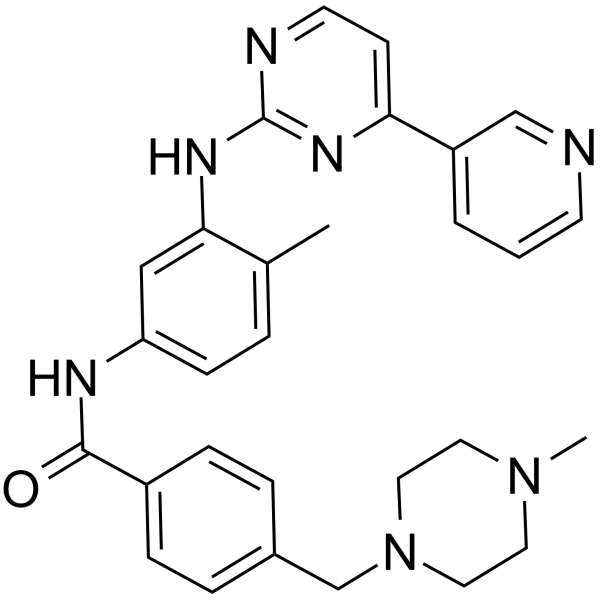
ImatinibTyrosine Kinases Inhibitor -
HY-112306
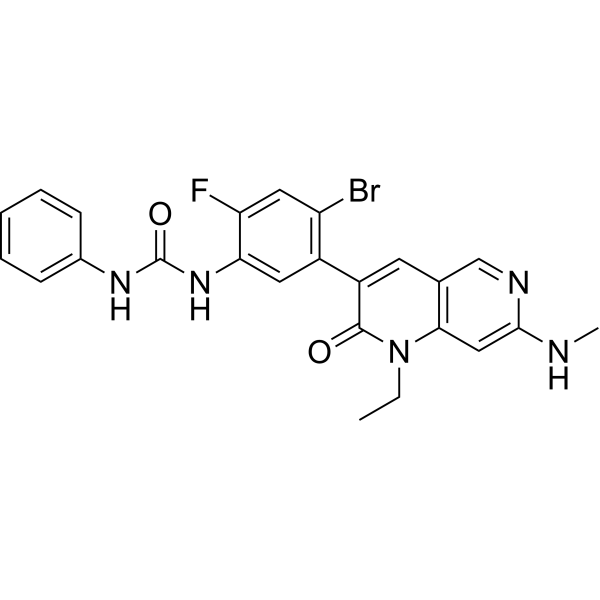
RipretinibKIT/PDGFRA Inhibitor -

HY-10201
SorafenibMultikinase Inhibitor -
HY-50856
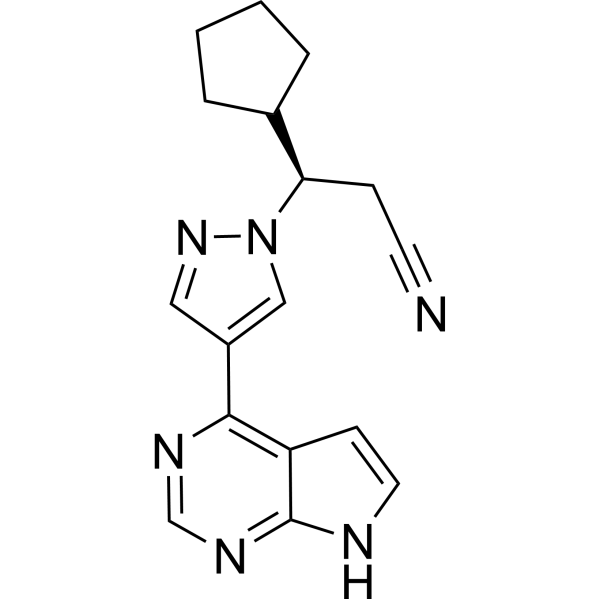
RuxolitinibJAK1/2 Inhibitor -
HY-10255A
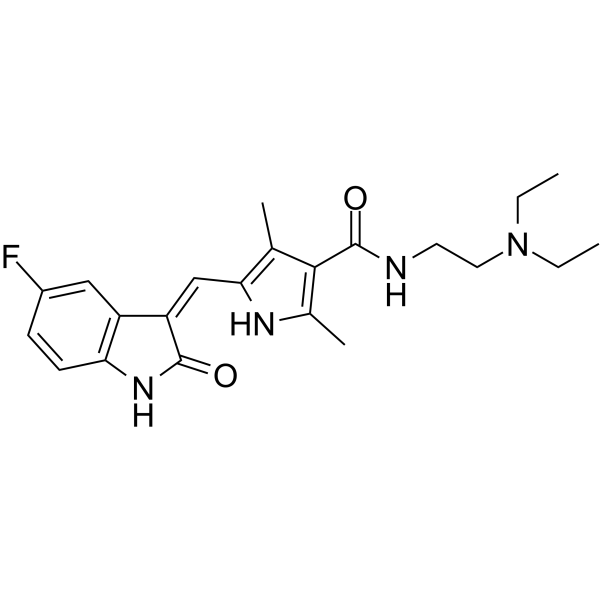
SunitinibMulti-targeted RTK Inhibitor -
HY-15772
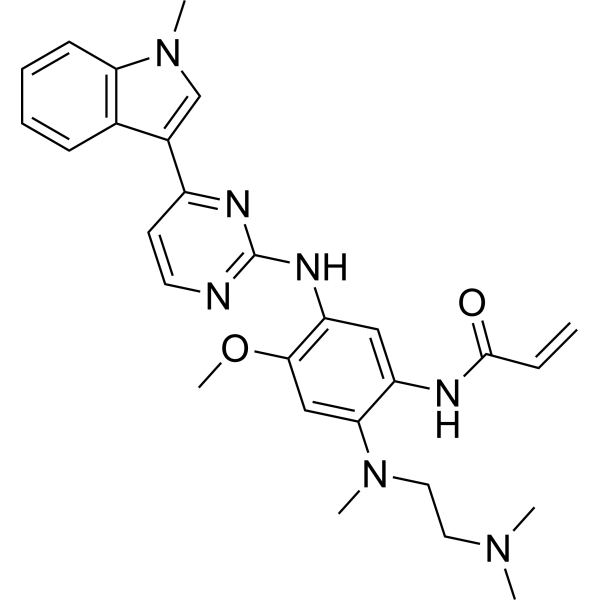
OsimertinibMutant-Selective EGFR Inhibitor -
HY-10331
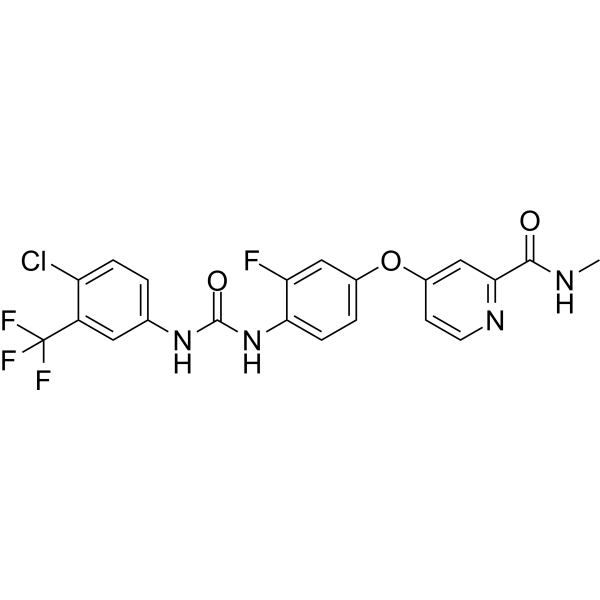
RegorafenibMulti-kinase Inhibitor -
HY-10230
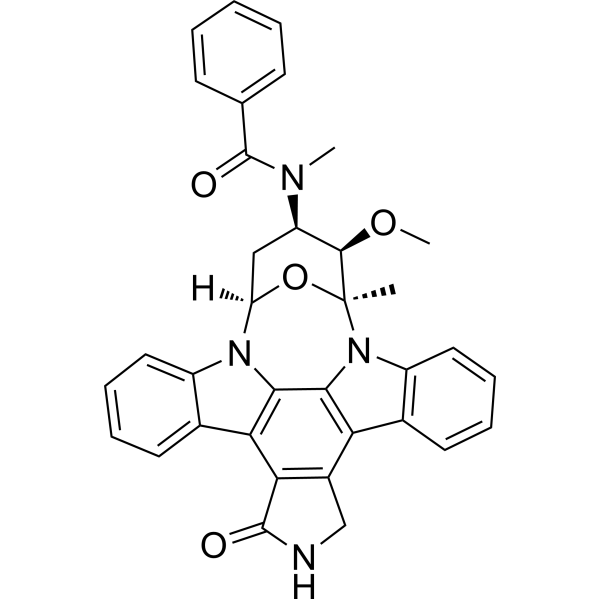
MidostaurinMulti-targeted Protein Kinase Inhibitor -
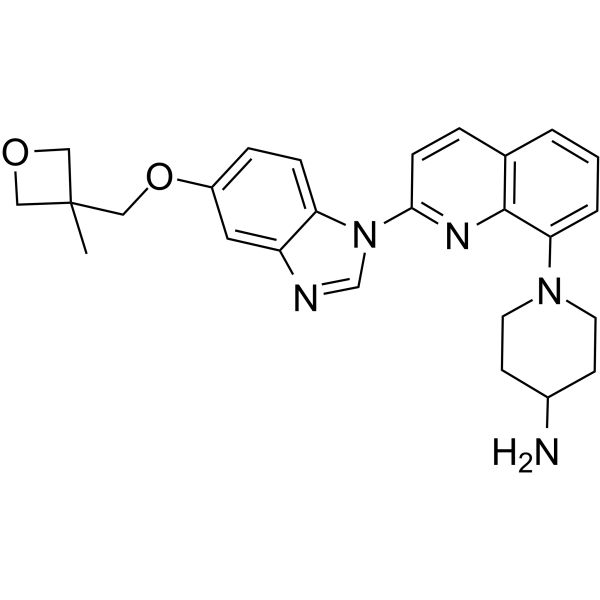
HY-13223
CrenolanibFLT3 Inhibitor -
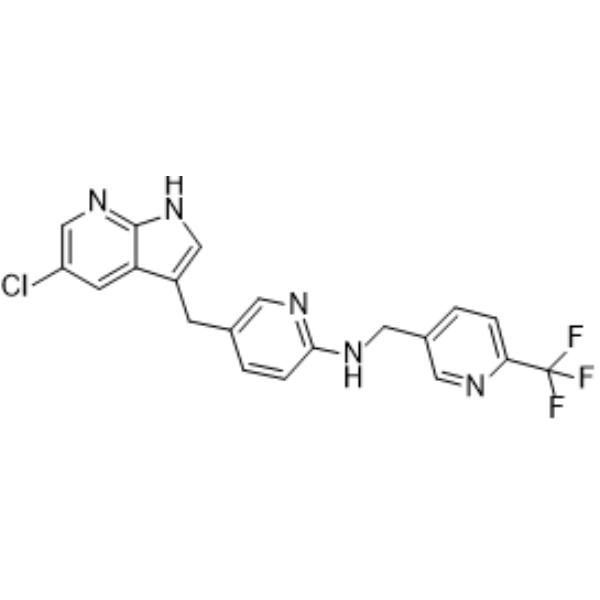
HY-16749
PexidartinibCSF1R/c-Kit Inhibitor -
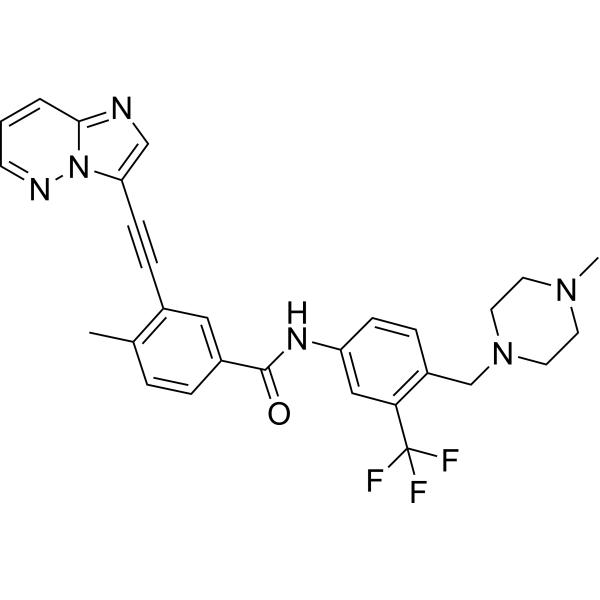
HY-12047
PonatinibMulti-targeted Kinase Inhibitor -
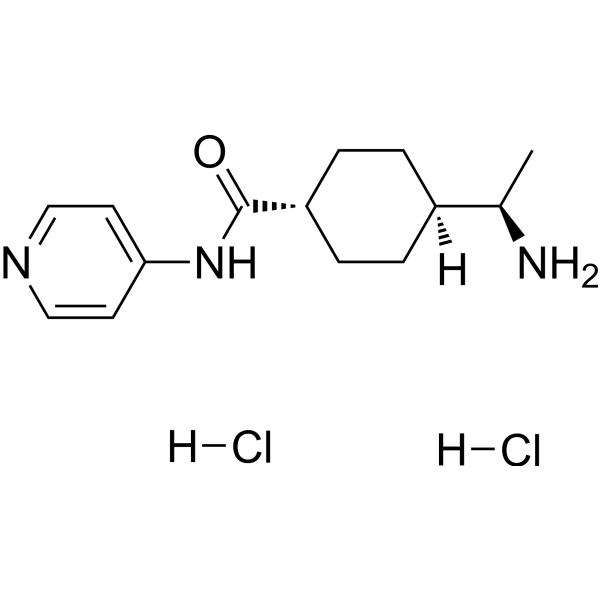
HY-10583
Y-27632 dihydrochlorideROCK Inhibitor
Publications Citing Use of MedChemExpress (MCE) Avapritinib
More- Cancer Cell. 2025 Apr 14;43(4):740-756.e8. [Abstract]
- Neuron. 2025 Aug 27:S0896-6273(25)00591-4. [Abstract]
- Acta Pharm Sin B. 2026 May;16(5):2947-2963. [Abstract]
- Acta Pharm Sin B. 2026 Feb.
- Biomaterials. 2022 Oct:289:121800. [Abstract]
- NPJ Precis Oncol. 2025 Aug 16;9(1):289. [Abstract]
- Pharmaceuticals (Basel). 2023 Nov 16;16(11):1618. [Abstract]
- Int J Mol Sci. 2025 Feb 25;26(5):1980. [Abstract]
- Bioengineering (Basel). 2025 Oct 19;12(10):1121. [Abstract]
- Mol Pharmacol. 2022 Jun;101(6):381-389. [Abstract]
- Biochem Biophys Res Commun. 2024 Dec 3:736:150504. [Abstract]
- Res Sq. 2026 Jun 24:rs.3.rs-9974885.
- bioRxiv. 2026 Jun 17.
- SSRN. 2023 Aug 14.
- Seoul National University. 2019 Aug.
 Customer Validation & Images

-
Histological Imaging/Staining
-
WB
-
Cell Proliferation/Viability Assay
-
Cell Proliferation/Viability Assay
-
Cell Proliferation/Viability Assay


Activité biologique
Description
IC50 & Target
IC50: 0.27 nM (KIT D816V), 0.24 nM (PDGFRA D842V)[1]
Cellular Effect
|
Cell Line

|
Type | Value | Description | References |
|---|---|---|---|---|
| BaF3 | GI50 |
4.075 μM
Compound: 5; BLU-285
|
Cytotoxicity in mouse parental BA/F3 cells incubated for 72 hrs by MTS assay
Cytotoxicity in mouse parental BA/F3 cells incubated for 72 hrs by MTS assay
|
[PMID: 30204441] |
In Vitro
Avapritinib (BLU-285) has demonstrated biochemical in vitro activity on the KIT exon 17 mutant enzyme, KIT D816V (IC50=0.27 nM). Cellular activity of Avapritinib on KIT D816 mutants is measured by autophosphorylation in the human mast cell leukemia cell line HMC1.2, and the P815 mouse mastocytoma cell line with IC50=4 and 22 nM, respectively. In Kasumi-1 cells, a t(8;21)-positive AML cell line with a KIT exon 17 N822K mutation, Avapritinib potently inhibits KIT N822K mutant autophosphorylation (IC50=40 nM), downstream signaling, as well as cellular proliferation (IC50=75 nM)[3].
MedChemExpress (MCE) has not independently confirmed the accuracy of these methods. They are for reference only.
In Vivo
MedChemExpress (MCE) has not independently confirmed the accuracy of these methods. They are for reference only.
Essai clinique
| NCT Number | Sponsor | Condition | Start Date |
Phase
|
|---|---|---|---|---|
| NCT01329991 | Plexxikon| | 2011-05 | PHASE1 |


Chemical Information
-
CAS No. 1703793-34-3
-
Appearance Solid
-
Masse moléculaire 498.56
-
Formule C26H27FN10
-
Color White to light yellow
-
SMILES
CN1N=CC(C2=CN3C(C(N4CCN(C5=NC=C([C@@](C)(N)C6=CC=C(F)C=C6)C=N5)CC4)=NC=N3)=C2)=C1
-
Synonyms
BLU-285
-
Livraison
Room temperature in continental US; may vary elsewhere.
-
Stockage
Powder -20°C 3 years 4°C 2 years In solvent -80°C 1 year -20°C 6 months


Publications (15)
-
Journal Impact Factor
-
Most Recent
-
Cancer Cell
2025 Apr 14;43(4):740-756.e8. PMID: 40086436 -
Neuron
Aberrant coupling of glutamate and tyrosine kinase receptors enables neuronal control of brain-tumor growth. [Abstract]2025 Aug 27:S0896-6273(25)00591-4. PMID: 40897174
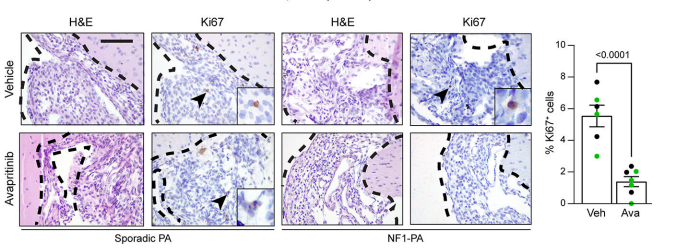
Avapritinib purchased from MedChemExpress. Usage Cited in: Neuron. 2025 Aug 27:S0896-6273(25)00591-4. [Abstract]
Avapritinib treatment (50 mg/kg/day) was administered. Representative immunohistochemistry images of Ki67+ cells were shown.
-
Acta Pharm Sin B
DeepICER: A deep learning framework for predicting compound-induced gene expression profiles. [Abstract]2026 May;16(5):2947-2963. PMID: 42180546 -
-
Biomaterials
2022 Oct:289:121800. PMID: 36166893 -
NPJ Precis Oncol
Clinical and preclinical insights into a novel MDM2::PDGFRA fusion in recurrent glioblastoma. [Abstract]2025 Aug 16;9(1):289. PMID: 40819143
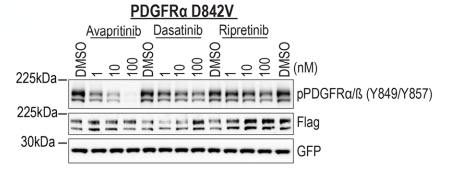
Avapritinib purchased from MedChemExpress. Usage Cited in: NPJ Precis Oncol. 2025 Aug 16;9(1):289. [Abstract]
PDGFRA D842V phosphorylation and total PDGFRA were assessed following a 2-hour treatment with DMSO (vehicle) or 1, 10, 100 nM concentrations of Avapritinib.
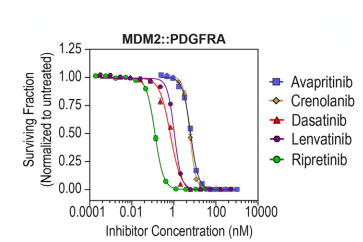
Avapritinib purchased from MedChemExpress. Usage Cited in: NPJ Precis Oncol. 2025 Aug 16;9(1):289. [Abstract]
PDGFRA was treated with Avapritinib, crenolanib, dasatinib, lenvatinib, or ripretinib for 72 h.
-
Pharmaceuticals (Basel)
Esterase-Responsive Polyglycerol-Based Nanogels for Intracellular Drug Delivery in Rare Gastrointestinal Stromal Tumors. [Abstract]2023 Nov 16;16(11):1618. PMID: 38004483 -
Int J Mol Sci
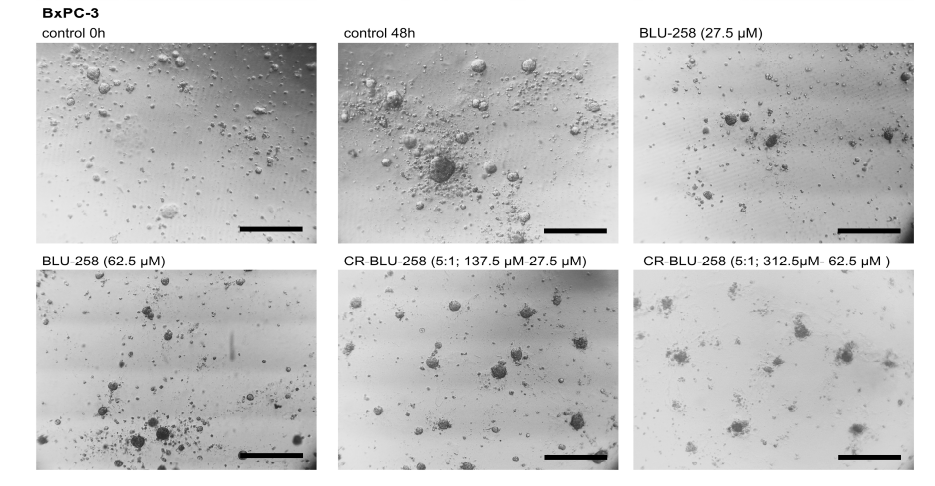
Interaction of Avapritinib with Congo Red in Pancreatic Cancer Cells: Molecular Modeling and Biophysical Studies. [Abstract]2025 Feb 25;26(5):1980. PMID: 40076604
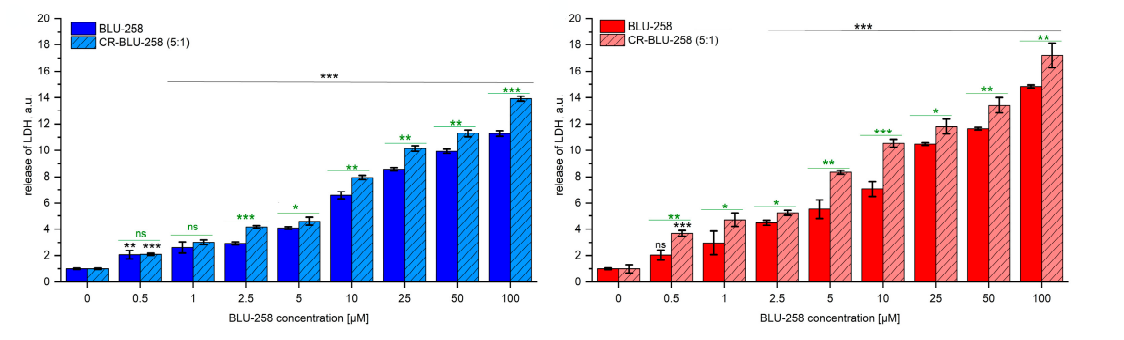
Avapritinib purchased from MedChemExpress. Usage Cited in: Int J Mol Sci. 2025 Feb 25;26(5):1980. [Abstract]
The cytotoxicity of BLU-258 alone and in aggregates with Congo red (CR-BLU-258) on pancreatic cell lines was assessed using an LDH assay after 48 h of incubation.
Avapritinib purchased from MedChemExpress. Usage Cited in: Int J Mol Sci. 2025 Feb 25;26(5):1980. [Abstract]
The morphology of the 3D cell cultures of BxPC3 cells was incubated for 48 h with BLU-258 or CR-BLU-258 and without the tested compounds; scale bar = 200 μm.
-
Bioengineering (Basel)
Precision Oncology for High-Grade Gliomas: A Tumor Organoid Model for Adjuvant Treatment Selection. [Abstract]2025 Oct 19;12(10):1121. PMID: 41155119 -
Mol Pharmacol
Influence of Tyrosine Kinase Inhibition on Organic Anion Transporting Polypeptide 1B3-Mediated Uptake. [Abstract]2022 Jun;101(6):381-389. PMID: 35383108 -
Biochem Biophys Res Commun
Avapritinib efficacy in primary hepatic neuroendocrine carcinoma with elevated PDGFRA expression: Insights from a PDX model study. [Abstract]2024 Dec 3:736:150504. PMID: 39121673 -
-
-
-


Solvant et solubilité
In Vitro:
DMSO : ≥ 83.33 mg/mL (167.14 mM; Hygroscopic DMSO has a significant impact on the solubility of product, please use newly opened DMSO)
* "≥" means soluble, but saturation unknown.
Please refer to the solubility information to select the appropriate solvent. Once prepared, please aliquot and store the solution to prevent product inactivation from repeated freeze-thaw cycles.
Storage method and period of stock solution: -80°C, 1 year; -20°C, 6 months. When stored at -80°C, please use it within 1 year. When stored at -20°C, please use it within 6 months.
Please refer to the solubility information to select the appropriate solvent. Once prepared, please aliquot and store the solution to prevent product inactivation from repeated freeze-thaw cycles.
Storage method and period of stock solution: -80°C, 1 year; -20°C, 6 months. When stored at -80°C, please use it within 1 year. When stored at -20°C, please use it within 6 months.
Concentration (start) × Volume (start) = Concentration (final) × Volume (final)
In Vivo:
Select the appropriate dissolution method based on your experimental animal and administration route.
- For the following dissolution methods, please ensure to first prepare a clear stock solution using an In Vitro approach and then sequentially add co-solvents:
- To ensure reliable experimental results, the clarified stock solution can be appropriately stored based on storage conditions. As for the working solution for In Vivo experiments, it is recommended to prepare freshly and use it on the same day.
- The percentages shown for the solvents indicate their volumetric ratio in the final prepared solution. If precipitation or phase separation occurs during preparation, heat and/or sonication can be used to aid dissolution.
Add each solvent one by one: 10% DMSO 40% PEG300 5% Tween-80 45% Saline
Solubility: ≥ 2.5 mg/mL (5.01 mM); Clear solution
This protocol yields a clear solution of ≥ 2.5 mg/mL (saturation unknown).
Taking 1 mL working solution as an example, add 100 μL DMSO stock solution (25.0 mg/mL) to 400 μL PEG300, and mix evenly; then add 50 μL Tween-80 and mix evenly; then add 450 μL Saline to adjust the volume to 1 mL.
Preparation of Saline: Dissolve 0.9 g sodium chloride in ddH₂O and dilute to 100 mL to obtain a clear Saline solution.
Add each solvent one by one: 10% DMSO 90% (20% SBE-β-CD in Saline)
Solubility: ≥ 2.5 mg/mL (5.01 mM); Clear solution
This protocol yields a clear solution of ≥ 2.5 mg/mL (saturation unknown).
Taking 1 mL working solution as an example, add 100 μL DMSO stock solution (25.0 mg/mL) to 900 μL 20% SBE-β-CD in Saline, and mix evenly.
Preparation of 20% SBE-β-CD in Saline (4°C, storage for one week): 2 g SBE-β-CD powder is dissolved in 10 mL Saline, completely dissolve until clear.
In Vivo Dissolution Calculator
Please enter the basic information of animal experiments:
-
-
-
-
Recommended: Prepare an additional quantity of animals to account for potential losses during experiments.
Please enter your animal formula composition:
-
%DMSO +
Recommended: Keep the proportion of DMSO in working solution below 2% if your animal is weak.
-
%+
-
+%Tween-80 + +
-
%Saline +
The co-solvents required include: DMSO, . All of co-solvents are available by MedChemExpress (MCE). , Tween 80. All of co-solvents are available by MedChemExpress (MCE).
Working solution concentration: 0.22 mg/mL
Method for preparing stock solution: mg drug dissolved in μL DMSO. Stock solution concentration: mg/mL.
1. Take μL DMSO stock solution;
2. Add μL .
μL , mix evenly;
3. Then add μL Tween 80, mix evenly;
4. Then add μL
Please ensure that the stock solution in the first step is dissolved to a clear state, and add co-solvents in sequence. You can use ultrasonic heating (ultrasonic cleaner, recommended frequency 20-40 kHz), vortexing, etc. to assist dissolution.


Pureté et documentation
-
Fiche technique (281 KB)
-
SDS (393 KB)
- English - EN (393 KB)
- Français - FR (393 KB)
- Deutsch - DE (393 KB)
- Norwegian - NO (393 KB)
- Español - ES (393 KB)
- Swedish - SV (393 KB)
- Italian - IT (393 KB)
- Korean - KR (393 KB)
- Portuguese - PT (393 KB)
-
Instruction de manipulation (2659 KB)
Références
[1]. Wu CP, et al. Avapritinib: A Selective Inhibitor of KIT and PDGFRα that Reverses ABCB1 and ABCG2-MediatedMultidrug Resistance in Cancer Cell Lines. Mol Pharm. 2019 Jul 1;16(7):3040-3052. [Content Brief]
[2]. Evans EK, et al. A precision therapy against cancers driven by KIT/PDGFRA mutations. Sci Transl Med. 2017 Nov 1;9(414). pii: eaao1690. [Content Brief]


Complete Stock Solution Preparation Table
Please refer to the solubility information to select the appropriate solvent. Once prepared, please aliquot and store the solution to prevent product inactivation from repeated freeze-thaw cycles.
Storage method and period of stock solution: -80°C, 1 year; -20°C, 6 months. When stored at -80°C, please use it within 1 year. When stored at -20°C, please use it within 6 months.
| Optional Solvent | Concentration Solvent Mass | 1 mg | 5 mg | 10 mg | 25 mg |
|---|---|---|---|---|---|
| DMSO | 1 mM | 2.0058 mL | 10.0289 mL | 20.0578 mL | 50.1444 mL |
| 5 mM | 0.4012 mL | 2.0058 mL | 4.0116 mL | 10.0289 mL | |
| 10 mM | 0.2006 mL | 1.0029 mL | 2.0058 mL | 5.0144 mL | |
| 15 mM | 0.1337 mL | 0.6686 mL | 1.3372 mL | 3.3430 mL | |
| 20 mM | 0.1003 mL | 0.5014 mL | 1.0029 mL | 2.5072 mL | |
| 25 mM | 0.0802 mL | 0.4012 mL | 0.8023 mL | 2.0058 mL | |
| 30 mM | 0.0669 mL | 0.3343 mL | 0.6686 mL | 1.6715 mL | |
| 40 mM | 0.0501 mL | 0.2507 mL | 0.5014 mL | 1.2536 mL | |
| 50 mM | 0.0401 mL | 0.2006 mL | 0.4012 mL | 1.0029 mL | |
| 60 mM | 0.0334 mL | 0.1671 mL | 0.3343 mL | 0.8357 mL | |
| 80 mM | 0.0251 mL | 0.1254 mL | 0.2507 mL | 0.6268 mL | |
| 100 mM | 0.0201 mL | 0.1003 mL | 0.2006 mL | 0.5014 mL |


Avapritinib Related Classifications
HY-101561 Related Classifications
 Powered by Bioz