



EFdA-TP
Based on 1 publication(s) in Google Scholar
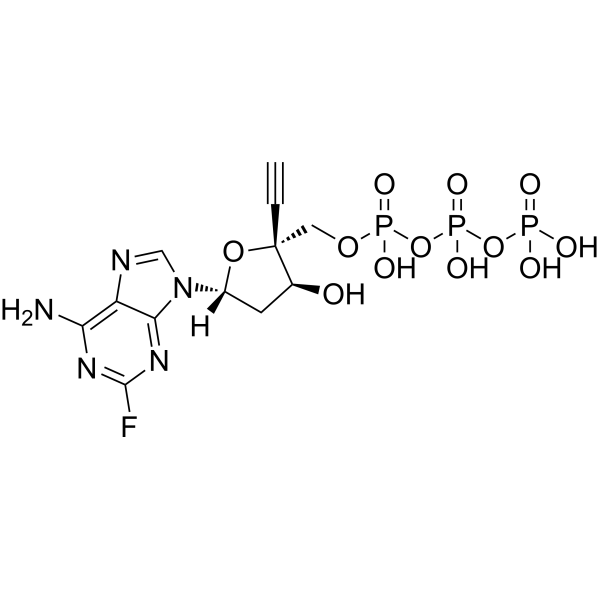
EFdA-TP is a potent nucleoside reverse transcriptase (RT) inhibitor. EFdA-TP inhibits RT-catalyzed DNA synthesis as an effective immediate or delayed chain terminator (ICT or DCT). EFdA-TP inhibits HIV-1 RT with multiple mechanisms.
Nos produits utilisent uniquement pour la recherche. Nous ne vendons pas aux patients.
- CAS No.: 950913-56-1
- Formule: C12H15FN5O12P3
- Masse moléculaire:533.19
-
Stockage:
Please store the product under the recommended conditions in the Certificate of Analysis.

To place orders, for customer services and technical support, please contact: MedChemExpress USA
Tel: 609-228-6898 E-mail: [email protected] [email protected]


-
 Activité biologique
-
Chemical Information
- Protocole
- Pureté et documentation
- Références
-
 Help & FAQs


Publications Citing Use of MedChemExpress (MCE) EFdA-TP
MoreVoir tous les produits spécifiques à Isoform DNA/RNA Synthesis
More

Activité biologique
Description
IC50 & Target
[1]|
HIV-1 |
In Vitro
EFdA-TP (0.05-10 μM; for 15 min) inhibits RT-catalyzed DNA synthesis as an ICT or DCT[1].
EFdA-TP can block RT as a translocation-defective RT inhibitor that dramatically slows DNA synthesis, acting as a de facto immediate chain terminator. EFdA-TP can function as a delayed chain terminator, allowing incorporation of an additional dNTP before blocking DNA synthesis[1].
MedChemExpress (MCE) has not independently confirmed the accuracy of these methods. They are for reference only.


Chemical Information
-
CAS No. 950913-56-1
-
Masse moléculaire 533.19
-
Formule C12H15FN5O12P3
-
SMILES
O=[P](O[P](O[P](O)(O)=O)(O)=O)(O)OC[C@]1(O[C@@](C[C@@H]1O)([H])N2C3=NC(F)=NC(N)=C3N=C2)C#C
-
Livraison
Room temperature in continental US; may vary elsewhere.
-
Stockage
Please store the product under the recommended conditions in the Certificate of Analysis.


Publications (1)
-
Journal Impact Factor
-
Most Recent
-
bioRxiv
Structural and Mechanistic Basis of F227C-Mediated Hypersusceptibility to Islatravir in HIV-1 Reverse Transcriptase. [Abstract]2026 Jun 10:2026.06.08.730881. PMID: 42327331


Pureté et documentation
Références
[1]. Eleftherios Michailidis, et al. 4'-Ethynyl-2-fluoro-2'-deoxyadenosine (EFdA) inhibits HIV-1 reverse transcriptase with multiple mechanisms. J Biol Chem. 2014 Aug 29;289(35):24533-48. [Content Brief]
[2]. Martin Markowitz, et al. 4'-Ethynyl-2-fluoro-2'-deoxyadenosine, MK-8591: a novel HIV-1 reverse transcriptase translocation inhibitor. Curr Opin HIV AIDS. 2018 Jul;13(4):294-299. [Content Brief]

Calculators
Concentration (start) × Volume (start) = Concentration (final) × Volume (final)


EFdA-TP Related Classifications
HY-138561 Related Classifications
 Powered by Bioz