



Mito-FerroGreen
Based on 7 publication(s) in Google Scholar
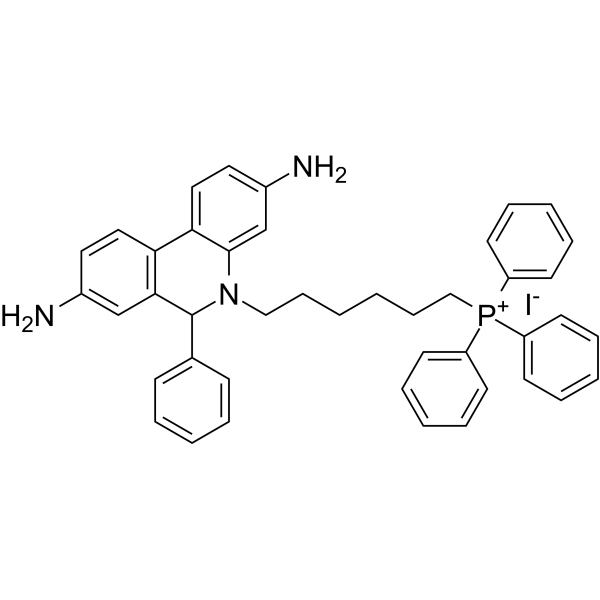
Mito-FerroGreen is a mitochondria-specific Fluorescent indicator used to detect mitochondrial Fe2+ levels (excitation: 488 nm; emission: 500-550 nm). Mito-FerroGreen can be applied to research related to colorectal cancer and chronic heart failure.
Nos produits utilisent uniquement pour la recherche. Nous ne vendons pas aux patients.
- Pureté : 98.0%
-
Stockage:
4°C, protect from light
* In solvent : -80°C, 6 months; -20°C, 1 month (protect from light)

To place orders, for customer services and technical support, please contact: MedChemExpress USA
Tel: 609-228-6898 E-mail: [email protected] [email protected]


-
 Activité biologique
-
Chemical Information
- Protocole
- Pureté et documentation
- Références
-
 Help & FAQs




Publications Citing Use of MedChemExpress (MCE) Mito-FerroGreen
More- Signal Transduct Target Ther. 2025 Dec 26;10(1):420. [Abstract]
- Nat Commun. 2026 Jun 9;17(1):5072. [Abstract]
- J Hazard Mater. 2025 Jul 15:492:137969. [Abstract]
- J Med Chem. 2026 Apr 23;69(8):9051-9070. [Abstract]
- Sci Rep. 2025 Feb 20;15(1):6200. [Abstract]
- Peptides. 2025 Dec:194:171454. [Abstract]
- BMC Nephrol. 2025 Apr 21;26(1):201. [Abstract]


Activité biologique
Description
In Vitro
1.1 Preparation of Working Solution
Prepare a 5 μM Mito-FerroGreen solution.
1.2 Experimental Procedures
1.2.1 Seed CRC cells transfected 48 hours prior into confocal culture dishes and continue culturing for 12 hours.
1.2.2 In specific experimental groups, add ferroptosis inhibitors at the time of seeding, followed by 12 hours of cell culture.
1.2.3 Incubate the cells in Mito-FerroGreen working solution at 37°C for 30 minutes.
1.2.4 After washing with PBS, perform imaging using a Leica laser confocal microscope.
MedChemExpress (MCE) has not independently confirmed the accuracy of these methods. They are for reference only.


Chemical Information
-
Appearance Solid
-
Color White to off-white
-
SMILES
[Mito-FerroGreen]
-
Livraison
Room temperature in continental US; may vary elsewhere.
-
Stockage
4°C, protect from light
* In solvent : -80°C, 6 months; -20°C, 1 month (protect from light)


Publications (7)
-
Journal Impact Factor
-
Most Recent
-
Signal Transduct Target Ther
Inhibin beta A drives colorectal cancer progression through macrophage M2 polarization and mitochondria-dependent ferroptosis suppression. [Abstract]2025 Dec 26;10(1):420. PMID: 41449244 -
Nat Commun
CLPX acquires an iron-sulfur cluster to sustain mitochondrial proteostasis in cancer cells. [Abstract]2026 Jun 9;17(1):5072. PMID: 42265110 -
J Hazard Mater
Isobavachalcone confers protection against Cryptococcus neoformans-induced ferroptosis in Caenorhabditis elegans via lifespan extension and GSH-GPX-1 axis modulation. [Abstract]2025 Jul 15:492:137969. PMID: 40154123 -
J Med Chem
2026 Apr 23;69(8):9051-9070. PMID: 41940724 -
Sci Rep
In vivo and in vitro investigations of schisandrin B against angiotensin II induced ferroptosis and atrial fibrosis by regulation of the SIRT1 pathway. [Abstract]2025 Feb 20;15(1):6200. PMID: 39979353 -
Peptides
FSTL1 silencing protects against lipopolysaccharide-induced ferroptosis in renal tubular cells by regulating the PI3K/Akt pathway. [Abstract]2025 Dec:194:171454. PMID: 41297179 -
BMC Nephrol
2025 Apr 21;26(1):201. PMID: 40259237


Pureté et documentation
-
Fiche technique (269 KB)
-
SDS (252 KB)
- English - EN (252 KB)
- Français - FR (252 KB)
- Deutsch - DE (252 KB)
- Norwegian - NO (252 KB)
- Español - ES (252 KB)
- Swedish - SV (252 KB)
- Italian - IT (252 KB)
- Korean - KR (252 KB)
- Portuguese - PT (252 KB)
-
Instruction de manipulation (2659 KB)
Références
[1]. Zhang Q, et al. Atorvastatin Induces Mitochondria-Dependent Ferroptosis the Modulation of Nrf2-xCT/GPx4 Axis. Frontiers in cell and developmental biology. 2022;10:806081. [Content Brief]
[2]. Li W, et al. Inhibin beta A drives colorectal cancer progression through macrophage M2 polarization and mitochondria-dependent ferroptosis suppression. Signal transduction and targeted therapy. 2025 Dec 26;10(1):420. [Content Brief]
[3]. Do Y, et al. Cardiomyocyte-specific deletion of the mitochondrial transporter Abcb10 causes cardiac dysfunction via lysosomal-mediated ferroptosis. Bioscience reports. 2024 May 29;44(5):BSR20231992. [Content Brief]

Calculators
Concentration (start) × Volume (start) = Concentration (final) × Volume (final)


Mito-FerroGreen Related Classifications
HY-D2295 Related Classifications
 Powered by Bioz