



CHMFL-ABL/KIT-155
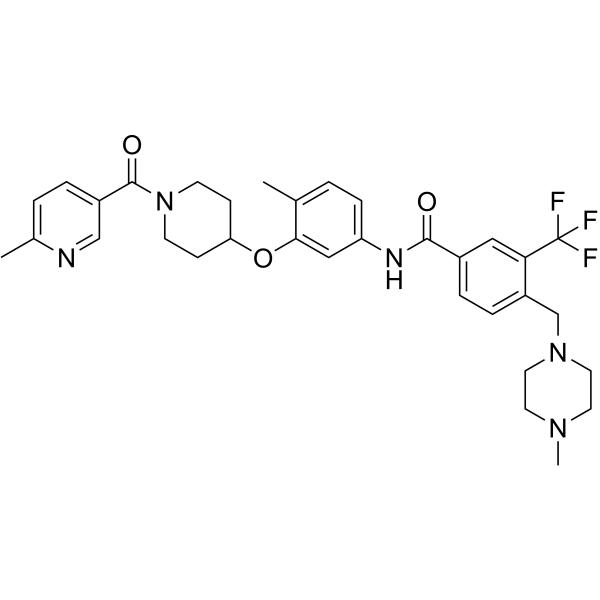
CHMFL-ABL/KIT-155 (CHMFL-ABL-KIT-155; compound 34) is a highly potent and orally active type II ABL/c-KIT dual kinase inhibitor (IC50s of 46 nM and 75 nM, respectively), and it also presents significant inhibitory activities to BLK (IC50=81 nM), CSF1R (IC50=227 nM), DDR1 (IC50=116 nM), DDR2 (IC50=325 nM), LCK (IC50=12 nM) and PDGFRβ (IC50=80 nM) kinases. CHMFL-ABL/KIT-155 (CHMFL-ABL-KIT-155) arrests cell cycle progression and induces apoptosis.
For research use only. We do not sell to patients.
- CAS No.: 2081093-21-0
- Formula: C33H38F3N5O3
- Molecular Weight:609.68
-
Storage:
Please store the product under the recommended conditions in the Certificate of Analysis.

To place orders, for customer services and technical support, please contact: MedChemExpress USA
Tel: 609-228-6898 E-mail: [email protected] [email protected]


-
 Biological Activity
-
Chemical Information
- Protocols
- Purity & Documentation
- References
-
 Help & FAQs


-
HY-10408
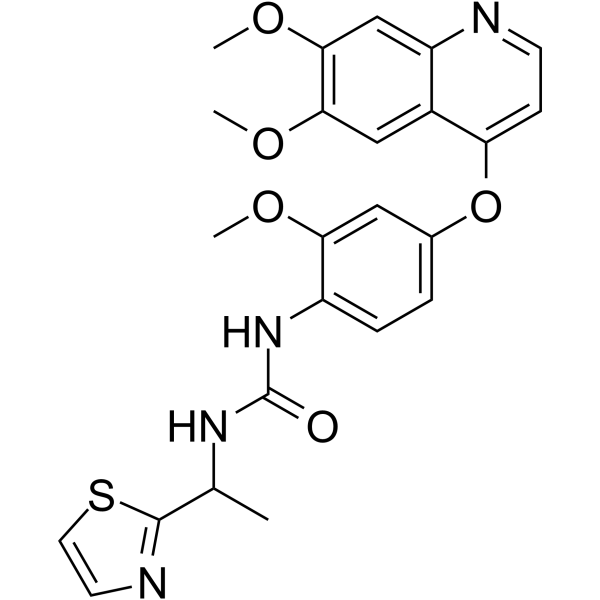
Ki20227CSF1R Inhibitor -
HY-10159
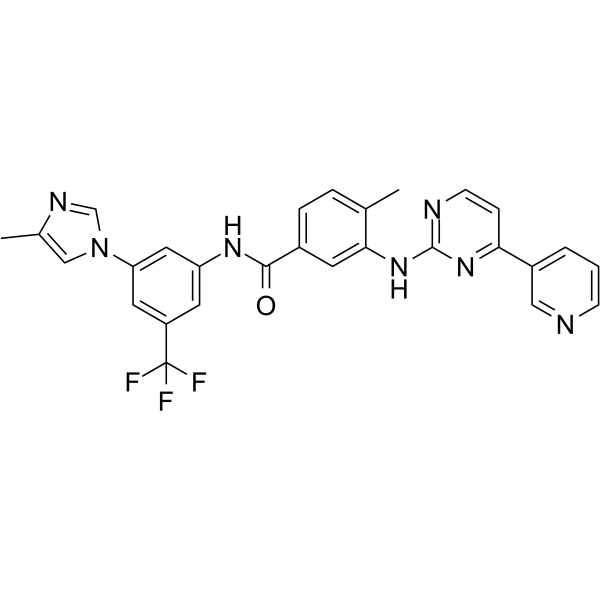
NilotinibBcr-Abl Inhibitor -
HY-13024
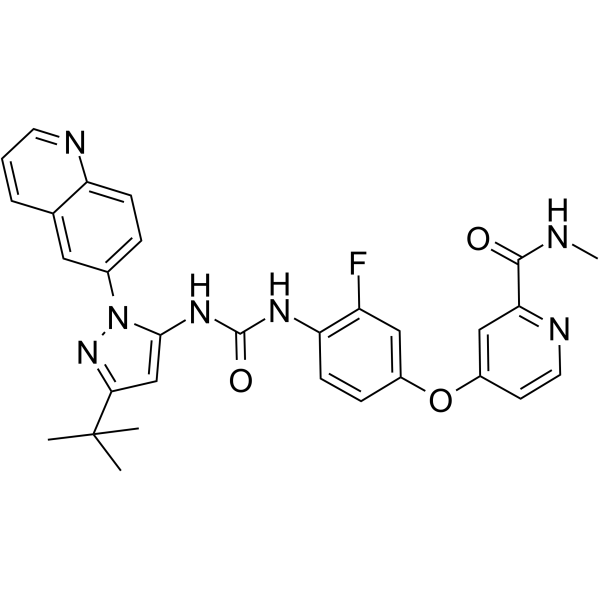
RebastinibKinase Inhibitor -
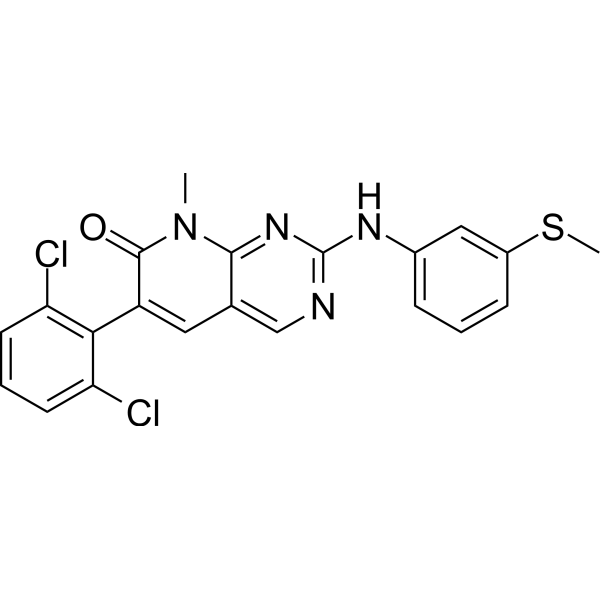
HY-10395
PD173955Src Inhibitor -
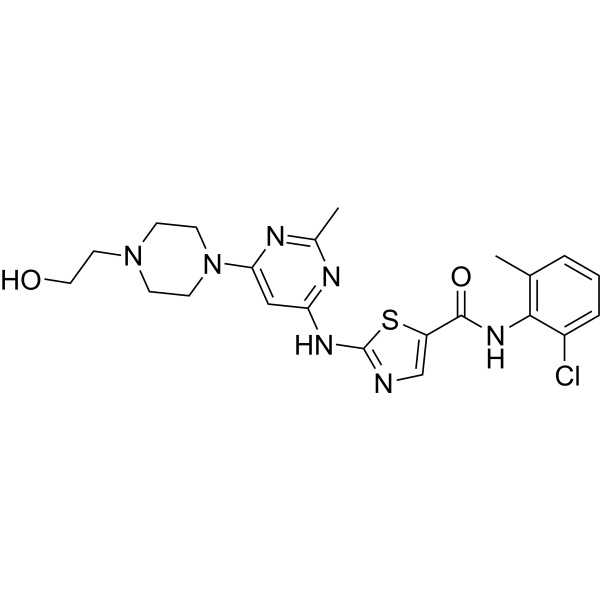
HY-10181
DasatinibSrc/Bcr-Abl Inhibitor -
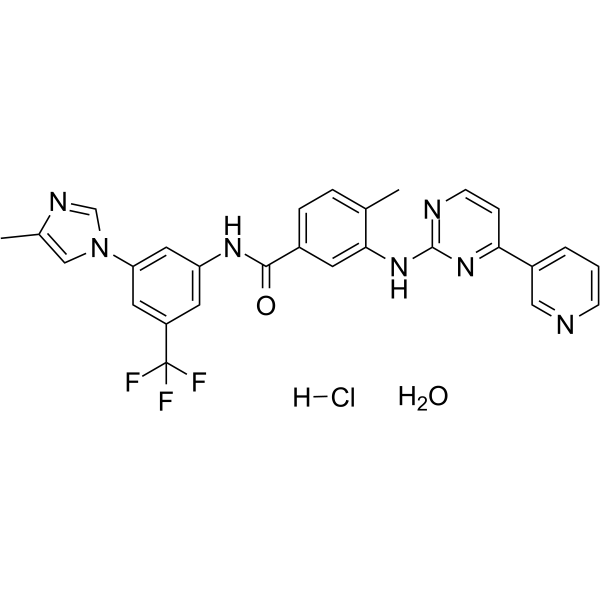
HY-10159A
Nilotinib monohydrochloride monohydrateTyrosine Kinase Inhibitor -
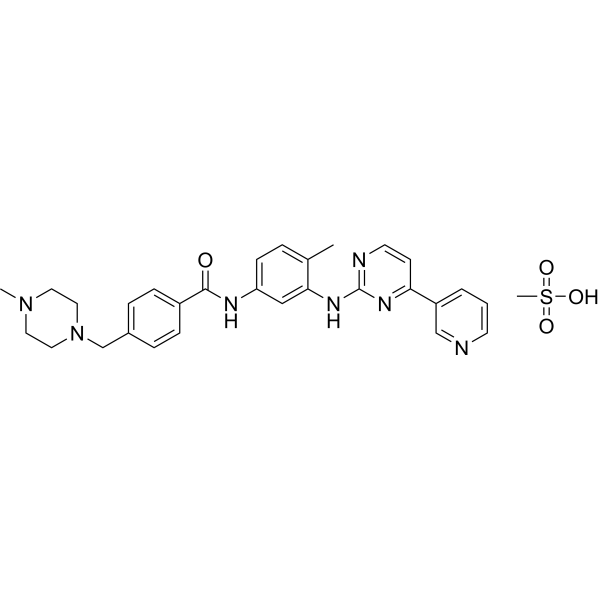
HY-50946
Imatinib Mesylatec-Kit Inhibitor -
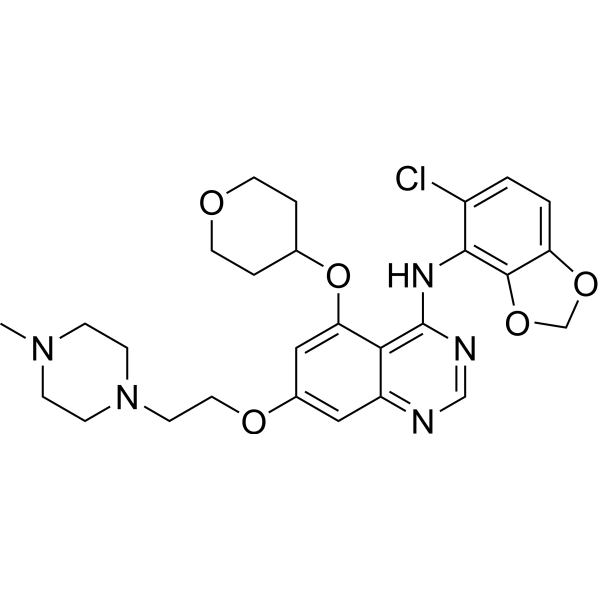
HY-10234
SaracatinibSrc Inhibitor -
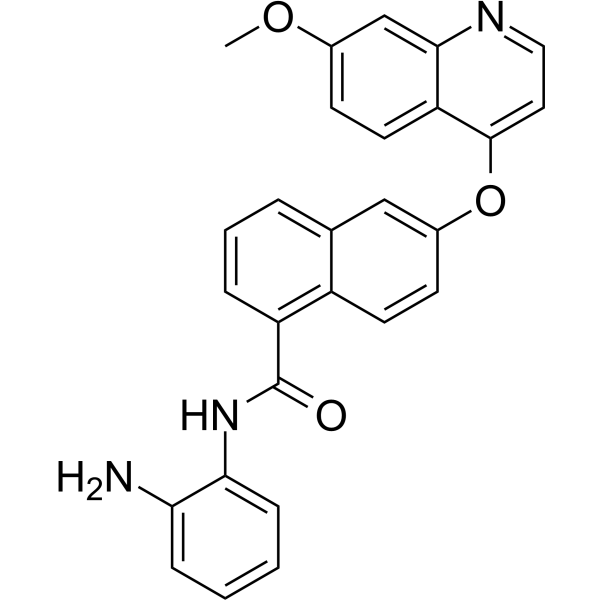
HY-124526
ChiauranibMulti-target Inhibitor -
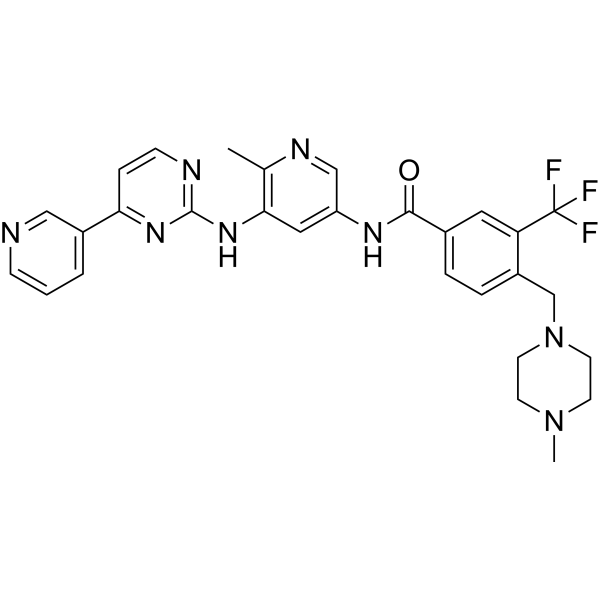
HY-13904
Flumatinibc-Kit Inhibitor -
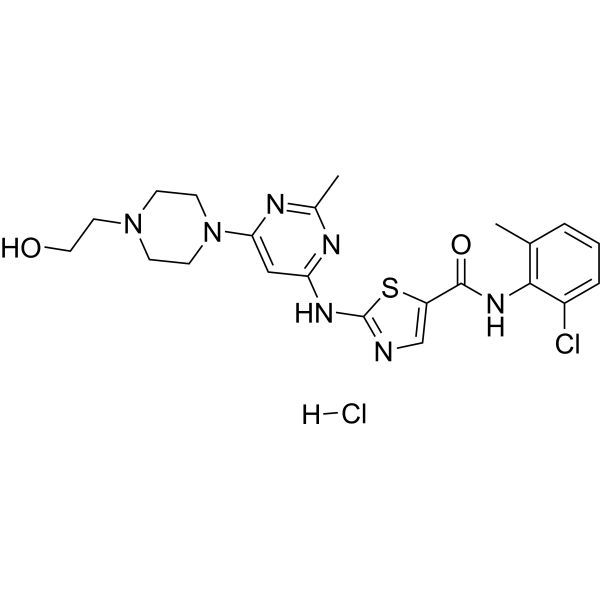
HY-10181A
Dasatinib hydrochlorideSrc/Bcr-Abl Inhibitor -

HY-10408R
Ki20227 (Standard)Reference Standard


Biological Activity
Description
IC50 & Target
IC50: 46 nM (type II ABL), 75 nM (c-KIT), 81 nM (BLK), 227 nM (CSF1R), 116 nM (DDR1), 325 nM (DDR2), 12 nM (LCK), 80 nM (PDGFRβ)[1]
Cellular Effect
|
Cell Line

|
Type | Value | Description | References |
|---|---|---|---|---|
| BaF3 | GI50 |
>10 μM
Compound: 34
|
Growth inhibition of mouse BAF3 cells measured after 72 hrs by CellTiter-Glo or CCK8 assay
Growth inhibition of mouse BAF3 cells measured after 72 hrs by CellTiter-Glo or CCK8 assay
|
[PMID: 27966954] |
| BaF3 | GI50 |
>10 μM
Compound: 34
|
Inhibition of BCR/ABL p210 fusion protein T315I mutant (unknown origin) expressed in BAF3 cells assessed as growth inhibition measured after 72 hrs by CellTiter-Glo or CCK8 assay
Inhibition of BCR/ABL p210 fusion protein T315I mutant (unknown origin) expressed in BAF3 cells assessed as growth inhibition measured after 72 hrs by CellTiter-Glo or CCK8 assay
|
[PMID: 27966954] |
| BaF3 | GI50 |
0.012 μM
Compound: 34
|
Inhibition of Tel-fused PDGFR-alpha (unknown origin) expressed in BAF3 cells assessed as growth inhibition measured after 72 hrs by CellTiter-Glo or CCK8 assay
Inhibition of Tel-fused PDGFR-alpha (unknown origin) expressed in BAF3 cells assessed as growth inhibition measured after 72 hrs by CellTiter-Glo or CCK8 assay
|
[PMID: 27966954] |
| BaF3 | GI50 |
0.014 μM
Compound: 34
|
Inhibition of Tel-fused PDGFR-beta (unknown origin) expressed in BAF3 cells assessed as growth inhibition measured after 72 hrs by CellTiter-Glo or CCK8 assay
Inhibition of Tel-fused PDGFR-beta (unknown origin) expressed in BAF3 cells assessed as growth inhibition measured after 72 hrs by CellTiter-Glo or CCK8 assay
|
[PMID: 27966954] |
| BaF3 | GI50 |
0.033 μM
Compound: 34
|
Inhibition of human BCR/ABL p210 fusion protein expressed in BAF3 cells assessed as growth inhibition measured after 72 hrs by CellTiter-Glo or CCK8 assay
Inhibition of human BCR/ABL p210 fusion protein expressed in BAF3 cells assessed as growth inhibition measured after 72 hrs by CellTiter-Glo or CCK8 assay
|
[PMID: 27966954] |
| BaF3 | GI50 |
0.035 μM
Compound: 34
|
Inhibition of Tel-fused VEGFR2 (unknown origin) expressed in BAF3 cells assessed as growth inhibition measured after 72 hrs by CellTiter-Glo or CCK8 assay
Inhibition of Tel-fused VEGFR2 (unknown origin) expressed in BAF3 cells assessed as growth inhibition measured after 72 hrs by CellTiter-Glo or CCK8 assay
|
[PMID: 27966954] |
| BaF3 | GI50 |
0.078 μM
Compound: 34
|
Inhibition of Tel-fused c-KIT V559D mutant (unknown origin) expressed in BAF3 cells assessed as growth inhibition measured after 72 hrs by CellTiter-Glo or CCK8 assay
Inhibition of Tel-fused c-KIT V559D mutant (unknown origin) expressed in BAF3 cells assessed as growth inhibition measured after 72 hrs by CellTiter-Glo or CCK8 assay
|
[PMID: 27966954] |
| BaF3 | GI50 |
0.124 μM
Compound: 34
|
Inhibition of Tel-fused c-KIT N822K mutant (unknown origin) expressed in BAF3 cells assessed as growth inhibition measured after 72 hrs by CellTiter-Glo or CCK8 assay
Inhibition of Tel-fused c-KIT N822K mutant (unknown origin) expressed in BAF3 cells assessed as growth inhibition measured after 72 hrs by CellTiter-Glo or CCK8 assay
|
[PMID: 27966954] |
| BaF3 | GI50 |
0.149 μM
Compound: 34
|
Inhibition of Tel-fused c-KIT (unknown origin) expressed in BAF3 cells assessed as growth inhibition measured after 72 hrs by CellTiter-Glo or CCK8 assay
Inhibition of Tel-fused c-KIT (unknown origin) expressed in BAF3 cells assessed as growth inhibition measured after 72 hrs by CellTiter-Glo or CCK8 assay
|
[PMID: 27966954] |
| BaF3 | GI50 |
0.162 μM
Compound: 34
|
Inhibition of Tel-fused CSF1R (unknown origin) expressed in BAF3 cells assessed as growth inhibition measured after 72 hrs by CellTiter-Glo or CCK8 assay
Inhibition of Tel-fused CSF1R (unknown origin) expressed in BAF3 cells assessed as growth inhibition measured after 72 hrs by CellTiter-Glo or CCK8 assay
|
[PMID: 27966954] |
| BaF3 | GI50 |
0.221 μM
Compound: 34
|
Inhibition of Tel-fused c-KIT L576P mutant (unknown origin) expressed in BAF3 cells assessed as growth inhibition measured after 72 hrs by CellTiter-Glo or CCK8 assay
Inhibition of Tel-fused c-KIT L576P mutant (unknown origin) expressed in BAF3 cells assessed as growth inhibition measured after 72 hrs by CellTiter-Glo or CCK8 assay
|
[PMID: 27966954] |
| BaF3 | GI50 |
0.27 μM
Compound: 34
|
Inhibition of BCR/ABL p210 fusion protein M356T mutant (unknown origin) expressed in BAF3 cells assessed as growth inhibition measured after 72 hrs by CellTiter-Glo or CCK8 assay
Inhibition of BCR/ABL p210 fusion protein M356T mutant (unknown origin) expressed in BAF3 cells assessed as growth inhibition measured after 72 hrs by CellTiter-Glo or CCK8 assay
|
[PMID: 27966954] |
| BaF3 | GI50 |
0.386 μM
Compound: 34
|
Inhibition of Tel-fused LCK (unknown origin) expressed in BAF3 cells assessed as growth inhibition measured after 72 hrs by CellTiter-Glo or CCK8 assay
Inhibition of Tel-fused LCK (unknown origin) expressed in BAF3 cells assessed as growth inhibition measured after 72 hrs by CellTiter-Glo or CCK8 assay
|
[PMID: 27966954] |
| BaF3 | GI50 |
0.49 μM
Compound: 34
|
Inhibition of BCR/ABL p210 fusion protein F317I mutant (unknown origin) expressed in BAF3 cells assessed as growth inhibition measured after 72 hrs by CellTiter-Glo or CCK8 assay
Inhibition of BCR/ABL p210 fusion protein F317I mutant (unknown origin) expressed in BAF3 cells assessed as growth inhibition measured after 72 hrs by CellTiter-Glo or CCK8 assay
|
[PMID: 27966954] |
| BaF3 | GI50 |
0.658 μM
Compound: 34
|
Inhibition of Tel-fused BLK (unknown origin) expressed in BAF3 cells assessed as growth inhibition measured after 72 hrs by CellTiter-Glo or CCK8 assay
Inhibition of Tel-fused BLK (unknown origin) expressed in BAF3 cells assessed as growth inhibition measured after 72 hrs by CellTiter-Glo or CCK8 assay
|
[PMID: 27966954] |
| BaF3 | GI50 |
0.67 μM
Compound: 34
|
Inhibition of BCR/ABL p210 fusion protein F317L mutant (unknown origin) expressed in BAF3 cells assessed as growth inhibition measured after 72 hrs by CellTiter-Glo or CCK8 assay
Inhibition of BCR/ABL p210 fusion protein F317L mutant (unknown origin) expressed in BAF3 cells assessed as growth inhibition measured after 72 hrs by CellTiter-Glo or CCK8 assay
|
[PMID: 27966954] |
| BaF3 | GI50 |
0.98 μM
Compound: 34
|
Inhibition of BCR/ABL p210 fusion protein H369P mutant (unknown origin) expressed in BAF3 cells assessed as growth inhibition measured after 72 hrs by CellTiter-Glo or CCK8 assay
Inhibition of BCR/ABL p210 fusion protein H369P mutant (unknown origin) expressed in BAF3 cells assessed as growth inhibition measured after 72 hrs by CellTiter-Glo or CCK8 assay
|
[PMID: 27966954] |
| BaF3 | GI50 |
1.01 μM
Compound: 34
|
Inhibition of Tel-fused c-KIT T670I/V559D double mutant (unknown origin) expressed in BAF3 cells assessed as growth inhibition measured after 72 hrs by CellTiter-Glo or CCK8 assay
Inhibition of Tel-fused c-KIT T670I/V559D double mutant (unknown origin) expressed in BAF3 cells assessed as growth inhibition measured after 72 hrs by CellTiter-Glo or CCK8 assay
|
[PMID: 27966954] |
| BaF3 | GI50 |
1.67 μM
Compound: 34
|
Inhibition of BCR/ABL p210 fusion protein Y253H mutant (unknown origin) expressed in BAF3 cells assessed as growth inhibition measured after 72 hrs by CellTiter-Glo or CCK8 assay
Inhibition of BCR/ABL p210 fusion protein Y253H mutant (unknown origin) expressed in BAF3 cells assessed as growth inhibition measured after 72 hrs by CellTiter-Glo or CCK8 assay
|
[PMID: 27966954] |
| BaF3 | GI50 |
1.84 μM
Compound: 34
|
Inhibition of Tel-fused c-KIT V654A mutant (unknown origin) expressed in BAF3 cells assessed as growth inhibition measured after 72 hrs by CellTiter-Glo or CCK8 assay
Inhibition of Tel-fused c-KIT V654A mutant (unknown origin) expressed in BAF3 cells assessed as growth inhibition measured after 72 hrs by CellTiter-Glo or CCK8 assay
|
[PMID: 27966954] |
| BaF3 | GI50 |
1.85 μM
Compound: 34
|
Inhibition of Tel-fused c-KIT T670I mutant (unknown origin) expressed in BAF3 cells assessed as growth inhibition measured after 72 hrs by CellTiter-Glo or CCK8 assay
Inhibition of Tel-fused c-KIT T670I mutant (unknown origin) expressed in BAF3 cells assessed as growth inhibition measured after 72 hrs by CellTiter-Glo or CCK8 assay
|
[PMID: 27966954] |
| BaF3 | GI50 |
2.87 μM
Compound: 34
|
Inhibition of Tel-fused c-KIT V559D/V654A double mutant (unknown origin) expressed in BAF3 cells assessed as growth inhibition measured after 72 hrs by CellTiter-Glo or CCK8 assay
Inhibition of Tel-fused c-KIT V559D/V654A double mutant (unknown origin) expressed in BAF3 cells assessed as growth inhibition measured after 72 hrs by CellTiter-Glo or CCK8 assay
|
[PMID: 27966954] |
| BaF3 | GI50 |
5.06 μM
Compound: 34
|
Inhibition of Tel-fused c-KIT D816V mutant (unknown origin) expressed in BAF3 cells assessed as growth inhibition measured after 72 hrs by CellTiter-Glo or CCK8 assay
Inhibition of Tel-fused c-KIT D816V mutant (unknown origin) expressed in BAF3 cells assessed as growth inhibition measured after 72 hrs by CellTiter-Glo or CCK8 assay
|
[PMID: 27966954] |
| BaF3 | GI50 |
6.08 μM
Compound: 34
|
Inhibition of BCR-fused DDR2 (unknown origin) expressed in BAF3 cells assessed as growth inhibition measured after 72 hrs by CellTiter-Glo or CCK8 assay
Inhibition of BCR-fused DDR2 (unknown origin) expressed in BAF3 cells assessed as growth inhibition measured after 72 hrs by CellTiter-Glo or CCK8 assay
|
[PMID: 27966954] |
| BaF3 | GI50 |
9.77 μM
Compound: 34
|
Inhibition of Tel-fused DDR1 (unknown origin) expressed in BAF3 cells assessed as growth inhibition measured after 72 hrs by CellTiter-Glo or CCK8 assay
Inhibition of Tel-fused DDR1 (unknown origin) expressed in BAF3 cells assessed as growth inhibition measured after 72 hrs by CellTiter-Glo or CCK8 assay
|
[PMID: 27966954] |
| CHO | GI50 |
>10 μM
Compound: 34
|
Antiproliferative activity against CHO cells measured after 72 hrs by CellTiter-Glo or CCK8 assay
Antiproliferative activity against CHO cells measured after 72 hrs by CellTiter-Glo or CCK8 assay
|
[PMID: 27966954] |
| GIST882 | GI50 |
0.095 μM
Compound: 34
|
Antiproliferative activity against human GIST882 cells measured after 72 hrs by CellTiter-Glo or CCK8 assay
Antiproliferative activity against human GIST882 cells measured after 72 hrs by CellTiter-Glo or CCK8 assay
|
[PMID: 27966954] |
| GISTT1 | GI50 |
0.023 μM
Compound: 34
|
Antiproliferative activity against human GISTT1 cells measured after 72 hrs by CellTiter-Glo or CCK8 assay
Antiproliferative activity against human GISTT1 cells measured after 72 hrs by CellTiter-Glo or CCK8 assay
|
[PMID: 27966954] |
| HL-60 | GI50 |
7.34 μM
Compound: 34
|
Antiproliferative activity against human HL60 cells measured after 72 hrs by CellTiter-Glo or CCK8 assay
Antiproliferative activity against human HL60 cells measured after 72 hrs by CellTiter-Glo or CCK8 assay
|
[PMID: 27966954] |
| K562 | EC50 |
<100 nM
Compound: 34
|
Inhibition of BCR/ABL p210 fusion protein autophosphorylation at Y245 in human K562 cells measured after 2 hrs by immunoblotting
Inhibition of BCR/ABL p210 fusion protein autophosphorylation at Y245 in human K562 cells measured after 2 hrs by immunoblotting
|
[PMID: 27966954] |
| K562 | GI50 |
0.027 μM
Compound: 34
|
Antiproliferative activity against human K562 cells measured after 72 hrs by CellTiter-Glo or CCK8 assay
Antiproliferative activity against human K562 cells measured after 72 hrs by CellTiter-Glo or CCK8 assay
|
[PMID: 27966954] |
| KU812 cell line | GI50 |
0.056 μM
Compound: 34
|
Antiproliferative activity against human KU812 cells measured after 72 hrs by CellTiter-Glo or CCK8 assay
Antiproliferative activity against human KU812 cells measured after 72 hrs by CellTiter-Glo or CCK8 assay
|
[PMID: 27966954] |
| MEG-01 | GI50 |
0.02 μM
Compound: 34
|
Antiproliferative activity against human MEG01 cells measured after 72 hrs by CellTiter-Glo or CCK8 assay
Antiproliferative activity against human MEG01 cells measured after 72 hrs by CellTiter-Glo or CCK8 assay
|
[PMID: 27966954] |
| MOLM-14 | GI50 |
8.49 μM
Compound: 34
|
Antiproliferative activity against human MOLM14 cells measured after 72 hrs by CellTiter-Glo or CCK8 assay
Antiproliferative activity against human MOLM14 cells measured after 72 hrs by CellTiter-Glo or CCK8 assay
|
[PMID: 27966954] |
| MV4-11 | GI50 |
8.14 μM
Compound: 34
|
Antiproliferative activity against human MV4-11 cells measured after 72 hrs by CellTiter-Glo or CCK8 assay
Antiproliferative activity against human MV4-11 cells measured after 72 hrs by CellTiter-Glo or CCK8 assay
|
[PMID: 27966954] |
| Rec1 | GI50 |
3.47 μM
Compound: 34
|
Antiproliferative activity against human Rec1 cells measured after 72 hrs by CellTiter-Glo or CCK8 assay
Antiproliferative activity against human Rec1 cells measured after 72 hrs by CellTiter-Glo or CCK8 assay
|
[PMID: 27966954] |
| Sf9 | IC50 |
46 nM
Compound: 34
|
Inhibition of C-terminal His-tagged human ABL1 expressed in baculovirus infected SF9 cells using Tyr 02 peptide as substrate measured after 1 hr by FRET based Z'Lyte assay
Inhibition of C-terminal His-tagged human ABL1 expressed in baculovirus infected SF9 cells using Tyr 02 peptide as substrate measured after 1 hr by FRET based Z'Lyte assay
|
[PMID: 27966954] |
| U-937 | GI50 |
5.73 μM
Compound: 34
|
Antiproliferative activity against human U937 cells measured after 72 hrs by CellTiter-Glo or CCK8 assay
Antiproliferative activity against human U937 cells measured after 72 hrs by CellTiter-Glo or CCK8 assay
|
[PMID: 27966954] |
In Vitro
CHMFL-ABL/KIT-155 (CHMFL-ABL-KIT-155) exhibits anti-proliferation activities in the BCR-ABL dependent CML cancer cell lines such as K562 (GI50: 0.027 µM), MEG-01 (GI50: 0.02 µM), and KU812 (GI50: 0.056 µM). It also potently inhibits the growth of c-KIT dependent GISTs cancer cell lines including GIST-T1 (GI50: 0.023 µM), GIST-882 (GI50: 0.095 µM) but not c-KIT independent GIST-48B (GI50: 3.96 µM) [1].
MedChemExpress (MCE) has not independently confirmed the accuracy of these methods. They are for reference only.
In Vivo
MedChemExpress (MCE) has not independently confirmed the accuracy of these methods. They are for reference only.


Chemical Information
-
CAS No. 2081093-21-0
-
Molecular Weight 609.68
-
Formula C33H38F3N5O3
-
SMILES
O=C(N1CCC(OC2=CC(NC(C3=CC=C(CN4CCN(C)CC4)C(C(F)(F)F)=C3)=O)=CC=C2C)CC1)C5=CC=C(C)N=C5
-
Synonyms
CHMFL-ABL-KIT-155
-
Shipping
Room temperature in continental US; may vary elsewhere.
-
Storage
Please store the product under the recommended conditions in the Certificate of Analysis.


Purity & Documentation
References
[1]. Wang Q, et al. Discovery of 4-Methyl-N-(4-((4-methylpiperazin-1-yl)methyl)-3-(trifluoromethyl)phenyl)-3-((1-nicotinoylpiperidin-4-yl)oxy)benzamide (CHMFL-ABL/KIT-155) as a Novel Highly Potent Type II ABL/KIT Dual Kinase Inhibitor with a Distinct Hinge Binding. J Med Chem. 2017 Jan 12;60(1):273-289. [Content Brief]

Calculators
Concentration (start) × Volume (start) = Concentration (final) × Volume (final)


CHMFL-ABL/KIT-155 Related Classifications
HY-101034 Related Classifications
 Powered by Bioz