



Cucurbitacin C

Based on 1 Customer Validation
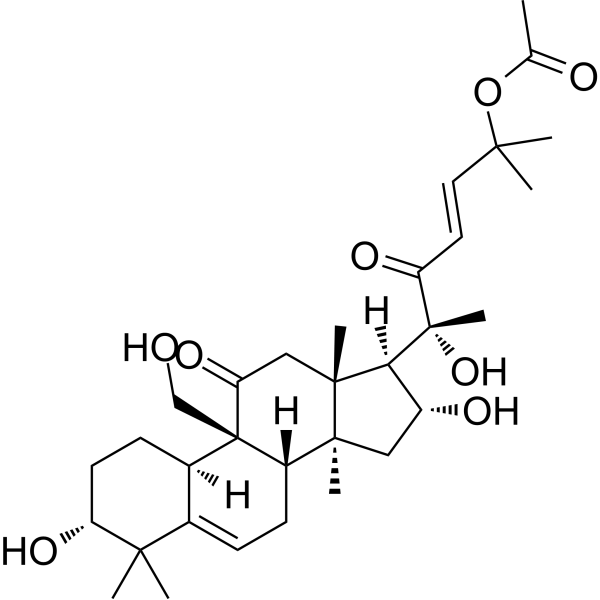
Cucurbitacin C is a tetracyclic triterpenoid compound. Cucurbitacin C exhibits significant in vivo and in vitro anticancer activity, which inhibits the PI3K/AKT signaling pathway to induce cell cycle arrest and apoptosis in cancer cells, and significantly suppresses the growth of HepG2 and PC-3 xenograft tumors in mice. Cucurbitacin C can be used in studies on plant defense mechanisms, secondary metabolism and cancer therapy.
Nur für Forschungszwecke. Wir verkaufen nicht an Patienten.
- Reinheit : 95.0%
- CAS. Nr.: 5988-76-1
- Formel: C32H48O8
- Molecular Weight:560.72
-
Speicherung:Powder -20°C, 3 years , 4°C, 2 years ; In solvent -80°C, 6 months , -20°C, 1 month

To place orders, for customer services and technical support, please contact: MedChemExpress USA
Tel: 609-228-6898 E-mail: [email protected] [email protected]


-
 Biologische Aktivität
-
Chemical Information
- Protokoll
- Reinheit & Dokumentation
- Verweise
-
 Help & FAQs




Biologische Aktivität
Beschreibung
Cellular Effect
|
Cell Line

|
Type | Value | Description | References |
|---|---|---|---|---|
| HCT-116 | IC50 |
0.21 μM
|
Antiproliferative activity against human HCT-116 colon cancer cells assessed as reduction in cell viability incubated for 24 hrs by CCK-8 assay.
Antiproliferative activity against human HCT-116 colon cancer cells assessed as reduction in cell viability incubated for 24 hrs by CCK-8 assay.
|
38505422 |
| HCT-116 | IC50 |
0.04 μM
|
Antiproliferative activity against human HCT-116 colon cancer cells assessed as reduction in cell viability incubated for 48 hrs by CCK-8 assay.
Antiproliferative activity against human HCT-116 colon cancer cells assessed as reduction in cell viability incubated for 48 hrs by CCK-8 assay.
|
38505422 |
| PC-3 | IC50 |
19.6 nM
|
Antiproliferative activity against human prostate cancer PC-3 cells assessed as reduction in cell viability incubated for 48 hrs by MTT assay.
Antiproliferative activity against human prostate cancer PC-3 cells assessed as reduction in cell viability incubated for 48 hrs by MTT assay.
|
30707394 |
| LNCaP | IC50 |
158.7 nM
|
Antiproliferative activity against human prostate cancer LNCaP cells assessed as reduction in cell viability incubated for 48 hrs by MTT assay.
Antiproliferative activity against human prostate cancer LNCaP cells assessed as reduction in cell viability incubated for 48 hrs by MTT assay.
|
30707394 |
In Vitro
Cucurbitacin C (CuC) (0.01-10 μM; 24-48 h) potently inhibits the proliferation of HCT-116 colon cancer cells, with an IC50 value of 0.21 μM at 24 h and 0.04 μM at 48 h[4].
Cucurbitacin C (0.1-0.5 μM; 24 h) inhibits the migration of HCT-116 colon cancer cells in a concentration-dependent manner[4].
Cucurbitacin C (24 h) downregulates the mRNA expression of MMP-1, MMP-3, MMP-9, MMP-13 and PGF in HCT-116 cells, exerts no significant effect on CDK2 expression, and upregulates MET expression[4].
Cucurbitacin C (10-100 nM; 14 days) significantly reduces the clonogenic capacity of LNCaP, DU145, PC-3, T24 and HepG2 cells[1].
Cucurbitacin C (20 nM; 12-24 h) significantly inhibits the migration of DU145, PC-3, HepG2 and T24 cells[1].
Cucurbitacin C (100 nM; 24 h) inhibits phosphorylation of Akt at the Ser473 site in a time-dependent manner in PC-3, T24 and HepG2 cells, with no effect on the expression of pan-Akt[1].
Cucurbitacin C exhibits favorable binding affinity to human MMP-1, MMP-3, MMP-9, MMP-13, PGF, MET and CDK2 proteins[4].
Cucurbitacin C (49.5-314.4 μg/g fresh weight; at approximately 10 days) shows an extremely strong negative correlation with the survival rate of Tetranychus urticae in bitter haploid cucumber lines[5].
Cucurbitacin C (0.1-1.0 μM; 24 h) induces concentration-dependent apoptosis in HCT-116 colon cancer cells after 24 h of treatment[4].
Cucurbitacin C (10-1000 nM; 24 h) induces dose-dependent early apoptosis in T24, HepG2 and PC-3 cells[1].
Cucurbitacin C (0.01-1 μM; 48 h) activates apoptosis-related proteins in LNCaP, PC-3, T24 and HepG2 cells through distinct pathways, including activation of caspase-8 and PARP in PC-3 and T24 cells, promotion of cleaved caspase-3 accumulation in LNCaP cells, and upregulation of cleaved caspase-9 levels in HepG2 cells[1].
Cucurbitacin C (10-1000 nM; 48 h) induces G1 phase arrest in DU145 and LNCaP cells, triggers G2/M phase arrest in T24, HepG2 and PC-3 cells, and increases the proportion of apoptotic cells in the sub-G1 phase[1].
Cucurbitacin C (100 nM; 24 h) regulates cell cycle regulatory proteins in LNCaP, PC-3, T24 and HepG2 cells, reduces the levels of cyclin A and cyclin D1, and induces p53-independent upregulation of p21[1].
Cucurbitacin C (24 h) alters the gene expression of PC-3 and HepG2 cells, exerts significant regulatory effects on the PI3K-Akt pathway, and upregulates cell cycle inhibitors and downstream target genes of Akt[1].
MedChemExpress (MCE) has not independently confirmed the accuracy of these methods. They are for reference only.
-
Cell Line:human HCT-116 colon cancer cells
-
Concentration:0.01, 0.05, 0.1, 0.5, 1, 5, 10 μM
-
Incubation Time:24, 48 h
-
Result:Inhibited the proliferative activity of HCT-116 cells in a concentration- and time-dependent manner, with IC50 values of 0.21 μM at 24 h and 0.04 μM at 48 h.
-
Cell Line:human HCT-116 colon cancer cells
-
Concentration:0.1, 0.5, 1.0 μM
-
Incubation Time:24 h
-
Result:Induced concentration-dependent apoptosis in HCT-116 cells, with increasing proportions of early and late apoptotic cells observed at higher cucurbitacin C concentrations.
-
Cell Line:human HCT-116 colon cancer cells
-
Concentration:0.1, 0.5, 1.0 μM
-
Incubation Time:24 h
-
Result:Inhibited migratory activity of HCT-116 cells in a concentration-dependent manner, with significantly reduced migration rate in the high-dose treatment group compared to controls.
-
Cell Line:LNCaP, DU145, PC-3, T24, HepG2
-
Concentration:0.001, 0.01, 0.1, 1, 10 μM
-
Incubation Time:48 h
-
Result:Dose-dependently inhibited the survival of all tested cancer cell lines.
Achieved 40-60% inhibition of cell survival at 10-100 nM, with PC-3 and T24 cells showing the highest sensitivity.
-
Cell Line:DU145, LNCaP, PC-3, T24, HepG2
-
Concentration:10, 100, 1000 nM
-
Incubation Time:48 h
-
Result:Induced G1 phase cell cycle arrest in DU145 and LNCaP cells.
Induced G2/M phase arrest in T24, HepG2, and PC-3 cells.
Caused a dramatic increase in the sub-G1 cell population at 1 μM.
-
Cell Line:LNCaP, PC-3, T24, HepG2
-
Concentration:0.01, 0.1, 1 μM
-
Incubation Time:24 h
-
Result:Dose-dependently up-regulated p21 protein levels in PC-3, T24, and HepG2 cells.
Caused p21 accumulation to peak at 1 μM in PC-3 cells and at 0.1 μM in HepG2 cells.
Showed no change in p53 expression in any of the cell lines.
-
Cell Line:LNCaP, PC-3, T24, HepG2
-
Concentration:0.01, 0.1, 1 μM
-
Incubation Time:48 h
-
Result:Dose-dependently activated caspase-8 and PARP in PC-3 and T24 cells.
Activated caspase-9 in PC-3 cells.
Slightly elevated cleaved caspase-3/-7 levels in PC-3 cells but not in T24 cells.
-
Cell Line:PC-3, T24, HepG2
-
Concentration:100 nM
-
Incubation Time:24 h
-
Result:Significantly decreased Akt phosphorylation at Ser473 in PC-3, T24, and HepG2 cells after 24 h, with no change in pan-Akt expression.
-
Cell Line:PC-3, T24
-
Concentration:100 nM
-
Incubation Time:1, 3, 10, 24 h
-
Result:Inhibited p-Akt (Ser473) in PC-3 cells starting at 3 h, with the most prominent effect at 24 h.
Inhibited p-Akt (Ser473) in T24 cells starting at 1 h, reaching the lowest point at 24 h.
In Vivo
Cucurbitacin C (0.1 mg/kg; i.p.; three times per week; 4 weeks) inhibits HepG2 xenograft tumor growth by reducing tumor weight and inducing intratumor apoptosis with low host toxicity[1].
MedChemExpress (MCE) has not independently confirmed the accuracy of these methods. They are for reference only.
-
Animal Model:C57BL/6 (male, 6-8 weeks old, 20 g)[4]
-
Dosage:0.05, 0.1 mg/kg
-
Administration:i.p.; once daily for 21 days
-
Result:Restored tumor-induced weight loss in mice.
Achieved tumor inhibition.
Reduced tumor weight and volume significantly compared to the model group for both doses.
Decreased the expression of MMP-1, MMP-3, MMP-9, MMP-13, and Pgf genes in tumor tissues for both doses.
Showed no significant effect on MET or CDK2 expression in tumor tissues for both doses.
-
Animal Model:SCID (7-week-old male, HepG2 cell subcutaneous xenograft model)[1]
-
Dosage:0.1 mg/kg
-
Administration:i.p.; three times per week; 4 weeks
-
Result:Reduced average tumor weight.
Increased DNA cleavage signals in treated tumors compared to controls.
Caused no significant changes in body weight between treated and control mice.
-
Animal Model:SCID (7-week-old male, PC-3 cell subcutaneous xenograft model)[1]
-
Dosage:0.1 mg/kg
-
Administration:i.p.; three times per week; 4 weeks
-
Result:Reduced average tumor weight.
Increased DNA cleavage signals in treated tumors compared to controls.
Caused no significant changes in body weight between treated and control mice.
- Detection of Apoptosis
- TUNEL staining for apoptotic DNA fragmentation
- Flow cytometric DNA-content cell-cycle staining
- Annexin V plus membrane-impermeant dye apoptosis staining
- BrdU Incorporation Assay
- Patient-Derived Xenograft (PDX)
- Apoptosis Solutions
- Protocol for Cell Cycle
- Splenic/Portal-Vein Liver Metastasis Xenograft
- Subcutaneous Cell-Line-Derived Xenograft
- Orthotopic Cell-Line Xenograft
- Intraperitoneal/Peritoneal Dissemination Xenograft


Chemical Information
-
CAS. Nr. 5988-76-1
-
Appearance Solid
-
Molecular Weight 560.72
-
Formel C32H48O8
-
Color White to off-white
-
SMILES
OC[C@]12[C@](CC=C3[C@@]2([H])CC[C@H](C3(C)C)O)([H])[C@]4([C@](CC1=O)([C@@]([C@@H](C4)O)([H])[C@@](C)(O)C(/C=C/C(C)(C)OC(C)=O)=O)C)C
-
Synonyms
CuC
-
Structure Classification
-
Initial Source
-
Versand
Room temperature in continental US; may vary elsewhere.
-
Speicherung
Powder -20°C 3 years 4°C 2 years In solvent -80°C 6 months -20°C 1 month


Reinheit & Dokumentation
-
Data Sheet (306 KB)
-
SDS (251 KB)
- English - EN (251 KB)
- Français - FR (251 KB)
- Deutsch - DE (251 KB)
- Norwegian - NO (251 KB)
- Español - ES (251 KB)
- Swedish - SV (251 KB)
- Italian - IT (251 KB)
- Korean - KR (251 KB)
- Portuguese - PT (251 KB)
-
Handling Instructions (2659 KB)
Verweise

Calculators
Konzentration (Stammlösung) × Volumen (Stammlösung) = Konzentration (Ziellösung) × Volumen (Ziellösung)


Cucurbitacin C Related Classifications
HY-N9968 Related Classifications
 Powered by Bioz