



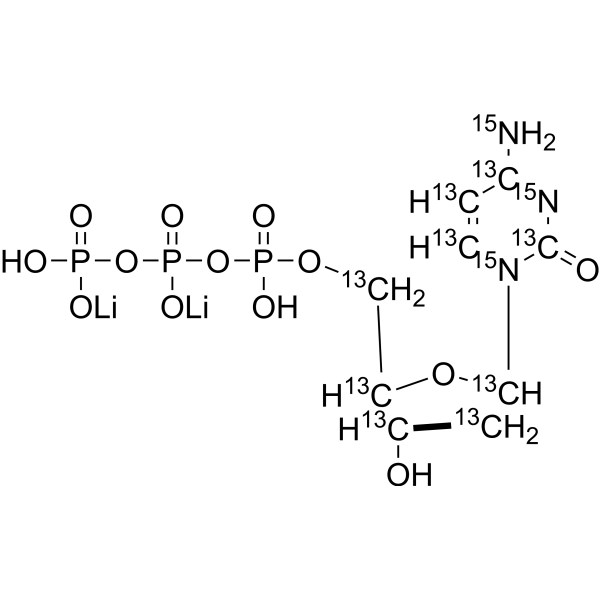
Deoxycytidine triphosphate-13C9,15N3 dilithium
Deoxycytidine triphosphate-13C9,15N3 (dCTP-13C9,15N3 dilithium; 2′-Deoxycytidine-5′-triphosphate-13C9,15N3) dilithium is 13C and 15N-labeled Deoxycytidine triphosphate (HY-101400). Deoxycytidine triphosphate (dCTP) is a nucleoside triphosphate that can be used for DNA synthesis. Deoxycytidine triphosphate has many applications, such as real-time PCR, cDNA synthesis, and DNA sequencing.
For research use only. We do not sell to patients.
- Formula: 13C9H14Li215N3O13P3
- Molecular Weight:490.94
-
Storage:
Please store the product under the recommended conditions in the Certificate of Analysis.

To place orders, for customer services and technical support, please contact: MedChemExpress USA
Tel: 609-228-6898 E-mail: [email protected] [email protected]


-
 Biological Activity
-
Chemical Information
- Protocols
- Purity & Documentation
- References
-
 Help & FAQs




Biological Activity
Description
In Vitro
Stable heavy isotopes of hydrogen, carbon, and other elements have been incorporated into drug molecules, largely as tracers for quantitation during the drug development process. Deuteration has gained attention because of its potential to affect the pharmacokinetic and metabolic profiles of drugs[1].
MedChemExpress (MCE) has not independently confirmed the accuracy of these methods. They are for reference only. Further protocols information, click here.
Application
1. This compound can be used as a tracer
2. This compound can be used as an internal standard for quantitative analysis by NMR, GC-MS, or LC-MS.


Chemical Information
-
Unlabeled CAS 2056-98-6
-
Molecular Weight 490.94
-
Formula 13C9H14Li215N3O13P3
-
SMILES
O[13C@H]1[13CH2][13C@H]([15N]2[13C]([15N]=[13C]([15NH2])[13CH]=[13CH]2)=O)O[13C@@H]1[13CH2]OP(OP(OP(O)(O[Li])=O)(O[Li])=O)(O)=O
-
Synonyms
dCTP-13C9,15N3 dilithium; 2′-Deoxycytidine-5′-triphosphate-13C9,15N3 dilithium
-
Shipping
Room temperature in continental US; may vary elsewhere.
-
Storage
Please store the product under the recommended conditions in the Certificate of Analysis.

Protocols
-
RT-PCR
Reverse transcription technology uses RNA as a template to synthesize DNA. RT-PCR is simple, specific and sensitive, and can be used to detect gene expression levels and expression differences in cells; detect RNA virus content; clone cDNA sequences of specific genes.
-
EdU Incorporation Assay (Click Chemistry-Based DNA Synthesis Measurement)
The EdU incorporation assay measures DNA synthesis by adding the thymidine analog 5-ethynyl-2′-deoxyuridine to cells or tissues, where it is incorporated into newly synthesized DNA during S phase. Incorporated EdU is detected by copper-catalyzed azide-alkyne cycloaddition, in which a fluorescent azide covalently reacts with the ethynyl group on EdU, allowing S-phase cells to be detected by fluorescence microscopy, flow cytometry, or high-content imaging. EdU detection does not require DNA denaturation or anti-BrdU antibody access, which preserves sample structure and improves compatibility with immunostaining and multiparameter cytometry compared with BrdU-based detection. EdU can be cytotoxic in a cell-type- and exposure-dependent manner, so pulse duration, concentration, and continuous-labeling designs should be validated for each cell type.
-
BrdU Incorporation Assay
Bromodeoxyuridine (BrdU) incorporation assay is based on the principle that BrdU, a thymidine analog, is incorporated into newly synthesized DNA during the S phase of the cell cycle, thereby serving as a marker of DNA replication and cellular proliferation. Incorporated BrdU can be detected using anti-BrdU antibodies following DNA denaturation, enabling visualization or quantification of proliferating cells through immunochemical detection methods such as immunofluorescence or immunohistochemistry.
-
Real Time qPCR (Q-PCR)
Real-time quantitative PCR (qPCR) quantifies an amplifiable nucleic-acid target by monitoring fluorescence during PCR cycling rather than measuring product only after amplification. The increase in fluorescence tracks accumulation of PCR product, and the quantification cycle (Cq; historically also Ct/CP) is related to the initial amount of target: samples containing more starting target generally reach the defined fluorescence threshold in fewer cycles.


Purity & Documentation
References
[1]. Russak EM, et al. Impact of Deuterium Substitution on the Pharmacokinetics of Pharmaceuticals. Ann Pharmacother. 2019 Feb;53(2):211-216. [Content Brief]
[2]. M H Tattersall, et al. Deoxyribonucleoside triphosphates in human cells: changes in disease and following exposure to drugs. Eur J Clin Invest. 1975 Apr;5(2):191-202. [Content Brief]
[3]. A W Harris, et al. Effect of thymidine on the sensitivity of cultured mouse tumor cells to 1-beta-D-arabinofuranosylcytosine. Cancer Res. 1979 Feb;39(2 Pt 1):538-41. [Content Brief]
[4]. B A Bladergroen, et al. CTP:phosphoethanolamine cytidylyltransferase. Biochim Biophys Acta. 1997 Sep 4;1348(1-2):91-9. [Content Brief]

Calculators
Concentration (start) × Volume (start) = Concentration (final) × Volume (final)


Deoxycytidine triphosphate-13C9,15N3 dilithium Related Classifications
HY-101400S2 Related Classifications
 Powered by Bioz