



Bederocin

Based on 1 Customer Validation
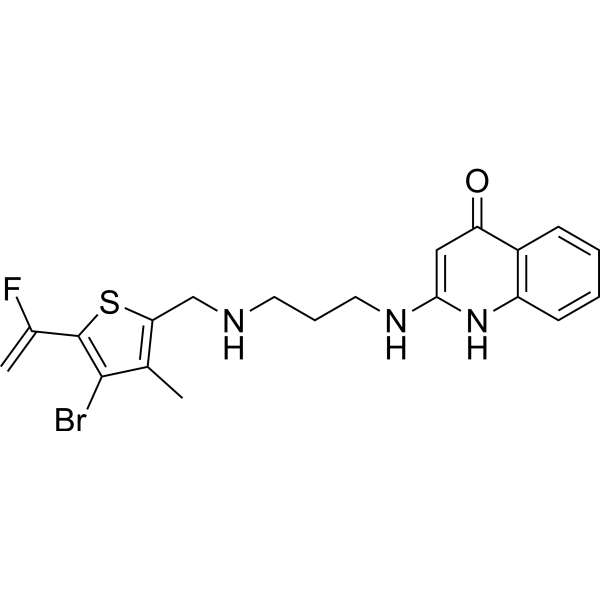
Bederocin (REP8839) is an antibacterial agent and a methionine-competitive MetRS inhibitor with a Ki of 10 pM against S. aureus MetRS. Bederocin induces autophagy. Bederocin exerts a bacteriostatic effect on S. aureus and is active against Gram-positive pathogens, including S. pyogenes and resistant strains, with little or no activity against Gram-negative bacteria. Bederocin can be used in research on bacterial infections.
For research use only. We do not sell to patients.
- Purity : 99.6%
- CAS No.: 757942-43-1
- Formula: C20H21BrFN3OS
- Molecular Weight:450.37
-
Storage:Powder -20°C, 3 years , 4°C, 2 years ; In solvent -80°C, 6 months , -20°C, 1 month

To place orders, for customer services and technical support, please contact: MedChemExpress USA
Tel: 609-228-6898 E-mail: [email protected] [email protected]


-
 Biological Activity
-
Chemical Information
- Protocols
- Purity & Documentation
- References
-
 Help & FAQs




Biological Activity
Description
IC50 & Target
[3]|
MetRS 10 pM (Ki, S. aureus) |
Cellular Effect
|
Cell Line

|
Type | Value | Description | References |
|---|---|---|---|---|
| A549 | IC50 |
20 μM
|
Cytotoxicity against human A549 cells assessed by MTT assay with concentrations up to 20 μM; IC50 greater than 20 μM.
Cytotoxicity against human A549 cells assessed by MTT assay with concentrations up to 20 μM; IC50 greater than 20 μM.
|
19015366 |
In Vitro
Bederocin increases the MIC from 0.12 μg/mL to 1 μg/mL in MetS-overexpressing S. aureus RN4220 (pYH4-metS), confirming target specificity[2].
Bederocin (1-32 μg/mL; 48 hours) has an MPC of 32 μg/mL in S. aureus strains, including MRSA[2].
Bederocin MIC increases from 0.015-0.06 μg/mL to 0.06-16 μg/mL in 19 Staphylococcus and Streptococcus strains[2].
Bederocin inhibits the growth of S. aureus with an MIC of 0.12 µg/mL, whereas reagent-resistant mutant strains have an MIC of 2-32 µg/mL[3].
Bederocin (20-24 h) shows potent broth microdilution activity against contemporary Gram-positive isolates, with an MIC90 of 0.12 µg/mL for S. aureus, an MIC90 of 0.12 µg/mL for S. epidermidis, an MIC90 of 0.12 µg/mL for S. pyogenes, and MIC90 values of 0.015 µg/mL or lower for enterococci[4].
Bederocin (0.05 nM-1 µM) loses efficacy against S. aureus mutant MetRS enzymes, with G54A A64P showing up to a 190,000-fold increase in Ki compared with wild-type MetRS[3].
Bederocin (Ki = 10 pM) inhibits purified S. aureus MetRS, exhibiting competitive inhibition with respect to methionine and noncompetitive inhibition with respect to ATP[5].
Bederocin inhibits protein synthesis in S. pneumoniae, with RNA synthesis inhibition as a secondary stringent response effect[5].
MedChemExpress (MCE) has not independently confirmed the accuracy of these methods. They are for reference only.
In Vivo
MedChemExpress (MCE) has not independently confirmed the accuracy of these methods. They are for reference only.
-
Animal Model:N2 (wild-type); MAH215 sqIs11 (lgg-1p::mCherry::GFP::lgg-1 + rol-6)[1]
-
Dosage:60 µM in agar plates
-
Administration:in agar plates; continuous exposure
-
Result:Increased lifespan in wild-type C. elegans (Figure 1B).
Lifespan extension was dose-dependent, and largest effect size was shown in Figure 1.
Increased thrashing in wild-type C. elegans compared with vehicle on days 7 and 13 at 60 µM (Figure 3D).
Increased the Red/Green fluorescence ratio in wild-type C. elegans on all days tested (days 1, 5, 9, and 13) at 60 µM (Figure 5B).
-
Animal Model:Partial-thickness wound model[5]
-
Dosage:2% (w/v)
-
Administration:topical; twice daily; 48 hours
-
Result:Exhibited superior efficacy alone and in combination with mupirocin compared with mupirocin alone against high-level mupirocin-resistant S. aureus (87-2787) in the partial thickness porcine wound colonization model.
Reduced viable CFU of high-level mupirocin-resistant S. aureus in a porcine partial thickness wound model more than mupirocin alone.


Chemical Information
-
CAS No. 757942-43-1
-
Appearance Solid
-
Molecular Weight 450.37
-
Formula C20H21BrFN3OS
-
Color White to off-white
-
SMILES
O=C1C=C(NCCCNCC2=C(C)C(Br)=C(C(F)=C)S2)NC3=C1C=CC=C3
-
Synonyms
REP8839
-
Shipping
Room temperature in continental US; may vary elsewhere.
-
Storage
Powder -20°C 3 years 4°C 2 years In solvent -80°C 6 months -20°C 1 month


Purity & Documentation
-
Data Sheet (275 KB)
-
SDS (394 KB)
- English - EN (394 KB)
- Français - FR (394 KB)
- Deutsch - DE (394 KB)
- Norwegian - NO (394 KB)
- Español - ES (394 KB)
- Swedish - SV (394 KB)
- Italian - IT (394 KB)
- Korean - KR (394 KB)
- Portuguese - PT (394 KB)
-
Handling Instructions (2659 KB)
References
[1]. Heath OC, et al. Novel tRNA Synthetase Inhibitors Increase Healthspan, Lifespan, and Autophagic Flux in C. elegans. Biomolecules. 2026 Jan 1;16(1):73. [Content Brief]
[2]. Ochsner UA, et al. Mode of action and biochemical characterization of REP8839, a novel inhibitor of methionyl-tRNA synthetase. Antimicrobial agents and chemotherapy. 2005 Oct;49(10):4253-62. [Content Brief]
[3]. Green LS, et al. Inhibition of methionyl-tRNA synthetase by REP8839 and effects of resistance mutations on enzyme activity. Antimicrobial agents and chemotherapy. 2009 Jan;53(1):86-94. [Content Brief]
[4]. Critchley IA, et al. Antibacterial activity of REP8839, a new antibiotic for topical use. Antimicrobial agents and chemotherapy. 2005 Oct;49(10):4247-52. [Content Brief]
[5]. Critchley IA, et al. Recent advances in the preclinical evaluation of the topical antibacterial agent REP8839. Current opinion in chemical biology. 2008 Aug;12(4):409-17. [Content Brief]

Calculators
Concentration (start) × Volume (start) = Concentration (final) × Volume (final)


Bederocin Related Classifications
HY-14784 Related Classifications
 Powered by Bioz
Keywords
- Bederocin
- 757942-43-1
- REP8839
- REP 8839
- REP-8839
- Bacterial
- Autophagy
- Aminoacyl-tRNA Synthetase
- tRNA Synthetase, aaRS
- ATF-4
- Caenorhabditis elegans
- Gram-positive pathogens
- Staphylococcus aureus
- Streptococcus pneumoniae
- autophagy
- methicillin-resistant Staphylococcus aureus
- methionyl-tRNA synthetase
- protein synthesis
- tRNA aminoacylation
- Inhibitor
- inhibitor
- inhibit