



Dusquetide

Based on 1 Customer Validation
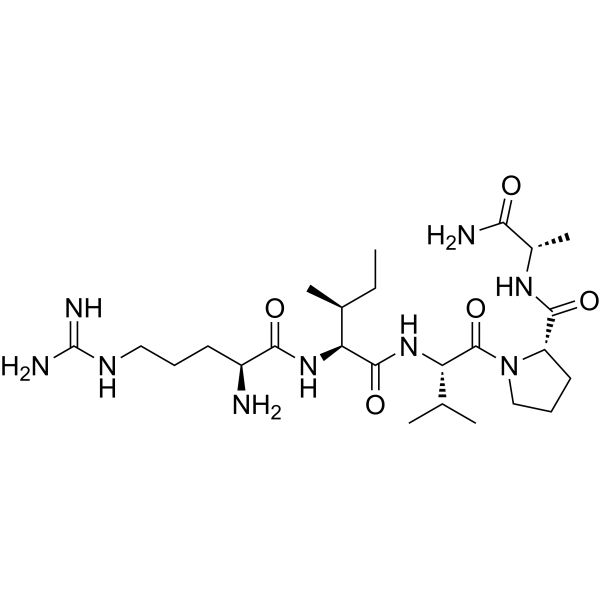
Dusquetide (SGX942) is a first-in-class innate defense regulator (IDR). Dusquetide modulates the innate immune response to both PAMPs and DAMPs by binding to p62. Dusquetide shows activity in both reducing inflammation and increasing clearance of bacterial infection. DAMPs: damage-associated molecular patterns; PAMPs: pathogen-associated molecular patterns
Nos produits utilisent uniquement pour la recherche. Nous ne vendons pas aux patients.
- Pureté : 99.96%
- CAS No.: 931395-42-5
- Formule: C25H47N9O5
- Masse moléculaire:553.70
-
Stockage:
Sealed storage, away from moisture and light, under nitrogen.
Powder -80°C, 2 years , -20°C, 1 year* In solvent : -80°C, 6 months; -20°C, 1 month (sealed storage, away from moisture and light, under nitrogen)

To place orders, for customer services and technical support, please contact: MedChemExpress USA
Tel: 609-228-6898 E-mail: [email protected] [email protected]


-
 Activité biologique
-
Chemical Information
-
Solvant et solubilité
- Protocole
- Pureté et documentation
- Références
-
 Help & FAQs




Activité biologique
Description
In Vivo
MedChemExpress (MCE) has not independently confirmed the accuracy of these methods. They are for reference only.
-
Animal Model:Female nude mice (MCF-7 tumor xenografts)[1]
-
Dosage:25 mg/kg
-
Administration:I.v.; days 0, 4, 7, 10, and 14
-
Result:Showed no increase in tumor growth or worsening of survival and a trend towards decreased tumor growth and improvement in survival with radiation.
Essai clinique
| NCT Number | Sponsor | Condition | Start Date |
Phase

|
|---|---|---|---|---|
| NCT01329991 | 2011-05 | PHASE1 |


Chemical Information
-
CAS No. 931395-42-5
-
Appearance Solid
-
Masse moléculaire 553.70
-
Formule C25H47N9O5
-
Color White to off-white
-
Synonyms
SGX942
-
Sequence Shortening
RIVPA-NH2
-
Livraison
Room temperature in continental US; may vary elsewhere.
-
Stockage
Sealed storage, away from moisture and light, under nitrogen
Powder -80°C 2 years -20°C 1 year * In solvent : -80°C, 6 months; -20°C, 1 month (sealed storage, away from moisture and light, under nitrogen)


Solvant et solubilité
In Vitro:
H2O : 50 mg/mL (90.30 mM; Need ultrasonic)
Please refer to the solubility information to select the appropriate solvent. Once prepared, please aliquot and store the solution to prevent product inactivation from repeated freeze-thaw cycles.
Storage method and period of stock solution: -80°C, 6 months; -20°C, 1 month (sealed storage, away from moisture and light, under nitrogen). When stored at -80°C, please use it within 6 months. When stored at -20°C, please use it within 1 month.
* Note: If you choose water as the stock solution, please dilute it to the working solution, then filter and sterilize it with a 0.22 μm filter before use.
Please refer to the solubility information to select the appropriate solvent. Once prepared, please aliquot and store the solution to prevent product inactivation from repeated freeze-thaw cycles.
Storage method and period of stock solution: -80°C, 6 months; -20°C, 1 month (sealed storage, away from moisture and light, under nitrogen). When stored at -80°C, please use it within 6 months. When stored at -20°C, please use it within 1 month.
* Note: If you choose water as the stock solution, please dilute it to the working solution, then filter and sterilize it with a 0.22 μm filter before use.
Concentration (start) × Volume (start) = Concentration (final) × Volume (final)


Pureté et documentation
-
Fiche technique (272 KB)
-
SDS (252 KB)
- English - EN (252 KB)
- Français - FR (252 KB)
- Deutsch - DE (252 KB)
- Norwegian - NO (252 KB)
- Español - ES (252 KB)
- Swedish - SV (252 KB)
- Italian - IT (252 KB)
- Korean - KR (252 KB)
- Portuguese - PT (252 KB)
-
Instruction de manipulation (2659 KB)
Références


Complete Stock Solution Preparation Table
Please refer to the solubility information to select the appropriate solvent. Once prepared, please aliquot and store the solution to prevent product inactivation from repeated freeze-thaw cycles.
Storage method and period of stock solution: -80°C, 6 months; -20°C, 1 month (sealed storage, away from moisture and light, under nitrogen). When stored at -80°C, please use it within 6 months. When stored at -20°C, please use it within 1 month.
| Optional Solvent | Concentration Solvent Mass | 1 mg | 5 mg | 10 mg | 25 mg |
|---|---|---|---|---|---|
| H2O | 1 mM | 1.8060 mL | 9.0302 mL | 18.0603 mL | 45.1508 mL |
| 5 mM | 0.3612 mL | 1.8060 mL | 3.6121 mL | 9.0302 mL | |
| 10 mM | 0.1806 mL | 0.9030 mL | 1.8060 mL | 4.5151 mL | |
| 15 mM | 0.1204 mL | 0.6020 mL | 1.2040 mL | 3.0101 mL | |
| 20 mM | 0.0903 mL | 0.4515 mL | 0.9030 mL | 2.2575 mL | |
| 25 mM | 0.0722 mL | 0.3612 mL | 0.7224 mL | 1.8060 mL | |
| 30 mM | 0.0602 mL | 0.3010 mL | 0.6020 mL | 1.5050 mL | |
| 40 mM | 0.0452 mL | 0.2258 mL | 0.4515 mL | 1.1288 mL | |
| 50 mM | 0.0361 mL | 0.1806 mL | 0.3612 mL | 0.9030 mL | |
| 60 mM | 0.0301 mL | 0.1505 mL | 0.3010 mL | 0.7525 mL | |
| 80 mM | 0.0226 mL | 0.1129 mL | 0.2258 mL | 0.5644 mL |
* Note: If you choose water as the stock solution, please dilute it to the working solution, then filter and sterilize it with a 0.22 μm filter before use.


Dusquetide Related Classifications
HY-P2076 Related Classifications
 Powered by Bioz