



EGR-1-IN-1
Based on 3 publication(s) in Google Scholar
EGR-1-IN-1 is a EGR-1 inhibitor with an IC50 of 1.86 μM. EGR-1-IN-1 binds to the zinc finger DNA-binding domain of EGR-1 and promotes the dissociation of the EGR-1-DNA complex. EGR-1-IN-1 reduces the mRNA expression levels of EGR-1-regulated inflammatory genes induced by TNFα. EGR-1-IN-1 alleviates atopic dermatitis-like lesions in the ear skin of mice. EGR-1-IN-1 serves as a lead compound for the development of targeted compounds for inflammatory skin diseases. EGR-1-IN-1 can be used in studies related to atopic dermatitis.
For research use only. We do not sell to patients.
- Purity : 99.07%
- CAS No.: 3077196-25-6
- Formula: C17H13N5O2S
- Molecular Weight:351.38
-
Storage:Powder -20°C, 3 years ; In solvent -80°C, 6 months , -20°C, 1 month


To place orders, for customer services and technical support, please contact: MedChemExpress USA
Tel: 609-228-6898 E-mail: [email protected] [email protected]


-
 Biological Activity
-
Chemical Information
-
Solvent & Solubility
- Protocols
- Purity & Documentation
- References
-
 Help & FAQs


Publications Citing Use of MedChemExpress (MCE) EGR-1-IN-1
More Customer Validation & Images

-
WB
-
Flow Cytometry
-
Bio/Physico-chemical Assay
-
Bio/Physico-chemical Assay
-
Cell Proliferation/Viability Assay
All DNA Methyltransferase Isoforms
More

Biological Activity
Description
IC50 & Target
|
13030 1.86 μM (IC50) |
In Vitro
EGR-1-IN-1 (IT25) potently inhibits the DNA-binding activity of human EGR-1, with an IC50 of 1.86 μM in in vitro biochemical assays, and achieves an inhibition rate of 76.1% at a concentration of 50 μM[1].
EGR-1-IN-1 (0-5 μM; 30 min pre-incubation, followed by 1 h TNFα stimulation) inhibits TNFα-induced formation of EGR-1-DNA complexes in human HaCaT keratinocytes[1].
EGR-1-IN-1 (0-5 μM; 30 min pre-incubation, followed by 12 h TNFα stimulation) reduces the mRNA expression of TNFα-induced, EGR-1-regulated inflammatory genes in human HaCaT keratinocytes[1].
MedChemExpress (MCE) has not independently confirmed the accuracy of these methods. They are for reference only. Further protocols information, click here.
-
Cell Line:human HaCaT keratinocytes
-
Concentration:0, 1, 5 μM
-
Incubation Time:30 min pre-incubation, followed by 12 h TNFα stimulation
-
Result:Dose-dependently reduced TNFα-induced mRNA expression of multiple EGR-1-regulated inflammatory genes, including TSLP, IL17, IL4, IL13, IL23, IL33, IL1β, IL6, CCL2, CCL5, and Artemin.
In Vivo
MedChemExpress (MCE) has not independently confirmed the accuracy of these methods. They are for reference only.
-
Animal Model:BALB/c (male, 6-8-week-old, DNCB-induced atopic dermatitis)[1]
-
Dosage:0.1%
-
Administration:topical; once daily five times weekly; 14 days
-
Result:Considerably improved gross ear skin lesions.
Effectively reduced DNCB-induced epidermal and dermal thickness.
Reduced infiltration of MPO-positive neutrophils, F4/80-positive macrophages, CD3ε-positive Th subsets, and toluidine blue-stained mast cells.
Reduced TSLP expression in the epidermal layer.
Substantially reduced sensory nerve density and intraepidermal innervation at the epidermal-dermal interface.


Chemical Information
-
CAS No. 3077196-25-6
-
Appearance Solid
-
Molecular Weight 351.38
-
Formula C17H13N5O2S
-
Color Light yellow to orange
-
SMILES
COC1=CC2=C(/C(C(N2)=O)=N/NC(NC3=CC=C(C=C3)C#N)=S)C=C1
-
Shipping
Room temperature in continental US; may vary elsewhere.
-
Storage
Powder -20°C 3 years In solvent -80°C 6 months -20°C 1 month


Publications (3)
-
Journal Impact Factor
-
Most Recent
-
Adv Sci (Weinh)
AXL Promotes Ischemic Myelin Repair Through Alleviating Myelin Debris Deposition and Lipid Droplets Accumulation. [Abstract]2026 Feb;13(10):e17825. PMID: 41524160
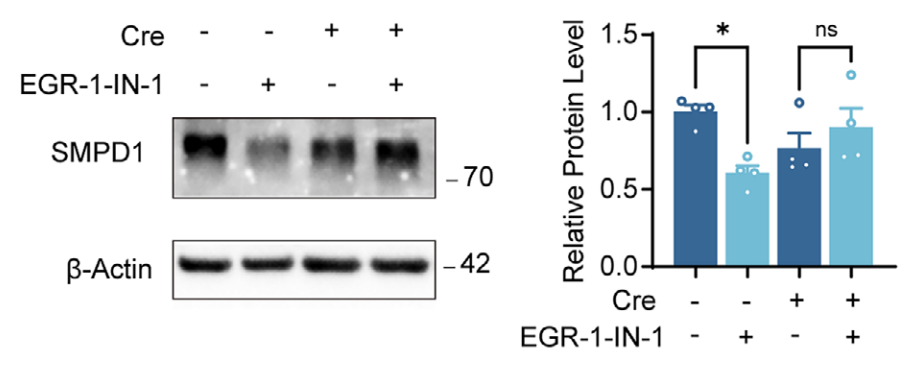
EGR-1-IN-1 purchased from MedChemExpress. Usage Cited in: Adv Sci (Weinh). 2026 Feb;13(10):e17825. [Abstract]
EGR-1-IN-1 (5 µM) decreased the expression of SMPD1 in Cre- microglia while not in Cre+ microglia after OAM.
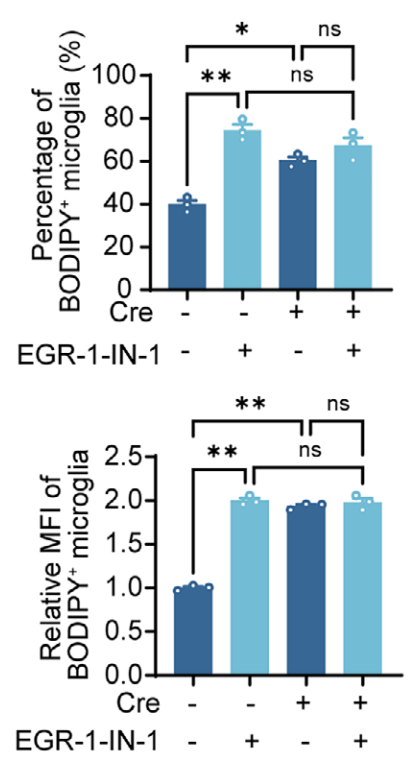
EGR-1-IN-1 purchased from MedChemExpress. Usage Cited in: Adv Sci (Weinh). 2026 Feb;13(10):e17825. [Abstract]
EGR-1-IN-1 (5 µM) increased the BODIPY+ lipid droplets in Cre- microglia after OAM for 6 h.
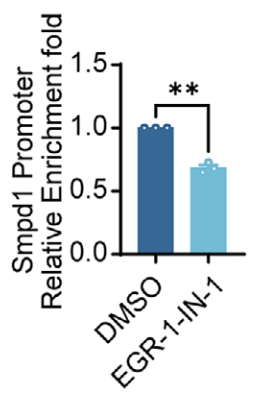
EGR-1-IN-1 purchased from MedChemExpress. Usage Cited in: Adv Sci (Weinh). 2026 Feb;13(10):e17825. [Abstract]
EGR-1-IN-1 (5 µM) significantly reduced EGR1 binding to Site-1 and Site-2 regions of the SMPD1 promoter in BV2 cells under OAM conditions.
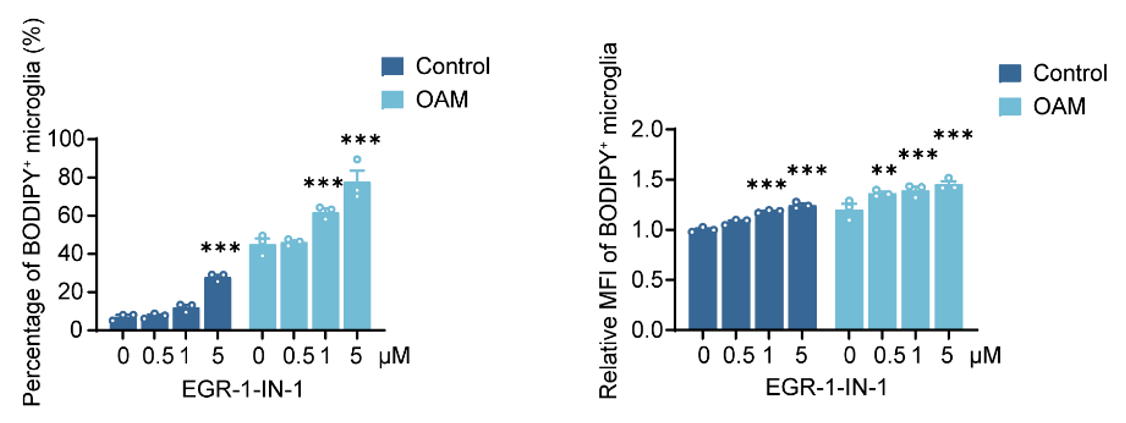
EGR-1-IN-1 purchased from MedChemExpress. Usage Cited in: Adv Sci (Weinh). 2026 Feb;13(10):e17825. [Abstract]
EGR-1-IN-1 (5 µM) significantly increased LDs formation in primary microglia in vitro.
-
Am J Chin Med
Andrographolide Suppresses Head and Neck Squamous Cell Carcinoma Progression via EGR1-ACSL4 Axis-Mediated Ferroptosis. [Abstract]2026;54(4):1309-1330. PMID: 42252950 -
Cell Signal
GPR91 mediates low shear stress-induced endothelial ferroptosis via EGR1-dependent GPX4 repression. [Abstract]2025 Sep 10:136:112127. PMID: 40939914
EGR-1-IN-1 purchased from MedChemExpress. Usage Cited in: Cell Signal. 2025 Sep 10:136:112127. [Abstract]
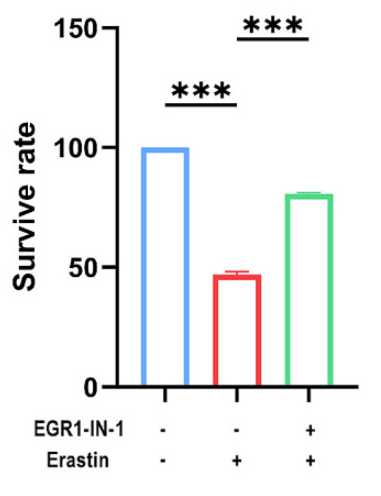
EGR-1-IN-1 (2 μM; 1 h) partially restored viability of HUVECs treated with Erastin.


Solvent & Solubility
In Vitro:
DMSO : 1 mg/mL (2.85 mM; ultrasonic and warming and heat to 60°C; Hygroscopic DMSO has a significant impact on the solubility of product, please use newly opened DMSO)
Acetone : < 1 mg/mL (insoluble)
THF : < 1 mg/mL (insoluble)
Please refer to the solubility information to select the appropriate solvent. Once prepared, please aliquot and store the solution to prevent product inactivation from repeated freeze-thaw cycles.
Storage method and period of stock solution: -80°C, 6 months; -20°C, 1 month. When stored at -80°C, please use it within 6 months. When stored at -20°C, please use it within 1 month.
Please refer to the solubility information to select the appropriate solvent. Once prepared, please aliquot and store the solution to prevent product inactivation from repeated freeze-thaw cycles.
Storage method and period of stock solution: -80°C, 6 months; -20°C, 1 month. When stored at -80°C, please use it within 6 months. When stored at -20°C, please use it within 1 month.
Concentration (start) × Volume (start) = Concentration (final) × Volume (final)

Protocols
-
RT-PCR
Reverse transcription technology uses RNA as a template to synthesize DNA. RT-PCR is simple, specific and sensitive, and can be used to detect gene expression levels and expression differences in cells; detect RNA virus content; clone cDNA sequences of specific genes.
-
RNA extraction experimental
By lysing cells, releasing RNA, and removing impurities such as proteins and DNA, high-purity RNA products are finally obtained. The commonly used traditional method is the guanidine isothiocyanate/phenol/chloroform method (Trizol), which is suitable for a variety of animal materials including animal tissues, microorganisms, cultured cells, etc., and most plant materials.
-
Cell Cytotoxicity Assay
Cytotoxicity assays are usually based on the assessment of cell membrane damage, which can also be indirectly detected by measuring cell viability. Detection methods include MTT assay, CKK-8 assay, LDH assay and ATP assay, etc.
-
TPA/Croton Oil Ear Edema and Dermatitis
The TPA (12-O-tetradecanoylphorbol-13-acetate) and croton oil-induced mouse ear edema model is a well-established acute cutaneous inflammation system used to evaluate topical anti-inflammatory activity by measuring edema formation, neutrophil infiltration, vascular permeability, and cytokine-mediated skin responses in vivo. The inflammatory response is triggered by topical application of phorbol esters (TPA) or croton oil constituents, leading to rapid activation of protein kinase C signaling, leukocyte recruitment, and increased vascular permeability, which can be quantified by ear thickness, weight, dye extravasation, and biochemical markers such as myeloperoxidase (MPO) activity and pro-inflammatory mediators in ear tissue homogenates. This model is widely used for screening anti-inflammatory agents, where reductions in edema and inflammatory biomarkers reflect suppression of acute dermal inflammation and immune cell infiltration. Histological evaluation typically confirms epidermal
-
Real Time qPCR (Q-PCR)
Real-time quantitative PCR (qPCR) quantifies an amplifiable nucleic-acid target by monitoring fluorescence during PCR cycling rather than measuring product only after amplification. The increase in fluorescence tracks accumulation of PCR product, and the quantification cycle (Cq; historically also Ct/CP) is related to the initial amount of target: samples containing more starting target generally reach the defined fluorescence threshold in fewer cycles.


Purity & Documentation
-
Data Sheet (281 KB)
-
SDS (252 KB)
- English - EN (252 KB)
- Français - FR (252 KB)
- Deutsch - DE (252 KB)
- Norwegian - NO (252 KB)
- Español - ES (252 KB)
- Swedish - SV (252 KB)
- Italian - IT (252 KB)
- Korean - KR (252 KB)
- Portuguese - PT (252 KB)
-
Handling Instructions (2659 KB)
References


Complete Stock Solution Preparation Table
Please refer to the solubility information to select the appropriate solvent. Once prepared, please aliquot and store the solution to prevent product inactivation from repeated freeze-thaw cycles.
Storage method and period of stock solution: -80°C, 6 months; -20°C, 1 month. When stored at -80°C, please use it within 6 months. When stored at -20°C, please use it within 1 month.
| Optional Solvent | Concentration Solvent Mass | 1 mg | 5 mg | 10 mg | 25 mg |
|---|---|---|---|---|---|
| DMSO | 1 mM | 2.8459 mL | 14.2296 mL | 28.4592 mL | 71.1480 mL |


EGR-1-IN-1 Related Classifications
HY-163731 Related Classifications
 Powered by Bioz
Keywords