



Epimedokoreanin B

Based on 1 Customer Validation
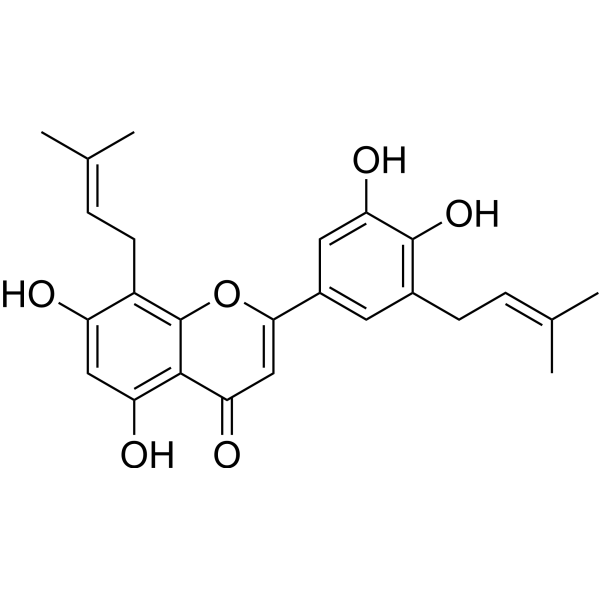
Epimedokoreanin B is a natural flavonoid with anticancer, anti-inflammatory and antibacterial effects. Epimedokoreanin B inhibits the growth of lung cancer cells through endoplasmic reticulum stress-mediated apoptosis accompanied by autophagosome accumulation. Epimedokoreanin B is an anti-periodontitis agent that inhibits gingipains and Porphyromonas gingivalis growth and biofilm formation.
For research use only. We do not sell to patients.
- Purity : 98.86%
- CAS No.: 161068-53-7
- Formula: C25H26O6
- Molecular Weight:422.47
-
Storage:
-20°C, protect from light
* In solvent : -80°C, 6 months; -20°C, 1 month (protect from light)

To place orders, for customer services and technical support, please contact: MedChemExpress USA
Tel: 609-228-6898 E-mail: [email protected] [email protected]


-
 Biological Activity
-
Chemical Information
- Protocols
- Purity & Documentation
- References
-
 Help & FAQs




Biological Activity
Description
In Vitro
Epimedokoreanin B (compound6; 3.13-25 μM; 48 hours) shows significate inhibitory effect on proliferation against lung cancer cell A549, Calu1 and H1299. Epimedokoreanin B displays no toxic on human bronchial epithelial cells BEAS-2B[1].
Epimedokoreanin B treatment inhibits cell proliferation and migration accompanied by cytoplasmic vacuolation in A549 and NCI-H292 cells. Atophagosome accumulation accompanied with autophagy flux blocking is observed in Epimedokoreanin B treated cells, this was consistent with the occurrence of ER stress[2].
Epimedokoreanin B (5 μM; 24 hours) inhibits CD163 expression and IL-10 production, which are known M2 markers, suggesting that Epimedokoreanin B inhibits M2 polarization in human monocyte-derived macrophages (HMDMs). Epimedokoreanin B suppresses STAT3 activation in HMDMs[4].
MedChemExpress (MCE) has not independently confirmed the accuracy of these methods. They are for reference only.
-
Cell Line:A549, Calu1 and H1299 cells
-
Concentration:3.13 μM, 6.25 μM, 12.5 μM and 25.0 μM
-
Incubation Time:48 hours
-
Result:Showed significate inhibitory effect on proliferation against lung cancer cell A549, Calu1 and H1299.
-
Cell Line:Human monocyte-derived macrophages (HMDMs)
-
Concentration:5 μM
-
Incubation Time:24 hours
-
Result:Significantly suppressed IL-10-induced JAK1/STAT3 activation.and H1299.
In Vivo
MedChemExpress (MCE) has not independently confirmed the accuracy of these methods. They are for reference only.
-
Animal Model:Female C3H mice (8-10 weeks old) injected with LM8 cells[4]
-
Dosage:20 mg/kg
-
Administration:Oral administration; thrice a week; for 17 days
-
Result:Inhibited tumor growth.


Chemical Information
-
CAS No. 161068-53-7
-
Appearance Solid
-
Molecular Weight 422.47
-
Formula C25H26O6
-
Color Light yellow to yellow
-
SMILES
O=C1C=C(C2=CC(C/C=C(C)\C)=C(O)C(O)=C2)OC3=C(C/C=C(C)\C)C(O)=CC(O)=C13
-
Structure Classification
-
Initial Source
-
Shipping
Room temperature in continental US; may vary elsewhere.
-
Storage
-20°C, protect from light
* In solvent : -80°C, 6 months; -20°C, 1 month (protect from light)


Purity & Documentation
-
Data Sheet (294 KB)
-
SDS (393 KB)
- English - EN (393 KB)
- Français - FR (393 KB)
- Deutsch - DE (393 KB)
- Norwegian - NO (393 KB)
- Español - ES (393 KB)
- Swedish - SV (393 KB)
- Italian - IT (393 KB)
- Korean - KR (393 KB)
- Portuguese - PT (393 KB)
-
Handling Instructions (2659 KB)
References
[1]. Huaran Zhang, et al. Flavonoids from the leaves of Epimedium Koreanum Nakai and their potential cytotoxic activities. Nat Prod Res. 2020 May;34(9):1256-1263. [Content Brief]
[2]. Hao Zheng, et al. Epimedokoreanin B inhibits the growth of lung cancer cells through endoplasmic reticulum stress-mediated paraptosis accompanied by autophagosome accumulation. Chem Biol Interact. 2022 Oct 1;366:110125. [Content Brief]
[3]. T Kariu, et al. Inhibition of gingipains and Porphyromonas gingivalis growth and biofilm formation by prenyl flavonoids. J Periodontal Res. 2017 Feb;52(1):89-96. [Content Brief]
[4]. Cheng Pan , et al. Flavonoid Compounds Contained in Epimedii Herba Inhibit Tumor Progression by Suppressing STAT3 Activation in the Tumor Microenvironment. Front Pharmacol. 2020 Mar 18;11:262. [Content Brief]

Calculators
Concentration (start) × Volume (start) = Concentration (final) × Volume (final)


Epimedokoreanin B Related Classifications
HY-N3831 Related Classifications
 Powered by Bioz