



Euphol
Based on 1 publication(s) in Google Scholar
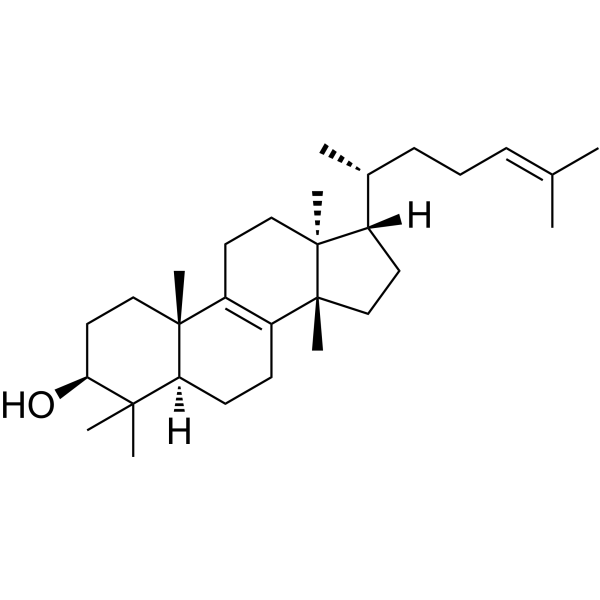
Euphol is a tetracyclic triterpene alcohol isolated from the sap of Euphorbia tirucalli with anti-mutagenic, anti-inflammatory and immunomodulatory effects, orally active. Euphol inhibits the monoacylglycerol lipase (MGL) activity via a reversible mechanism (IC50=315 nM). MGL inhibition in the periphery modulates the endocannabinoid system to block the development of inflammatory pain.
Nur für Forschungszwecke. Wir verkaufen nicht an Patienten.
- Reinheit : 99.68%
- CAS. Nr.: 514-47-6
- Formel: C30H50O
- Molecular Weight:426.72
-
Speicherung:
-20°C, protect from light
* In solvent : -80°C, 6 months; -20°C, 1 month (protect from light)

To place orders, for customer services and technical support, please contact: MedChemExpress USA
Tel: 609-228-6898 E-mail: [email protected] [email protected]


-
 Biologische Aktivität
-
Chemical Information
-
Lösungsmittel & Löslichkeit
- Protokoll
- Reinheit & Dokumentation
- Verweise
-
 Help & FAQs




Publications Citing Use of MedChemExpress (MCE) Euphol
MoreAlle Endogenous Metabolite Isoform-spezifische Produkte anzeigen
More

Biologische Aktivität
Beschreibung
IC50 & Target
IC50: 315 nM (monoacylglycerol lipase activity)[1]
In Vitro
Euphol (0.01-0.3 mM; 24-72 hours) markedly inhibits T47D cells proliferation, the IC50 values of euphol treatment for 24, 48 and 72 h were 0.26, 0.22 and 0.13 mM, respectively[2]. Euphol (0.03 mM; 48 or 72 hours) leads to cell cycle arrest by regulating expression of cell cycle-associated proteins[2].
MedChemExpress (MCE) has not independently confirmed the accuracy of these methods. They are for reference only.
-
Cell Line:T47D cells
-
Concentration:0.01, 0.03, 0.1 and 0.3 mM
-
Incubation Time:24, 48 and 72 hours
-
Result:Decreased the percentage of viable cells.
-
Cell Line:T47D cells
-
Concentration:0.03 mM
-
Incubation Time:48 and 72 hours
-
Result:Increased the expression of p21 and p27, reduced the expression of cyclin A, B1 and D.


Chemical Information
-
CAS. Nr. 514-47-6
-
Appearance Solid
-
Molecular Weight 426.72
-
Formel C30H50O
-
Color White to off-white
-
SMILES
C[C@@]1(CC2)[C@@](CC[C@]1([C@H](C)CC/C=C(C)/C)[H])(C)C3=C2[C@]4(C)[C@](CC3)([H])C(C)(C)[C@@H](O)CC4
-
Structure Classification
-
Initial Source
-
Versand
Room temperature in continental US; may vary elsewhere.
-
Speicherung
-20°C, protect from light
* In solvent : -80°C, 6 months; -20°C, 1 month (protect from light)


Publications (1)
-
Journal Impact Factor
-
Most Recent


Lösungsmittel & Löslichkeit
In Vitro:
Ethanol : ≥ 100 mg/mL (234.35 mM)
* "≥" means soluble, but saturation unknown.
Please refer to the solubility information to select the appropriate solvent. Once prepared, please aliquot and store the solution to prevent product inactivation from repeated freeze-thaw cycles.
Storage method and period of stock solution: -80°C, 6 months; -20°C, 1 month (protect from light). When stored at -80°C, please use it within 6 months. When stored at -20°C, please use it within 1 month.
Please refer to the solubility information to select the appropriate solvent. Once prepared, please aliquot and store the solution to prevent product inactivation from repeated freeze-thaw cycles.
Storage method and period of stock solution: -80°C, 6 months; -20°C, 1 month (protect from light). When stored at -80°C, please use it within 6 months. When stored at -20°C, please use it within 1 month.
Konzentration (Stammlösung) × Volumen (Stammlösung) = Konzentration (Ziellösung) × Volumen (Ziellösung)
In Vivo:
Select the appropriate dissolution method based on your experimental animal and administration route.
- For the following dissolution methods, please ensure to first prepare a clear stock solution using an In Vitro approach and then sequentially add co-solvents:
- To ensure reliable experimental results, the clarified stock solution can be appropriately stored based on storage conditions. As for the working solution for In Vivo experiments, it is recommended to prepare freshly and use it on the same day.
- The percentages shown for the solvents indicate their volumetric ratio in the final prepared solution. If precipitation or phase separation occurs during preparation, heat and/or sonication can be used to aid dissolution.
Add each solvent one by one: 10% EtOH 90% Corn Oil
Solubility: ≥ 10 mg/mL (23.43 mM); Clear solution
This protocol yields a clear solution of ≥ 10 mg/mL (saturation unknown). If the continuous dosing period exceeds half a month, please choose this protocol carefully.
Taking 1 mL working solution as an example, add 100 μL EtOH stock solution (100.0 mg/mL) to 900 μL Corn oil, and mix evenly.
In Vivo Dissolution Calculator
Please enter the basic information of animal experiments:
-
-
-
-
Recommended: Prepare an additional quantity of animals to account for potential losses during experiments.
Working solution concentration: 0.22 mg/mL


Reinheit & Dokumentation
-
Data Sheet (273 KB)
-
SDS (251 KB)
- English - EN (251 KB)
- Français - FR (251 KB)
- Deutsch - DE (251 KB)
- Norwegian - NO (251 KB)
- Español - ES (251 KB)
- Swedish - SV (251 KB)
- Italian - IT (251 KB)
- Korean - KR (251 KB)
- Portuguese - PT (251 KB)
-
Handling Instructions (2659 KB)
Verweise
[1]. Wang L, et al. Euphol arrests breast cancer cells at the G1 phase through the modulation of cyclin D1, p21 and p27 expression. Mol Med Rep. 2013 Oct;8(4):1279-85. [Content Brief]
[2]. Dutra RC, et al. Euphol, a tetracyclic triterpene produces antinociceptive effects in inflammatory and neuropathic pain: the involvement of cannabinoid system. Neuropharmacology. 2012 Sep;63(4):593-605. [Content Brief]


Complete Stock Solution Preparation Table
Please refer to the solubility information to select the appropriate solvent. Once prepared, please aliquot and store the solution to prevent product inactivation from repeated freeze-thaw cycles.
Storage method and period of stock solution: -80°C, 6 months; -20°C, 1 month (protect from light). When stored at -80°C, please use it within 6 months. When stored at -20°C, please use it within 1 month.
| Optional Solvent | Concentration Solvent Mass | 1 mg | 5 mg | 10 mg | 25 mg |
|---|---|---|---|---|---|
| Ethanol | 1 mM | 2.3435 mL | 11.7173 mL | 23.4346 mL | 58.5864 mL |
| 5 mM | 0.4687 mL | 2.3435 mL | 4.6869 mL | 11.7173 mL | |
| 10 mM | 0.2343 mL | 1.1717 mL | 2.3435 mL | 5.8586 mL | |
| 15 mM | 0.1562 mL | 0.7812 mL | 1.5623 mL | 3.9058 mL | |
| 20 mM | 0.1172 mL | 0.5859 mL | 1.1717 mL | 2.9293 mL | |
| 25 mM | 0.0937 mL | 0.4687 mL | 0.9374 mL | 2.3435 mL | |
| 30 mM | 0.0781 mL | 0.3906 mL | 0.7812 mL | 1.9529 mL | |
| 40 mM | 0.0586 mL | 0.2929 mL | 0.5859 mL | 1.4647 mL | |
| 50 mM | 0.0469 mL | 0.2343 mL | 0.4687 mL | 1.1717 mL | |
| 60 mM | 0.0391 mL | 0.1953 mL | 0.3906 mL | 0.9764 mL | |
| 80 mM | 0.0293 mL | 0.1465 mL | 0.2929 mL | 0.7323 mL | |
| 100 mM | 0.0234 mL | 0.1172 mL | 0.2343 mL | 0.5859 mL |


Euphol Related Classifications
HY-N0313 Related Classifications
 Powered by Bioz