



FAICAR

Based on 1 Customer Validation
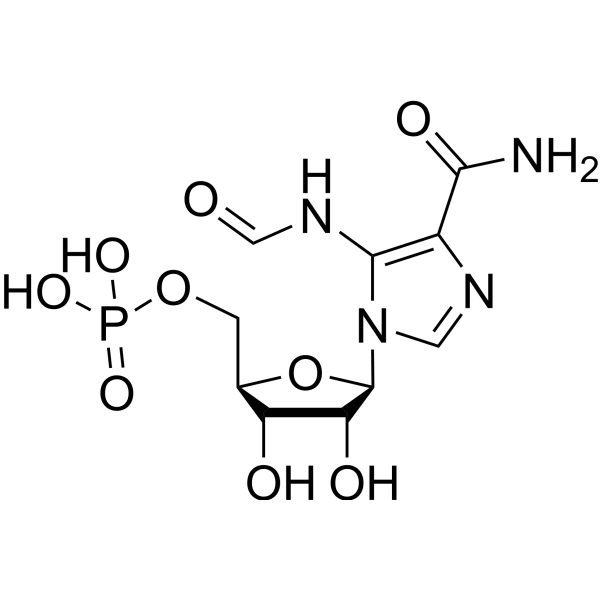
FAICAR (5-Formamidoimidazole-4-carboxamide ribotide) is a purine nucleotide and the IMP cyclohydrolase substrate of Cryptococcus neoformans ATIC. It is a key intermediate in the de novo purine synthesis pathway. FAICAR can be used in studies related to Cryptococcus neoformans infection.
Nos produits utilisent uniquement pour la recherche. Nous ne vendons pas aux patients.
- Pureté : 85.0%
- CAS No.: 13018-54-7
- Formule: C10H15N4O9P
- Masse moléculaire:366.22
-
Stockage:
-20°C, stored under nitrogen
* In solvent : -80°C, 6 months; -20°C, 1 month (stored under nitrogen)

To place orders, for customer services and technical support, please contact: MedChemExpress USA
Tel: 609-228-6898 E-mail: [email protected] [email protected]


-
 Activité biologique
-
Chemical Information
- Protocole
- Pureté et documentation
- Références
-
 Help & FAQs


Voir tous les produits spécifiques à Isoform DNA/RNA Synthesis
More

Activité biologique
Description
In Vitro
FAICAR (0.005-0.3 mM) was used as substrate at 37°C, and recombinantly expressed C. neoformans ATIC exhibits IMP cyclohydrolase activity with a Km_app of 30 μM, Vmax of 8.6 U/mg, and kcat of 7.7 s−1[1].
FAICAR (0.1-4 μM) acts as a substrate for human AICAR transformylase-IMP cyclohydrolase's IMP cyclohydrolase domain, with a Ks of 0.87 μM at pH 7.4, and supports an IMP cyclohydrolase specific activity of 29.5 nmol IMP formed/min/μg protein at a concentration of 4 μM[2].
MedChemExpress (MCE) has not independently confirmed the accuracy of these methods. They are for reference only.


Chemical Information
-
CAS No. 13018-54-7
-
Appearance Solid
-
Masse moléculaire 366.22
-
Formule C10H15N4O9P
-
Color Dark purple to black
-
SMILES
O=C(C1=C(NC=O)N([C@@H]2O[C@H](COP(O)(O)=O)[C@@H](O)[C@H]2O)C=N1)N
-
Synonyms
5-Formamidoimidazole-4-carboxamide ribotide
-
Structure Classification
-
Initial Source
Methanocaldococcus jannaschii
-
Livraison
Room temperature in continental US; may vary elsewhere.
-
Stockage
-20°C, stored under nitrogen
* In solvent : -80°C, 6 months; -20°C, 1 month (stored under nitrogen)


Pureté et documentation
-
Fiche technique (307 KB)
-
SDS (252 KB)
- English - EN (252 KB)
- Français - FR (252 KB)
- Deutsch - DE (252 KB)
- Norwegian - NO (252 KB)
- Español - ES (252 KB)
- Swedish - SV (252 KB)
- Italian - IT (252 KB)
- Korean - KR (252 KB)
- Portuguese - PT (252 KB)
-
Instruction de manipulation (2659 KB)
Références
[1]. Wizrah MSI, et al. AICAR transformylase/IMP cyclohydrolase (ATIC) is essential for de novo purine biosynthesis and infection by Cryptococcus neoformans. J Biol Chem. 2022;298(10):102453. [Content Brief]
[2]. Szabados E, et al. Radioassay of bifunctional 5-aminoimidazole-4-carboxamide ribotide transformylase-IMP cyclohydrolase by thin-layer chromatography. Anal Biochem. 1994;221(2):401-404. [Content Brief]
[3]. Vergis JM, et al. Catalytic mechanism of the cyclohydrolase activity of human aminoimidazole carboxamide ribonucleotide formyltransferase/inosine monophosphate cyclohydrolase. Biochemistry. 2004;43(5):1184-1192. [Content Brief]

Calculators
Concentration (start) × Volume (start) = Concentration (final) × Volume (final)


FAICAR Related Classifications
HY-133157 Related Classifications
 Powered by Bioz