



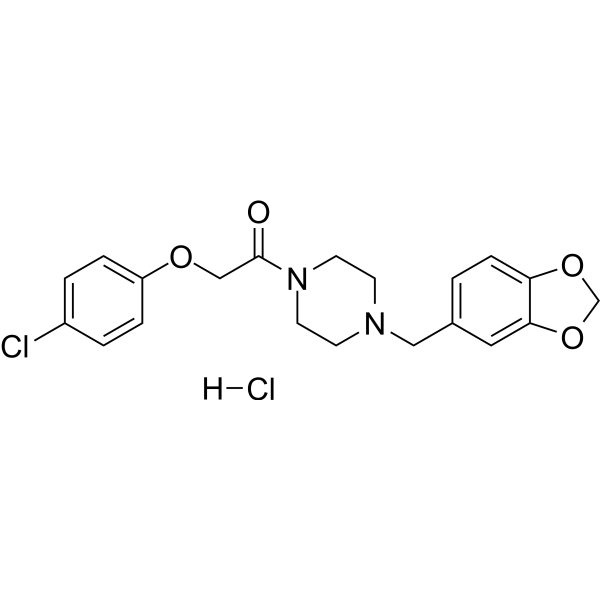
Fipexide hydrochloride
Based on 1 publication(s) in Google Scholar
Fipexide hydrochloride, a parachloro-phenossiacetic acid derivative, is an orally active nootropic agent. Fipexide hydrochloride reduces striatal adenylate cyclase activity. Fipexide hydrochloride has positive effect on cognitive performance by dopaminergic neurotransmission. Fipexide hydrochloride is used for senile dementia research. Fipexide hydrochloride acts as a chemical inducer in callus formation, shoot regeneration and Agrobacterium infection.
Nur für Forschungszwecke. Wir verkaufen nicht an Patienten.
- Reinheit : 99.84%
- CAS. Nr.: 34161-23-4
- Formel: C20H22Cl2N2O4
- Molecular Weight:425.31
-
Speicherung:
4°C, sealed storage, away from moisture
* In solvent : -80°C, 6 months; -20°C, 1 month (sealed storage, away from moisture)

To place orders, for customer services and technical support, please contact: MedChemExpress USA
Tel: 609-228-6898 E-mail: [email protected] [email protected]


-
 Biologische Aktivität
-
Chemical Information
-
Lösungsmittel & Löslichkeit
- Protokoll
- Reinheit & Dokumentation
- Verweise
-
 Help & FAQs



Publications Citing Use of MedChemExpress (MCE) Fipexide hydrochloride
More

Biologische Aktivität
Beschreibung
In Vitro
Fipexide (50 μM; for 15 days) hydrochloride shows simple structures, which contained epidermal regions with well-expanded cells and actively dividing regions for Arabidopsis wild-type seedlings[2]
MedChemExpress (MCE) has not independently confirmed the accuracy of these methods. They are for reference only.
In Vivo
MedChemExpress (MCE) has not independently confirmed the accuracy of these methods. They are for reference only.
-
Animal Model:Kindled rats[3]
-
Dosage:10 mg/kg
-
Administration:Orally; 5-10 days
-
Result:Completely abolishes the memory deficit produced by kindling.
Antagonized the amnestic effect of Pentylenetetrazole (PTZ) -kindling.


Chemical Information
-
CAS. Nr. 34161-23-4
-
Appearance Solid
-
Molecular Weight 425.31
-
Formel C20H22Cl2N2O4
-
Color White to off-white
-
SMILES
ClC1=CC=C(OCC(N2CCN(CC3=CC=C(OCO4)C4=C3)CC2)=O)C=C1.[H]Cl
-
Versand
Room temperature in continental US; may vary elsewhere.
-
Speicherung
4°C, sealed storage, away from moisture
* In solvent : -80°C, 6 months; -20°C, 1 month (sealed storage, away from moisture)


Publications (1)
-
Journal Impact Factor
-
Most Recent
-
Int J Mol Sci
Optimization of Mature Embryo-Based Tissue Culture and Agrobacterium-Mediated Transformation in Model Grass Brachypodium distachyon. [Abstract]2019 Oct 31;20(21):5448. PMID: 31683725


Lösungsmittel & Löslichkeit
In Vitro:
DMSO : 50 mg/mL (117.56 mM; Need ultrasonic; Hygroscopic DMSO has a significant impact on the solubility of product, please use newly opened DMSO)
Please refer to the solubility information to select the appropriate solvent. Once prepared, please aliquot and store the solution to prevent product inactivation from repeated freeze-thaw cycles.
Storage method and period of stock solution: -80°C, 6 months; -20°C, 1 month (sealed storage, away from moisture). When stored at -80°C, please use it within 6 months. When stored at -20°C, please use it within 1 month.
Please refer to the solubility information to select the appropriate solvent. Once prepared, please aliquot and store the solution to prevent product inactivation from repeated freeze-thaw cycles.
Storage method and period of stock solution: -80°C, 6 months; -20°C, 1 month (sealed storage, away from moisture). When stored at -80°C, please use it within 6 months. When stored at -20°C, please use it within 1 month.
Konzentration (Stammlösung) × Volumen (Stammlösung) = Konzentration (Ziellösung) × Volumen (Ziellösung)
In Vivo:
Select the appropriate dissolution method based on your experimental animal and administration route.
- For the following dissolution methods, please ensure to first prepare a clear stock solution using an In Vitro approach and then sequentially add co-solvents:
- To ensure reliable experimental results, the clarified stock solution can be appropriately stored based on storage conditions. As for the working solution for In Vivo experiments, it is recommended to prepare freshly and use it on the same day.
- The percentages shown for the solvents indicate their volumetric ratio in the final prepared solution. If precipitation or phase separation occurs during preparation, heat and/or sonication can be used to aid dissolution.
Add each solvent one by one: 10% DMSO 90% (20% SBE-β-CD in Saline)
Solubility: ≥ 2 mg/mL (4.70 mM); Clear solution
This protocol yields a clear solution of ≥ 2 mg/mL (saturation unknown).
Taking 1 mL working solution as an example, add 100 μL DMSO stock solution (20.0 mg/mL) to 900 μL 20% SBE-β-CD in Saline, and mix evenly.
Preparation of 20% SBE-β-CD in Saline (4°C, storage for one week): 2 g SBE-β-CD powder is dissolved in 10 mL Saline, completely dissolve until clear.
In Vivo Dissolution Calculator
Please enter the basic information of animal experiments:
-
-
-
-
Recommended: Prepare an additional quantity of animals to account for potential losses during experiments.
Please enter your animal formula composition:
-
%DMSO +
Recommended: Keep the proportion of DMSO in working solution below 2% if your animal is weak.
-
%+
-
+%Tween-80 + +
-
%Saline +
The co-solvents required include: DMSO, . All of co-solvents are available by MedChemExpress (MCE). , Tween 80. All of co-solvents are available by MedChemExpress (MCE).
Working solution concentration: 0.22 mg/mL
Method for preparing stock solution: mg drug dissolved in μL DMSO. Stock solution concentration: mg/mL. * In solvent : -80°C, 6 months; -20°C, 1 month (sealed storage, away from moisture)
1. Take μL DMSO stock solution;
2. Add μL .
μL , mix evenly;
3. Then add μL Tween 80, mix evenly;
4. Then add μL
Please ensure that the stock solution in the first step is dissolved to a clear state, and add co-solvents in sequence. You can use ultrasonic heating (ultrasonic cleaner, recommended frequency 20-40 kHz), vortexing, etc. to assist dissolution.


Reinheit & Dokumentation
-
Data Sheet (272 KB)
-
SDS (252 KB)
- English - EN (252 KB)
- Français - FR (252 KB)
- Deutsch - DE (252 KB)
- Norwegian - NO (252 KB)
- Español - ES (252 KB)
- Swedish - SV (252 KB)
- Italian - IT (252 KB)
- Korean - KR (252 KB)
- Portuguese - PT (252 KB)
-
Handling Instructions (2659 KB)
Verweise
[1]. A Marino, et al. Fipexide improvement of cognitive functions in rat: behavioural and neurochemical studies. Pharmacol Res. Mar-Apr 1990;22(2):179-87. [Content Brief]
[2]. Takeshi Nakano, et al.FPX is a Novel Chemical Inducer that Promotes Callus Formation and Shoot Regeneration in Plants. Plant Cell Physiol. 2018 Aug 1;59(8):1555-1567. [Content Brief]
[3]. M G Genkova-Papazova, et al. Piracetam and fipexide prevent PTZ-kindling-provoked amnesia in rats. Eur Neuropsychopharmacol. 1996 Nov;6(4):285-90. [Content Brief]


Complete Stock Solution Preparation Table
Please refer to the solubility information to select the appropriate solvent. Once prepared, please aliquot and store the solution to prevent product inactivation from repeated freeze-thaw cycles.
Storage method and period of stock solution: -80°C, 6 months; -20°C, 1 month (sealed storage, away from moisture). When stored at -80°C, please use it within 6 months. When stored at -20°C, please use it within 1 month.
| Optional Solvent | Concentration Solvent Mass | 1 mg | 5 mg | 10 mg | 25 mg |
|---|---|---|---|---|---|
| DMSO | 1 mM | 2.3512 mL | 11.7561 mL | 23.5123 mL | 58.7807 mL |
| 5 mM | 0.4702 mL | 2.3512 mL | 4.7025 mL | 11.7561 mL | |
| 10 mM | 0.2351 mL | 1.1756 mL | 2.3512 mL | 5.8781 mL | |
| 15 mM | 0.1567 mL | 0.7837 mL | 1.5675 mL | 3.9187 mL | |
| 20 mM | 0.1176 mL | 0.5878 mL | 1.1756 mL | 2.9390 mL | |
| 25 mM | 0.0940 mL | 0.4702 mL | 0.9405 mL | 2.3512 mL | |
| 30 mM | 0.0784 mL | 0.3919 mL | 0.7837 mL | 1.9594 mL | |
| 40 mM | 0.0588 mL | 0.2939 mL | 0.5878 mL | 1.4695 mL | |
| 50 mM | 0.0470 mL | 0.2351 mL | 0.4702 mL | 1.1756 mL | |
| 60 mM | 0.0392 mL | 0.1959 mL | 0.3919 mL | 0.9797 mL | |
| 80 mM | 0.0294 mL | 0.1470 mL | 0.2939 mL | 0.7348 mL | |
| 100 mM | 0.0235 mL | 0.1176 mL | 0.2351 mL | 0.5878 mL |


Fipexide hydrochloride Related Classifications
HY-B1124A Related Classifications
 Powered by Bioz