



Flunixin-d3
Based on 1 publication(s) in Google Scholar
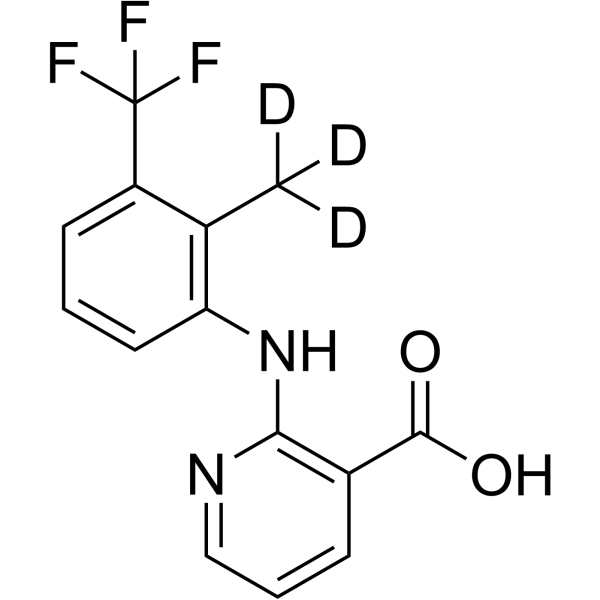
Flunixin-d3 is the deuterium labeled Flunixin. Flunixin Meglumine is a potent inhibitor of COX used as analgesic agent with anti-inflammatory and antipyretic activity.
For research use only. We do not sell to patients.
- CAS No.: 1015856-60-6
- Formula: C14H8D3F3N2O2
- Molecular Weight:299.26
-
Storage:
Please store the product under the recommended conditions in the Certificate of Analysis.

To place orders, for customer services and technical support, please contact: MedChemExpress USA
Tel: 609-228-6898 E-mail: [email protected] [email protected]


-
 Biological Activity
-
Chemical Information
- Protocols
- Purity & Documentation
- References
-
 Help & FAQs


Publications Citing Use of MedChemExpress (MCE) Flunixin-d3
More

Biological Activity
Description
In Vitro
Stable heavy isotopes of hydrogen, carbon, and other elements have been incorporated into drug molecules, largely as tracers for quantitation during the drug development process. Deuteration has gained attention because of its potential to affect the pharmacokinetic and metabolic profiles of drugs[1].
MedChemExpress (MCE) has not independently confirmed the accuracy of these methods. They are for reference only. Further protocols information, click here.
Application
1. This compound can be used as a tracer
2. This compound can be used as an internal standard for quantitative analysis by NMR, GC-MS, or LC-MS.


Chemical Information
-
CAS No. 1015856-60-6
-
Unlabeled CAS 38677-85-9
-
Molecular Weight 299.26
-
Formula C14H8D3F3N2O2
-
SMILES
N(C1=C(C(O)=O)C=CC=N1)C2=C(C([2H])([2H])[2H])C(C(F)(F)F)=CC=C2
-
Synonyms
Sch 14714-d3
-
Shipping
Room temperature in continental US; may vary elsewhere.
-
Storage
Please store the product under the recommended conditions in the Certificate of Analysis.


Publications (1)
-
Journal Impact Factor
-
Most Recent
-
Rapid Commun Mass Spectrom
Equine metabolic investigation of the phosphodiesterase-4 inhibitor ibudilast as a potential performance enhancer. [Abstract]2024 Dec 15;38(23):e9916. PMID: 39307998

Protocols
-
Research Protocol for Inflammation-related Diseases
The NLRP3 inflammasome is a cytosolic innate immune signaling platform that integrates priming signals and danger-signal activation to promote caspase-1 activation, maturation of IL-1β and IL-18, and gasdermin D-mediated pyroptotic cell death. The core experimental logic is to determine whether inflammatory disease phenotypes are driven by increased NLRP3 expression, ASC-containing inflammasome assembly, caspase-1 cleavage, GSDMD cleavage, and extracellular release of IL-1β/IL-18 rather than by nonspecific cell injury alone. The pathway is strongly linked to inflammation-related disease phenotypes because monosodium urate crystals activate NALP3/NLRP3 inflammasome signaling in gout-like crystal inflammation, cholesterol crystals activate NLRP3 inflammasomes in atherogenesis models, and DSS-induced intestinal inflammation has been reported to involve NLRP3 inflammasome activity. However, experimental colitis studies also show context-dependent protective effects of NLRP3 inflammasome co


Purity & Documentation
References
[1]. Cox L, et al. Levomepromazine for nausea and vomiting in palliative care. Cochrane Database Syst Rev. 2015;2015(11):CD009420. Published 2015 Nov 2. [Content Brief]
[2]. Cheng Z, et al. Measurement of cyclooxygenase inhibition in vivo: a study of two non-steroidal anti-inflammatory drugs in sheep. Inflammation. 1998 Aug;22(4):353-66. [Content Brief]
[3]. Bryant, C.E., B.A. Farnfield, and H.J. Janicke, Evaluation of the ability of carprofen and flunixin meglumine to inhibit activation of nuclear factor kappa B. Am J Vet Res, 2003. 64(2): p. 211-5. [Content Brief]

Calculators
Concentration (start) × Volume (start) = Concentration (final) × Volume (final)


Flunixin-d3 Related Classifications
HY-121046S Related Classifications
 Powered by Bioz