



FM4-64 (solution)

Based on 1 Customer Validation
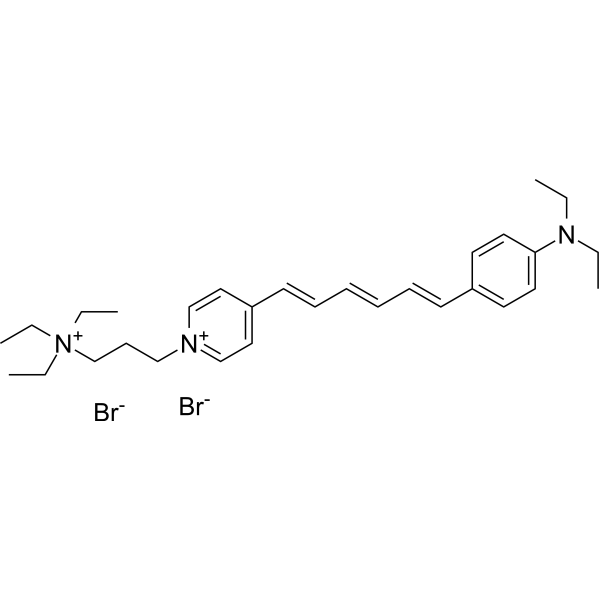
FM4-64 (solution) is a very lipophilic, water-soluble styrene dyes, can specifically bind to cell membranes and inner membrane organelles to produce fluorescence. FM4-64 is widely used in endocytic and exospic membrane structure markers.
Solvent and concentration: DMSO: 5 mM
For research use only. We do not sell to patients.
- CAS No.: 162112-35-8
- Formula: C30H45Br2N3
- Molecular Weight:607.52
-
Storage:
Please store the product under the recommended conditions in the Certificate of Analysis.


To place orders, for customer services and technical support, please contact: MedChemExpress USA
Tel: 609-228-6898 E-mail: [email protected] [email protected]


-
 Biological Activity
-
Chemical Information
- Purity & Documentation
- References
-
 Help & FAQs


-
HY-D0814
DAPI dihydrochlorideFluorescent DNA Stain -
HY-103466
FM4-64Red Fluorescent Dye -
HY-D1434
FM1-43Track Endocytosis/Exocytosis -

HY-DY1059
FM1-43 (solution)Track Endocytosis/Exocytosis -
HY-D0985A
TMREMitochondrial Membrane Potential Fluorescent Dye -

HY-DY1023
TMRE (solution)Mitochondrial Membrane Potential Fluorescent Dye -
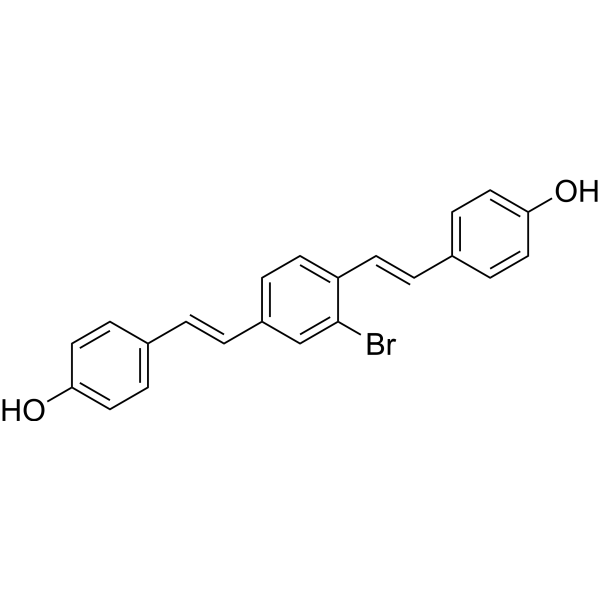
HY-103470
K114Fluorescent Dye -
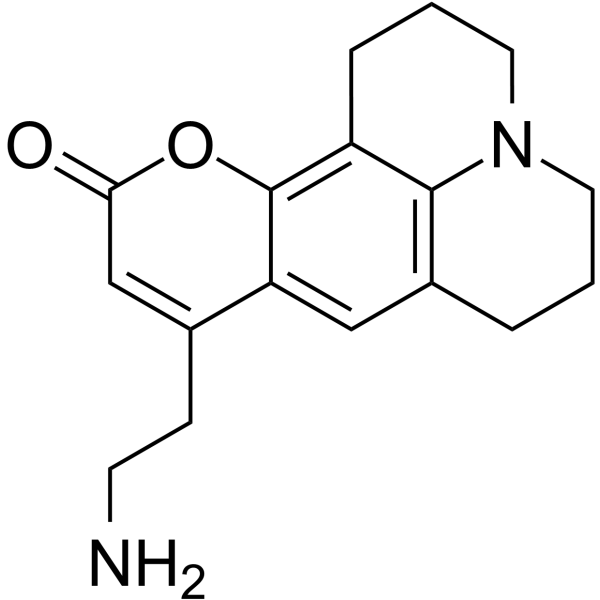
HY-103465
FFN511FFNs -

HY-103465R
FFN511 (Standard)Reference Standard -

HY-103467
NPE-caged-HPTS sodium


Biological Activity
Description
Solvent and concentration: DMSO: 5 mM
In Vitro
Guidelines (Following is our recommended protocol. This protocol only provides a guideline, and should be modified according to your specific needs).
1. Preparation of FM4-64 working solution
Dilute the stock solution in HBSS. The corresponding stock solution can be diluted according to the actual situation. Note that if the solvent is DMSO, the cytotoxicity of DMSO must be considered, and a solvent control should be prepared; if the solvent is pure water, the working solution needs to be filtered and sterilized before adding cells.
Note: Please adjust the concentration of FM working solution according to the actual situation.
2. Cell staining (Suspension cells)
2.1 Centrifuge at 1000 g at 4°C for 3-5 minutes and then discard the supernatant. Wash twice with PBS, 5 minutes each time. The cell density is 1×10⁶/mL
2.2 Add 1 mL of working solution, and then incubate at room temperature for 5-30 minutes.
2.3 Centrifuge at 400 g at 4°C for 3-4 minutes and then discard the supernatant.
2.4 Wash twice with PBS, 5 minutes each time.
2.5 Resuspend cells with serum-free cell culture medium or PBS. Observation by fluorescence microscopy or flow cytometry.
3. Cell staining (Adherent cells)
3.1 Culture adherent cells on sterile coverslips.
3.2 Remove the coverslip from the medium and aspirate excess medium.
3.3 Add 100 μL of working solution, gently shake it to completely cover the cells, and then incubate at room temperature for 5-30 minutes.
3.4 Wash twice with medium, 5 minutes each time. Observation by fluorescence microscopy or flow cytometry.
MedChemExpress (MCE) has not independently confirmed the accuracy of these methods. They are for reference only.


Chemical Information
-
CAS No. 162112-35-8
-
Appearance Liquid
-
Molecular Weight 607.52
-
Formula C30H45Br2N3
-
Color Pale purple to purple
-
SMILES
CC[N+](CCC[N+]1=CC=C(/C=C/C=C/C=C/C2=CC=C(N(CC)CC)C=C2)C=C1)(CC)CC.[Br-].[Br-]
-
Shipping
Room temperature in continental US; may vary elsewhere.
-
Storage
Please store the product under the recommended conditions in the Certificate of Analysis.


Purity & Documentation
-
Data Sheet (268 KB)
-
SDS (251 KB)
- English - EN (251 KB)
- Français - FR (251 KB)
- Deutsch - DE (251 KB)
- Norwegian - NO (251 KB)
- Español - ES (251 KB)
- Swedish - SV (251 KB)
- Italian - IT (251 KB)
- Korean - KR (251 KB)
- Portuguese - PT (251 KB)
-
Handling Instructions (2659 KB)
References
[1]. Zal T, et al. Spectral shift of fluorescent dye FM4-64 reveals distinct microenvironment of nuclear envelope in living cells. Traffic. 2006;7(12):1607-1613. [Content Brief]
[2]. Stenovec M, et al. Distinct labelling of fusion events in rat lactotrophs by FM 1-43 and FM 4-64 is associated with conformational differences. Acta Physiol (Oxf). 2007;191(1):35-42. [Content Brief]
[3]. Bolte S, et al, Satiat-Jeunemaitre B. FM-dyes as experimental probes for dissecting vesicle trafficking in living plant cells. J Microsc. 2004;214(Pt 2):159-173. [Content Brief]
[4]. J E Gale, et al. FM1-43 dye behaves as a permeant blocker of the hair-cell mechanotransducer channel. J Neurosci. 2001 Sep 15;21(18):7013-25. [Content Brief]

Calculators
Concentration (start) × Volume (start) = Concentration (final) × Volume (final)


FM4-64 (solution) Related Classifications
HY-DY1031 Related Classifications
 Powered by Bioz