



FPI-1523
Based on 1 publication(s) in Google Scholar
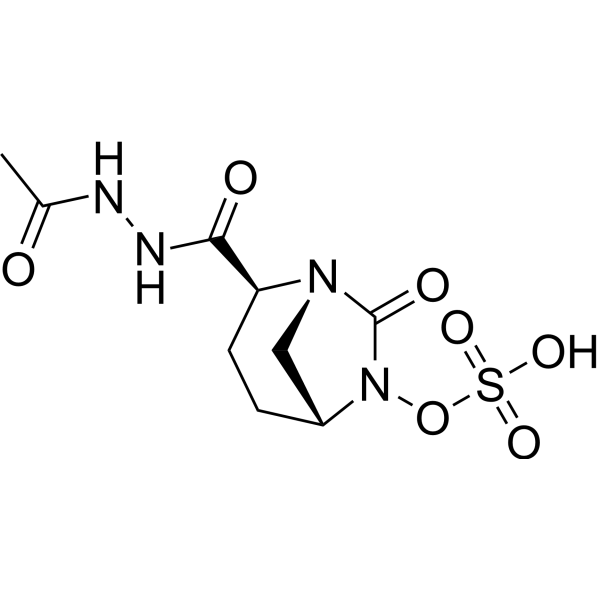
FPI-1523, a derivative of Avibactam, is a potent β-lactamase inhibitor, with Kds of 4 nM and 34 nM for CTX-M-15 and OXA-48, respectively. FPI-1523 also inhibits PBP2, with an IC50 of 3.2 μM. FPI-1523 exhibits considerable antimicrobial activity.
For research use only. We do not sell to patients.
- CAS No.: 1452459-50-5
- Formula: C9H14N4O7S
- Molecular Weight:322.30
-
Storage:
Please store the product under the recommended conditions in the Certificate of Analysis.

To place orders, for customer services and technical support, please contact: MedChemExpress USA
Tel: 609-228-6898 E-mail: [email protected] [email protected]


-
 Biological Activity
-
Chemical Information
- Protocols
- Purity & Documentation
- References
-
 Help & FAQs


Publications Citing Use of MedChemExpress (MCE) FPI-1523
MoreAll Beta-lactamase Isoforms
More

Biological Activity
Description
IC50 & Target
β-lactamase[1]
In Vitro
FPI-1523 inhibits K12 E. coli K12 and PBP2, with MIC and IC50 of 4 μg/mL and 0.4 μg/mL, respectively[1].
FPI-1523 inhibit E. coli BW25113 pGDP-2 transformants either with an empty vector or expressing different β-lactamases, with low MICs (1-2 μM)[1].
MedChemExpress (MCE) has not independently confirmed the accuracy of these methods. They are for reference only.


Chemical Information
-
CAS No. 1452459-50-5
-
Molecular Weight 322.30
-
Formula C9H14N4O7S
-
SMILES
CC(NNC([C@H]1[N@@]2C(N([C@H](CC1)C2)OS(=O)(O)=O)=O)=O)=O
-
Shipping
Room temperature in continental US; may vary elsewhere.
-
Storage
Please store the product under the recommended conditions in the Certificate of Analysis.


Publications (1)
-
Journal Impact Factor
-
Most Recent


Purity & Documentation
References

Calculators
Concentration (start) × Volume (start) = Concentration (final) × Volume (final)


FPI-1523 Related Classifications
HY-139745A Related Classifications
 Powered by Bioz