



Levocabastine
Based on 1 publication(s) in Google Scholar
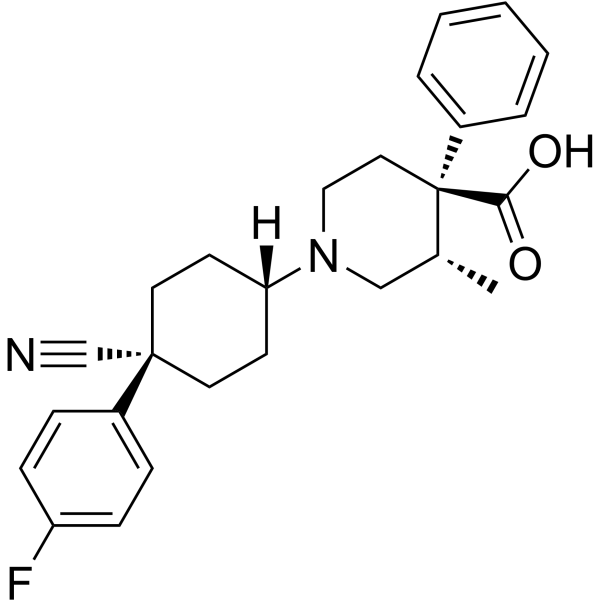
Levocabastine (R 50547) is a potent and selective histamine H1-receptor antagonist. Levocabastine hydrochloride is also a selective, high affinity neurotensin receptor subtype 2 (NTR2) antagonist, with a Ki of 17 nM for mNTR2. Levocabastine can act as a VLA-4 antagonist, interferes with conjunctival eosinophil infiltration in allergic conjunctivitis (AC).
For research use only. We do not sell to patients.
- CAS No.: 79516-68-0
- Formula: C26H29FN2O2
- Molecular Weight:420.52
-
Storage:
Please store the product under the recommended conditions in the Certificate of Analysis.

To place orders, for customer services and technical support, please contact: MedChemExpress USA
Tel: 609-228-6898 E-mail: [email protected] [email protected]


-
 Biological Activity
-
Chemical Information
- Purity & Documentation
- References
-
 Help & FAQs


Publications Citing Use of MedChemExpress (MCE) Levocabastine
MoreAll Histamine Receptor Isoforms
More

Biological Activity
Description
|
H1 Receptor |
α4β1 |
NTR2 17 nM (Ki) |
Cellular Effect
|
Cell Line

|
Type | Value | Description | References |
|---|---|---|---|---|
| CHO-K1 | EC50 |
28 nM
Compound: 6
|
Agonist activity at rat NTS2 stably expressed in CHOK1 cells assessed as induction of calcium release by FLIPR assay
Agonist activity at rat NTS2 stably expressed in CHOK1 cells assessed as induction of calcium release by FLIPR assay
|
[PMID: 24856674] |
In Vitro
Levocabastine (0-1000 μM; HEK-293 cells) causes inhibition of 125I-FN binding to the SPA bead-associated α4β1 integrin in a concentration-dependent manner with an IC50 of 406.2μm[3].
Levocabastine (0-1000 μM; 30 min; Jurkat cells and EoL-1 cells) inhibits α4β1 integrin/VCAM-1-mediated cell adhesion in vitro. Levocabastine inhibits α4β1 integrindependent adhesion of Jurkat cells to VCAM-1 with an IC50 of 395.6 μM, and the adhesion of EoL-1 cells with an IC50 of 403.6 μM. Moreover, Levocabastine inhibits adhesion of human eosinophils to VCAM-1-coated wells (IC50=443.7 μM)[3].
MedChemExpress (MCE) has not independently confirmed the accuracy of these methods. They are for reference only. .
In Vivo
Levocabastine (0.05 mg/kg; i.p.; once; male C57BL/6J mice) blocks anti-stress effect ofβ-LT on mouse behavior[2].
Levocabastine (500 µg/eye; drops eye; once; ovalbumin-sensitized guinea pigs) induces allergic conjunctivitis (AC) and a significant increase of conjunctival VLA-4[3].
MedChemExpress (MCE) has not independently confirmed the accuracy of these methods. They are for reference only.
-
Animal Model:Guinea-pig with Parainfluenza-3 (PI-3) virus[1]
-
Dosage:0.25 mg/kg
-
Administration:Intraperitoneal injection; twice a day for five days
-
Result:Suppressed the influx of broncho-alveolar cells and increased in albumin content.
-
Animal Model:Male C57BL/6J mice (8-9 weeks old)[2]
-
Dosage:0.05 mg/kg; 30 mg/kg (β-LT)
-
Administration:Intraperitoneal injection; once
-
Result:Blocked the anxiolytic effect of β-LT and decreased the number of head-dips.
-
Animal Model:Ovalbumin-sensitized guinea pigs[3]
-
Dosage:500 µg/eye
-
Administration:drops eye, once
-
Result:Produced a noteworthy protection from allergic conjunctivitis (AC) and prevented the conjuctival elevation of VLA-4 as well as conjunctival eosinophil infiltration.
Clinical Trial
| NCT Number | Sponsor | Condition | Start Date |
Phase
|
|---|---|---|---|---|
| NCT01329991 | Plexxikon| | 2011-05 | PHASE1 |


Chemical Information
-
CAS No. 79516-68-0
-
Molecular Weight 420.52
-
Formula C26H29FN2O2
-
SMILES
OC([C@@]1(C2=CC=CC=C2)[C@@H](CN([C@]3([H])CC[C@](CC3)(C4=CC=C(C=C4)F)C#N)CC1)C)=O
-
Synonyms
R 50547
-
Shipping
Room temperature in continental US; may vary elsewhere.
-
Storage
Please store the product under the recommended conditions in the Certificate of Analysis.


Publications (1)
-
Journal Impact Factor
-
Most Recent


Purity & Documentation
References
[1]. Folkerts G, et, al. Virus-induced airway hyperresponsiveness in the guinea-pig: possible involvement of histamine and inflammatory cells. Br J Pharmacol. 1993 Apr;108(4):1083-93. [Content Brief]
[2]. Yamauchi R, et, al. Effect of beta-lactotensin on acute stress and fear memory. Peptides. 2006 Dec;27(12):3176-82. [Content Brief]
[3]. Qasem AR, et, al. Contribution of alpha4beta1 integrin to the antiallergic effect of levocabastine. Biochem Pharmacol. 2008 Sep 15;76(6):751-62. [Content Brief]

Calculators
Concentration (start) × Volume (start) = Concentration (final) × Volume (final)


Levocabastine Related Classifications
HY-14277 Related Classifications
 Powered by Bioz