



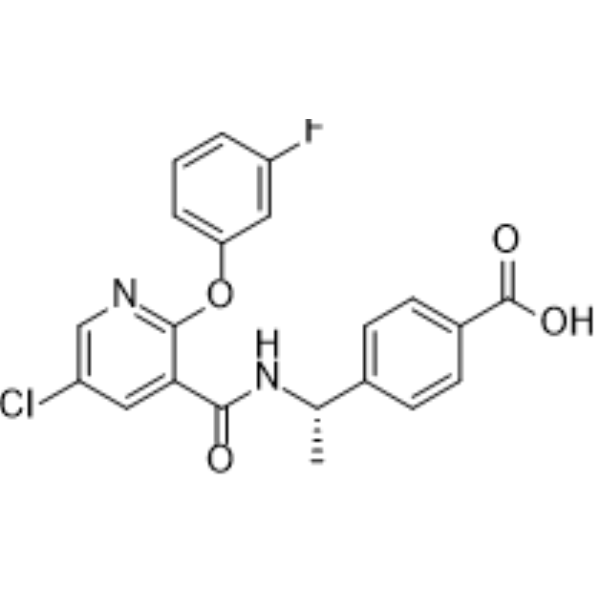
AAT-008

Based on 1 Customer Validation
AAT-008 is a potent, selective, and orally active prostaglandin EP4 receptor antagonist with Kis of 0.97 and 6.1 nM for recombinant human EP4 and recombinant rat EP4, respectively. AAT-008 exerts tumor growth delay in mice bearing CT26WT colon tumors when combined with radiotherapy. AAT-008 can be used for the study of acute and chronic inflammatory pain and cancer .
Para uso exclusivo en investigación. No vendemos a pacientes.
- Pureza : 98.03%
- No. CAS: 847727-81-5
- Fòrmula: C21H16ClFN2O4
- Peso molecular:414.81
-
Almacenamiento:Powder -20°C, 3 years , 4°C, 2 years ; In solvent -80°C, 6 months , -20°C, 1 month

To place orders, for customer services and technical support, please contact: MedChemExpress USA
Tel: 609-228-6898 E-mail: [email protected] [email protected]


-
 Actividad biológica
-
Chemical Information
-
Solvente y solubilidad
- Protocolo
- Pureza y Documentación
- Referencias
-
 Help & FAQs




Actividad biológica
Descripciòn
IC50 & Target
[1]|
EP4 0.97 nM (Ki) |
EP4 6.1 nM (IC50) |
Cellular Effect
|
Cell Line

|
Type | Value | Description | References |
|---|---|---|---|---|
| HEK293 | IC50 |
16.3 nM
Compound: 4j; AAT-008
|
Antagonist activity at human EP4 receptor expressed in HEK293 cells assessed as inhibition of PGE2-induced cAMP level by HTS assay
Antagonist activity at human EP4 receptor expressed in HEK293 cells assessed as inhibition of PGE2-induced cAMP level by HTS assay
|
[PMID: 28169162] |
| HEK293 | IC50 |
2.4 nM
Compound: 4j; AAT-008
|
Displacement of [3H]PGE from human EP4 receptor expressed in HEK293 cell membranes
Displacement of [3H]PGE from human EP4 receptor expressed in HEK293 cell membranes
|
[PMID: 28169162] |
Parmacokinetics
| Species | Dose | Route | T1/2 | AUC0-inf | CLtotal | Vdss | F | Cmax | Tmax |
|---|---|---|---|---|---|---|---|---|---|
| Dog[1] | 1 mg/kg | i.v. | 8.43 h | 7490 ng·h/mL | 2.30 mL/min/kg | 1.21 L/kg | / | / | / |
| Dog[1] | 1 mg/kg | p.o. | 7.95 h | 6080 ng·h/mL | / | / | 80.6 % | 1450 ng/mL | 0.438 h |
| Monkey[1] | 1 mg/kg | i.v. | 14.5 h | 3390 ng·h/mL | 5.31 mL/min/kg | 4.70 L/kg | / | / | / |
| Monkey[1] | 1 mg/kg | p.o. | 21.9 h | 2460 ng·h/mL | / | / | 73.3 % | 76.0 ng/mL | 8 h |
| Rat[1] | 1 mg/kg | i.v. | 4.59 h | 9620 ng·h/mL | 1.75 mL/min/kg | 0.593 L/kg | / | / | / |
| Rat[1] | 1 mg/kg | p.o. | 3.71 h | 7090 ng·h/mL | / | / | 73.6 % | 994 ng/mL | 0.750 h |
In Vivo
AAT-008 (3-30 mg/kg, p.o., once or twice daily, up to 18 days) exerts tumor growth delay in Balb/c mice bearing CT26WT colon tumors alone or combined with radiotherapy[2].
MedChemExpress (MCE) has not independently confirmed the accuracy of these methods. They are for reference only.
-
Animal Model:CT26WT cells (5 × 10⁵) were subcutaneously injected into the right hind legs of 7-week-old female Balb/c mice[2]
-
Dosage:3, 10, 30 mg/kg
-
Administration:p.o., once or twice daily, up to 18 days
-
Result:Showed minimal tumor growth delay alone.
Prolonged tumor doubling time when combined with radiotherapy (9 Gy on day 3).
Increased the mean proportion of intratumoral Teff (CD45+CD8+CD69+).


Chemical Information
-
No. CAS 847727-81-5
-
Appearance Solid
-
Peso molecular 414.81
-
Fòrmula C21H16ClFN2O4
-
Color White to off-white
-
SMILES
O=C(O)C1=CC=C([C@@H](NC(C2=CC(Cl)=CN=C2OC3=CC=CC(F)=C3)=O)C)C=C1
-
Envío
Room temperature in continental US; may vary elsewhere.
-
Almacenamiento
Powder -20°C 3 years 4°C 2 years In solvent -80°C 6 months -20°C 1 month


Solvente y solubilidad
In Vitro:
DMSO : 100 mg/mL (241.07 mM; Need ultrasonic; Hygroscopic DMSO has a significant impact on the solubility of product, please use newly opened DMSO)
Please refer to the solubility information to select the appropriate solvent. Once prepared, please aliquot and store the solution to prevent product inactivation from repeated freeze-thaw cycles.
Storage method and period of stock solution: -80°C, 6 months; -20°C, 1 month. When stored at -80°C, please use it within 6 months. When stored at -20°C, please use it within 1 month.
Please refer to the solubility information to select the appropriate solvent. Once prepared, please aliquot and store the solution to prevent product inactivation from repeated freeze-thaw cycles.
Storage method and period of stock solution: -80°C, 6 months; -20°C, 1 month. When stored at -80°C, please use it within 6 months. When stored at -20°C, please use it within 1 month.
Concentration (start) × Volume (start) = Concentration (final) × Volume (final)

Protocolo
-
Patient-Derived Xenograft (PDX)
Patient-derived xenograft (PDX) models are generated by engrafting primary human tumor tissue directly into immunodeficient mice, allowing in vivo propagation of patient tumor biology without initial in vitro adaptation. These models are used to preserve key histopathological and molecular characteristics of the original tumor and enable assessment of tumor growth dynamics and therapeutic response in a living organism. The biological readout is tumor engraftment and subsequent growth in the murine host, which reflects the ability of human tumor cells to survive, vascularize, and expand in an immunocompromised microenvironment.
-
Patient-Derived Orthotopic Xenograft (PDOX)
Patient-derived orthotopic xenograft (PDOX) modeling implants fresh patient tumor tissue or patient-derived tumor cells into the anatomically corresponding organ or tissue site of immunodeficient mice, usually by surgical orthotopic implantation, to preserve patient tumor histology, local microenvironmental context, invasion, metastatic behavior, and treatment-response features better than subcutaneous implantation. PDOX readouts include tumor engraftment, orthotopic tumor growth, local invasion, metastasis, recurrence after resection, histologic similarity to the donor tumor, biomarker retention, molecular concordance, survival, and response or resistance to therapy. PDOX models are used for preclinical drug testing and individualized therapy evaluation, but engraftment success varies by tumor type and specimen quality.
-
Formalin-Induced Paw Inflammation/Nociceptive Inflammation
The formalin-induced paw inflammation/nociceptive test is a chemical persistent pain model in rodents in which subcutaneous injection of formalin into the hind paw produces spontaneous nocifensive behaviors such as flinching and licking. The response is classically biphasic, consisting of an early acute phase (Phase I) reflecting direct activation of peripheral nociceptors (particularly C-fiber afferents), followed by a later prolonged phase (Phase II) associated with central sensitization in the spinal dorsal horn driven by sustained afferent input and inflammatory signaling. This model is widely used to evaluate analgesic and anti-inflammatory interventions because it captures both peripheral nociception and central sensitization processes within a single assay system.
-
Subcutaneous Cell-Line-Derived Xenograft
Subcutaneous cell-line-derived xenograft (CDX) models are established by implanting cultured human cancer cell lines into immunodeficient mice, where the injected cells form localized tumors that can be monitored in vivo as a measure of tumorigenic potential, growth kinetics, and treatment response. These models are widely used in oncology research because they allow reproducible tumor formation and enable comparative assessment of tumor growth between different cell lines or genetic manipulations in a controlled in vivo microenvironment. Subcutaneous implantation of cancer cells in immunodeficient mice is a standard approach for evaluating tumor growth behavior and therapeutic response across multiple cancer types, including prostate, esophageal, pancreatic, and colon cancer models.
-
Orthotopic Cell-Line Xenograft
Orthotopic cell-line xenograft models involve implantation of human cancer cell lines into the anatomically corresponding organ of immunodeficient mice to reproduce tumor growth within a native microenvironment, enabling more clinically relevant tumor behavior compared with subcutaneous models. These models are widely used because orthotopic placement better recapitulates tumor progression, including invasion and metastatic spread, which are often underrepresented in heterotopic implantation systems. Compared with conventional xenografts, orthotopic implantation is described as more technically complex but provides improved simulation of tumor-microenvironment interactions and metastatic behavior, making it particularly valuable for translational oncology research. Surgical orthotopic implantation approaches have been emphasized as enabling faithful reproduction of clinical cancer features, including metastasis and disease progression patterns that align with the tumor’s organ of origi


Pureza y Documentación
-
Ficha de datos (274 KB)
-
SDS (251 KB)
- English - EN (251 KB)
- Français - FR (251 KB)
- Deutsch - DE (251 KB)
- Norwegian - NO (251 KB)
- Español - ES (251 KB)
- Swedish - SV (251 KB)
- Italian - IT (251 KB)
- Korean - KR (251 KB)
- Portuguese - PT (251 KB)
-
Instrucciones de manejo (2659 KB)
Referencias
[1]. Okumura Y, et al. Discovery of AAT-008, a novel, potent, and selective prostaglandin EP4 receptor antagonist. Bioorg Med Chem Lett. 2017;27(5):1186-1192. [Content Brief]
[2]. Manabe Y, et al. Biological effects of prostaglandin E2-EP4 antagonist (AAT-008) in murine colon cancer in vivo: enhancement of immune response to radiotherapy and potential as a radiosensitizer. Transl Cancer Res. 2023 Feb 28;12(2):351-358. [Content Brief]


Complete Stock Solution Preparation Table
Please refer to the solubility information to select the appropriate solvent. Once prepared, please aliquot and store the solution to prevent product inactivation from repeated freeze-thaw cycles.
Storage method and period of stock solution: -80°C, 6 months; -20°C, 1 month. When stored at -80°C, please use it within 6 months. When stored at -20°C, please use it within 1 month.
| Optional Solvent | Concentration Solvent Mass | 1 mg | 5 mg | 10 mg | 25 mg |
|---|---|---|---|---|---|
| DMSO | 1 mM | 2.4107 mL | 12.0537 mL | 24.1074 mL | 60.2686 mL |
| 5 mM | 0.4821 mL | 2.4107 mL | 4.8215 mL | 12.0537 mL | |
| 10 mM | 0.2411 mL | 1.2054 mL | 2.4107 mL | 6.0269 mL | |
| 15 mM | 0.1607 mL | 0.8036 mL | 1.6072 mL | 4.0179 mL | |
| 20 mM | 0.1205 mL | 0.6027 mL | 1.2054 mL | 3.0134 mL | |
| 25 mM | 0.0964 mL | 0.4821 mL | 0.9643 mL | 2.4107 mL | |
| 30 mM | 0.0804 mL | 0.4018 mL | 0.8036 mL | 2.0090 mL | |
| 40 mM | 0.0603 mL | 0.3013 mL | 0.6027 mL | 1.5067 mL | |
| 50 mM | 0.0482 mL | 0.2411 mL | 0.4821 mL | 1.2054 mL | |
| 60 mM | 0.0402 mL | 0.2009 mL | 0.4018 mL | 1.0045 mL | |
| 80 mM | 0.0301 mL | 0.1507 mL | 0.3013 mL | 0.7534 mL | |
| 100 mM | 0.0241 mL | 0.1205 mL | 0.2411 mL | 0.6027 mL |


AAT-008 Related Classifications
HY-122168 Related Classifications
 Powered by Bioz