



Anticancer agent 42
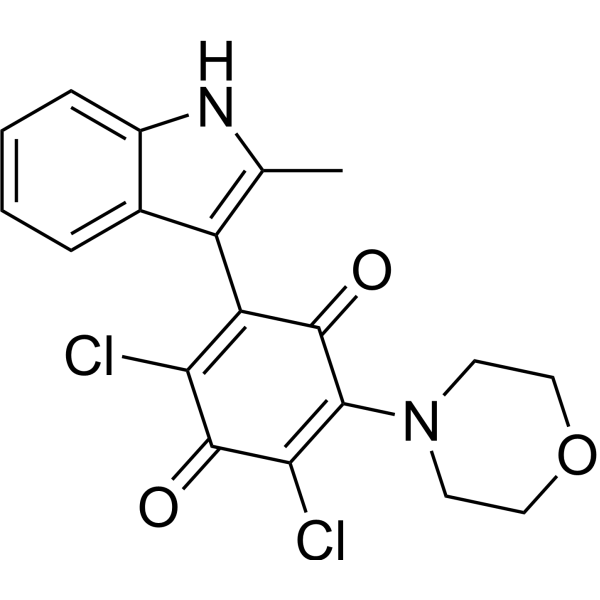
Anticancer agent 42 (compound 10d) is an orally active anticancer agent, and shows a potent antitumor activity against MDA-MB-231 cell with an IC50 of 0.07 μM. Anticancer agent 42 can exert its anticancer activity by activating apoptotic pathway and p53 expression. Anticancer agent 42 can be used to study metastatic breast cancer.
Para uso exclusivo en investigación. No vendemos a pacientes.
- No. CAS: 2687265-18-3
- Fòrmula: C19H16Cl2N2O3
- Peso molecular:391.25
-
Almacenamiento:
Please store the product under the recommended conditions in the Certificate of Analysis.

To place orders, for customer services and technical support, please contact: MedChemExpress USA
Tel: 609-228-6898 E-mail: [email protected] [email protected]


-
 Actividad biológica
-
Chemical Information
- Protocolo
- Pureza y Documentación
- Referencias
-
 Help & FAQs




Actividad biológica
Descripciòn
IC50 & Target
IC50: 0.07 μM (Anticancer in MDA-MB-231 cell)[1]
Cellular Effect
|
Cell Line

|
Type | Value | Description | References |
|---|---|---|---|---|
| A549 | IC50 |
0.21 μM
Compound: 10d
|
Antiproliferative activity against human A549 cells assessed as inhibition of cell growth by MTT assay
Antiproliferative activity against human A549 cells assessed as inhibition of cell growth by MTT assay
|
[PMID: 35477142] |
| HeLa | IC50 |
0.32 μM
Compound: 10d
|
Antiproliferative activity against human HeLa cells assessed as inhibition of cell growth by MTT assay
Antiproliferative activity against human HeLa cells assessed as inhibition of cell growth by MTT assay
|
[PMID: 35477142] |
| MDA-MB-231 | IC50 |
0.07 μM
Compound: 10d
|
Antiproliferative activity against human MDA-MB-231 cells assessed as inhibition of cell growth by MTT assay
Antiproliferative activity against human MDA-MB-231 cells assessed as inhibition of cell growth by MTT assay
|
[PMID: 35477142] |
In Vitro
Anticancer agent 42 (compound 10d) (0-20 μM, 4 h) exhibits a potent antitumor activity against MDA-MB-231 cells[1].
Anticancer agent 42 (10 μM, 24 h) induces G2 and S phase arrest in MDA-MB-231 cells[1].
Anticancer agent 42 (10 μM, 24 h) induces cell apoptosis by regulating the expression of apoptosis related proteins in MDA-MB-231 cells[1].
Anticancer agent 42 (0-1 μM) depolarizes mitochondrial membrane and decreases the mitochondrial membrane potential leading to apoptosis[1].
Anticancer agent 42 (0-1 μM, 24 h) induces the cells to produce a large amount of ROS[1].
MedChemExpress (MCE) has not independently confirmed the accuracy of these methods. They are for reference only.
-
Cell Line:A549, MDA-MB-231, HeLa[1]
-
Concentration:0-20 μM
-
Incubation Time:4 h
-
Result:Exhibited a potent activity against MDA-MB-231 with an IC50 of 0.07 μM.
-
Cell Line:MDA-MB-231 cells[1]
-
Concentration:10 μM
-
Incubation Time:24 h
-
Result:Induced G2 and S phase arrest in MDA-MB-231 cells; caused the percentage of MDA-MB-231 cells in G1 phase to decrease significantly (from 74.44% to 16.48%), cells in G1 phase to increase (from 16.61% to 28.47%), and in G2 phase to significantly increase (from 8.95% to 55.05%).
-
Cell Line:MDA-MB-231 cells[1]
-
Concentration:10 μM
-
Incubation Time:24 h
-
Result:Induced cell apoptosis, with apoptotic rate of 31.69%.
-
Cell Line:MDA-MB-231 cells[1]
-
Concentration:100 nM
-
Incubation Time:48 h
-
Result:Increased the level of human apoptosis-related proteins (pro-caspase 3, catalase, HTRA2/Omi and p53) in MDA-MB-231 cell.
-
Cell Line:MDA-MB-231 cells[1]
-
Concentration:0, 0.035, 0.07, 0.14, 0.21 μM
-
Incubation Time:24 h
-
Result:Increased caspase 9, caspase3, cytochrome C and Bax expression, but decreased Bal-2 expression with increasing concentration.
In Vivo
Anticancer agent 42 (Kunming mice, 238-600 mg/kg, IP, once) shows no obvious liver and kidney damage to mice, with an LD50 of 374 mg/kg[1].
Anticancer agent 42 (Kunming mice, 25 mg/kg, IP, once every two days) causes mild liver and kidney damage[1].
Anticancer agent 42 (BALB/c mice, suppresses breast cancer 4T1 tumor growth, the anti-tumor effect is better combined use with CA (Cyanoacrylates), and can cross through the skin to achieve anti-tumor effects.[1].
MedChemExpress (MCE) has not independently confirmed the accuracy of these methods. They are for reference only.
-
Animal Model:Kunming mice (n=10, 5 male and 5 female)[1]
-
Dosage:5000 mg/kg
-
Administration:Intragastric administration, once
-
Result:Had extremely low oral toxicity, did not cause death in mice at 5000 mg/kg.
-
Animal Model:Kunming mice[1]
-
Dosage:600, 476, 378, 300, 238 mg/kg
-
Administration:IP, once
-
Result:Showed no obvious liver and kidney damage to mice, with an LD50 of 374 mg/kg.
-
Animal Model:Kunming mice (n=3)[1]
-
Dosage:25 mg/kg
-
Administration:IP, once every two days
-
Result:Caused mild liver and kidney damage after administration, slightly increased ALT, AST and BUN of mice.
-
Animal Model:BALB/c mice (4T1 tumor-bearing, female, eight groups, 6 mice per group)[1]
-
Dosage:10d (50 mg/kg) + CA; 10d (50 mg/kg) + saline; 10d (200 mg/kg) + CA
-
Administration:Intratumoral injection, every four days (50 mg/kg); smear, every two days (200 mg/kg), for 14 days.
-
Result:Showed obvious antitumor effect from the 8th day; had protective effects on the spleens of tumor-bearing mice; the anti-tumor effect is better when combined use with CA; can cross through the skin to achieve anti-tumor effects.


Chemical Information
-
No. CAS 2687265-18-3
-
Peso molecular 391.25
-
Fòrmula C19H16Cl2N2O3
-
SMILES
CC1=C(C2=CC=CC=C2N1)C3=C(C(C(Cl)=C(C3=O)N4CCOCC4)=O)Cl
-
Envío
Room temperature in continental US; may vary elsewhere.
-
Almacenamiento
Please store the product under the recommended conditions in the Certificate of Analysis.


Pureza y Documentación
Referencias

Calculators
Concentration (start) × Volume (start) = Concentration (final) × Volume (final)


Anticancer agent 42 Related Classifications
HY-146516 Related Classifications
 Powered by Bioz