



Germicidin B
Germicidin B is an antibiotic with bactericidal activity. Germicidin B inhibits hexokinase II with an IC50 of 25.16 μM. Germicidin B suppresses spore germination in Streptomyces. Germicidin B is applicable to studies on bacterial infections.
For research use only. We do not sell to patients.
- CAS No.: 150973-78-7
- Formula: C10H14O3
- Molecular Weight:182.22
-
Storage:
Please store the product under the recommended conditions in the Certificate of Analysis.


To place orders, for customer services and technical support, please contact: MedChemExpress USA
Tel: 609-228-6898 E-mail: [email protected] [email protected]


-
 Biological Activity
-
Chemical Information
- Protocols
- Purity & Documentation
- References
-
 Help & FAQs


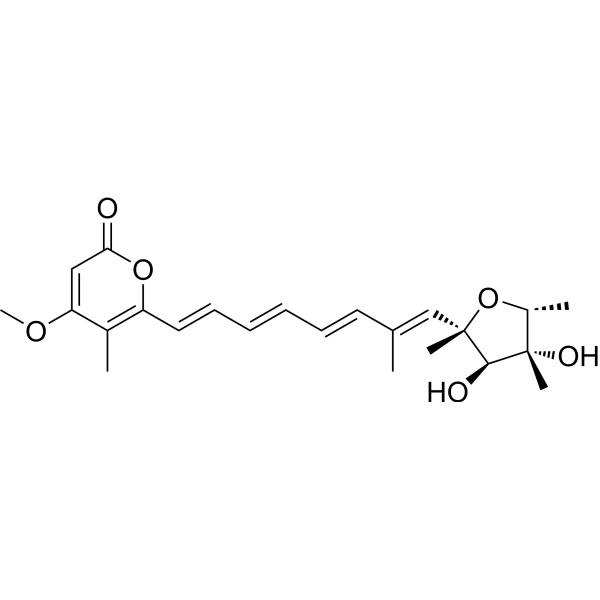
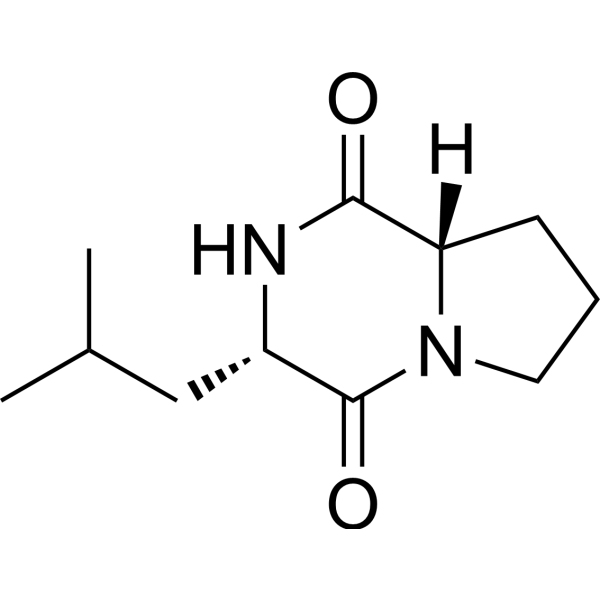
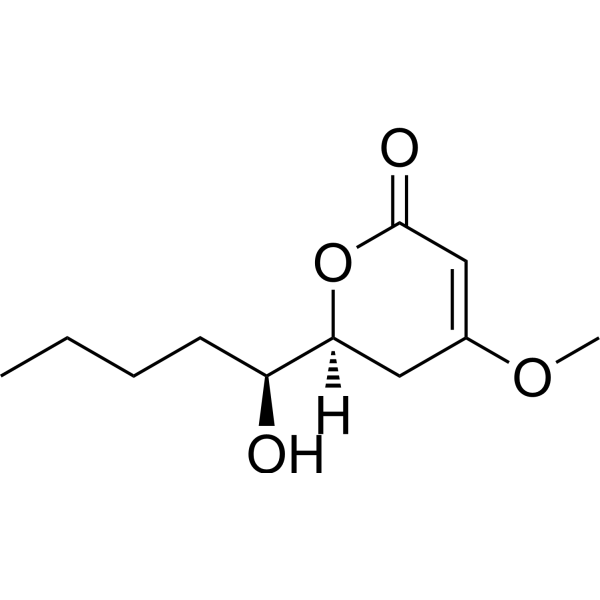

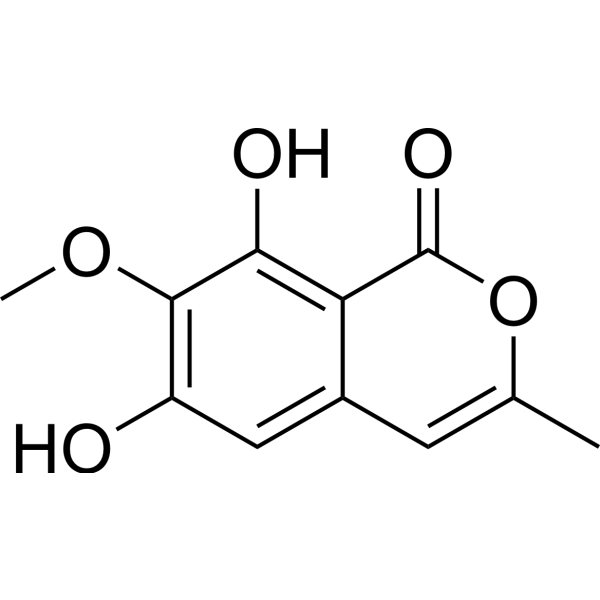
All Antibiotic Isoforms
More

Biological Activity
Description
IC50 & Target
|
hexokinase II 25.16 μM (IC50) |
In Vitro
Germicidin B (37 °C, 10 min) significantly inhibits the activity of purified hexokinase II, with an IC50 of 7.11 μM[1].
Germicidin B (0.01-1000 μg/mL) inhibits spore germination of Streptomyces [3].
MedChemExpress (MCE) has not independently confirmed the accuracy of these methods. They are for reference only. Further protocols information, click here.


Chemical Information
-
CAS No. 150973-78-7
-
Molecular Weight 182.22
-
Formula C10H14O3
-
SMILES
O=C1OC(C(C)C)=CC(O)=C1CC
-
Structure Classification
-
Initial Source
Streptomyces Viridochromogenes
-
Shipping
Room temperature in continental US; may vary elsewhere.
-
Storage
Please store the product under the recommended conditions in the Certificate of Analysis.

Protocols
-
Cell Cytotoxicity Assay
Cytotoxicity assays are usually based on the assessment of cell membrane damage, which can also be indirectly detected by measuring cell viability. Detection methods include MTT assay, CKK-8 assay, LDH assay and ATP assay, etc.
-
Bacterial live/dead nucleic-acid viability staining
The LIVE/DEAD bacterial viability staining method is based on differential permeability of nucleic-acid-binding fluorescent dyes, most commonly SYTO 9 and propidium iodide (PI), which enables discrimination of bacterial populations with intact versus compromised cytoplasmic membranes. SYTO 9 penetrates both intact and damaged bacterial membranes and binds nucleic acids to produce green fluorescence, whereas propidium iodide penetrates only cells with compromised membranes and fluoresces red while also reducing SYTO 9 signal through competitive binding and fluorescence interactions. The resulting fluorescence pattern is interpreted as a proxy for membrane integrity, which is widely used as an indicator of bacterial viability in microscopy, flow cytometry, and spectroscopic platforms. However, mechanistic studies show that SYTO 9 and PI interactions involve displacement and fluorescence resonance energy transfer effects, which can influence signal interpretation depending on dye ratios a


Purity & Documentation
-
Data Sheet (270 KB)
-
SDS (252 KB)
- Français - FR (252 KB)
- Deutsch - DE (252 KB)
- Norwegian - NO (252 KB)
- Español - ES (252 KB)
- Swedish - SV (252 KB)
- Italian - IT (252 KB)
- Korean - KR (252 KB)
- Portuguese - PT (252 KB)
-
Handling Instructions (2659 KB)
References
[1]. Aoki Y, Matsumoto D, Kawaide H, Natsume M. Physiological role of germicidins in spore germination and hyphal elongation in Streptomyces coelicolor A3(2). J Antibiot (Tokyo). 2011 Sep;64(9):607-11. [Content Brief]
[2]. Zhang XM, et al. Hexokinase II Inhibitory Effect of Secondary Metabolites Derived from a Streptomyces sp. Associated with Mud Dauber Wasp. Chem Biodivers. 2020;17(7):e2000140. [Content Brief]
[3]. Song L, et al. Type III polyketide synthase beta-ketoacyl-ACP starter unit and ethylmalonyl-CoA extender unit selectivity discovered by Streptomyces coelicolor genome mining. J Am Chem Soc. 2006;128(46):14754-14755. [Content Brief]

Calculators
Concentration (start) × Volume (start) = Concentration (final) × Volume (final)


Germicidin B Related Classifications
HY-111331 Related Classifications
 Powered by Bioz