



Givastomig

Based on 1 Customer Validation
Givastomig (ABL111, TJ033721) is a bispecific antibody (BsAb) inhibitor. Givastomig can specifically binds to Claudin18.2 (CLDN 18.2) on the surface of cancer cells and 4-1BB (CD137, TNFRSF9) on the surface of activated T cells and natural killer (NK) cells. Givastomig is engineered to contain a single Fc-domain mutation (asparagine to alanine) to eliminate Fc-effector function. Givastomig-bound cell lines expressing a range of CLDN18.2 levels with high affinity and induced 4-1BB activation only in the context of CLDN18.2 binding. Givastomig can be used for the study of colon carcinoma.
연구목적의 판매만을 진행합니다. 환자를 대상으로 한 판매는 하지 않습니다.
- Purity : 98.56%
- CAS No.: 2762499-30-7
- 분자량:201.929 kDa
-
보관:
Please store the product under the recommended conditions in the Certificate of Analysis.


To place orders, for customer services and technical support, please contact: MedChemExpress USA
Tel: 609-228-6898 E-mail: [email protected] [email protected]


-
 Biological Activity
-
Chemical Information
- Protocol
- 순도&문서
- References
-
 Help & FAQs




Biological Activity
제품 설명
Isotype
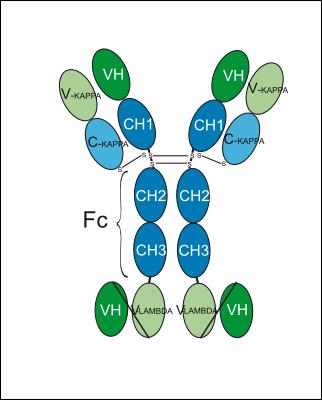
IgG1-kappa-[scFv-lambda-heavy]2
Recommend Isotype Controls
Species Reactivity
Human
IC50 & Target
TNFRSF9 & CLDN18
In Vitro
Givastomig binds to human CLDN18.2 VLP and human 4-1BB protein with high affinity, achieving an equilibrium dissociation constant (KD = 1.698 × 10⁻¹⁰/9.88 × 10-9 M)[1].
Givastomig (0.001-1000 nM, 1 h) specifically binds to CLDN18.2 (EC50 = 0.13 nM) and does not cross-react with its isoform CLDN18.1 expressed in normal lung tissue[1].
Givastomig (0.001-1000 nM, 30 min) shows a stronger binding affinity to all the tested CHO-K1-hCLDN18.2 expressing high, medium and even low level of CLDN18.2 than the control monoclonal antibody[1].
Givastomig (6 h) is co-cultured with NF-κB/4-1BB reporter Jurkat cell lines, which induces strong NF-κB signaling activation, while when co-cultured with CLDN18.2+ cells, it does not activate NF-κB signaling[1].
MedChemExpress (MCE) has not independently confirmed the accuracy of these methods. They are for reference only. Further protocols information, click here.
In Vivo
Givastomig (0.4-10 mg/kg, i.v., once a week, for a total of three cycles) shows that the anti-tumor activity in colon carcinoma mouse models is dose-dependent[1].
Givastomig (10-100 mg/kg, i.v., once a week, for 5 times) demonstrates excellent safety in cynomolgus monkeys[1].
MedChemExpress (MCE) has not independently confirmed the accuracy of these methods. They are for reference only.
-
Animal Model:Female C57BL/6-Tnfrsf9tm1 (TNFRSF9) (humanized h4-1BB) mice at the age of 6-8 weeks were subcutaneously inoculated with human CLDN18.2 expressing MC38 (MC38hCLDN18.2) colon carcinoma tumor cells (5×10⁵ cells)[1].
-
Dosage:4 mg/kg
-
Administration:I.v., Biweekly
-
Result:The tumor almost completely disappeared.
Fifty-four days after the initial tumor inoculation, cured mice were challenged again with MC38hCLDN18.2 tumor cells. All cured mice developed resistance to the new tumor challenge, while untreated juvenile mice developed tumors.
The tumor infiltration of CD45+ leukocytes and CD8+ T cells was significantly increased, and the CD8+/Treg (regulatory T cell) ratio was improved.
-
Animal Model:Female C57BL/6-Tnfrsf9tm1 (TNFRSF9) (humanized h4-1BB) mice at the age of 6-8 weeks were subcutaneously inoculated with human CLDN18.2 expressing MC38 (MC38hCLDN18.2) colon carcinoma tumor cells (5×10⁵ cells)[1].
-
Dosage:0.4 mg/kg, 1 mg/kg, 2 mg/kg, 5 mg/kg, 10 mg/kg
-
Administration:I.v., once a week, for a total of three cycles
-
Result:The antitumor activity is dose-dependent. Low doses (0.4, 1 mg/kg) produce partial efficacy, while high doses (5, 10 mg/kg) achieve complete tumor regression.
The increase in intratumoral CD45+ leukocytes and CD8+ T cells is positively correlated with the administered dose.
-
Animal Model:Cynomolgus monkeys (Macaca fascicularis)[1].
-
Dosage:10 mg/kg, 30 mg/kg, 100 mg/kg
-
Administration:I.v., once a week, for 5 times
-
Result:The drug was well tolerated at doses up to 100 mg/kg, with no observed adverse event level (NOAEL).
No drug-related hepatotoxicity was observed.
Peripheral blood immune cell typing and cytokine testing showed no signs of systemic immune activation.
Monitoring of body weight, food consumption, clinical symptoms, electrocardiogram, hematology, and coagulation function revealed no drug-induced abnormalities.
Clinical Trial
| NCT Number | Sponsor | Condition | Start Date |
Phase

|
|---|---|---|---|---|
| NCT01329991 | Plexxikon| | 2011-05 | PHASE1 |
Gene ID
Accession
Conjugated
Unconjugated
Reconsititution
The product can be reconstituted/diluted with sterile PBS or saline.
Format
-
IgG1-kappa-[scFv]2-lambda-heavy
신청
ELISA, FACS, Functional assay
Verified Bioactivity
-
 Immobilized 4-1BB/TNFRSF9 Protein, Human (HY-P7125) can bind Givastomig. The EC50 for this effect is 1.795 ng/mL.
 -
 Immobilized Claudin-18/CLDN18.2 Protein-VLP, Human (HEK293, HY-P78368) can bind Givastomig. The EC50 for this effect is 1.744 ng/mL.


Chemical Information
-
CAS No. 2762499-30-7
-
Appearance Liquid
-
분자량 201.929 kDa
-
Color Colorless to light yellow
-
Synonyms
TJ-CD4B; ABL111; TJ033721
-
선적
Shipping with dry ice.
-
Formulation
Please refer to the lot-specific COA for specific buffer information.
-
보관
Please store the product under the recommended conditions in the Certificate of Analysis.

Protocol
-
Genotoxicity/Mutagenicity Study
The bacterial reverse mutation assay detects point mutations that restore amino-acid prototrophy in auxotrophic Salmonella typhimurium or Escherichia coli tester strains; after exposure to a test article, mutagenic activity is read out as an increased number of revertant colonies on minimal agar compared with the vehicle control. The assay uses tester strains with different mutation targets so that base-substitution and frameshift mutagens can be detected, and testing is performed with and without exogenous mammalian metabolic activation because some chemicals require biotransformation to become mutagenic.


순도&문서
-
Data Sheet (263 KB)
-
SDS (394 KB)
- English - EN (394 KB)
- Français - FR (394 KB)
- Deutsch - DE (394 KB)
- Norwegian - NO (394 KB)
- Español - ES (394 KB)
- Swedish - SV (394 KB)
- Italian - IT (394 KB)
- Korean - KR (394 KB)
- Portuguese - PT (394 KB)
-
Inhibitory Antibodies User Guide (603 KB)
References
[1]. Gao J, et al. CLDN18.2 and 4-1BB bispecific antibody givastomig exerts antitumor activity through CLDN18.2-expressing tumor-directed T-cell activation. J Immunother Cancer. 2023 Jun;11(6):e006704. [Content Brief]
[2]. Ku G, et al. A First-in-Human Study of Givastomig, a CLDN18.2 and 4-1BB Bispecific Antibody, as Monotherapy in Patients with CLDN18.2-Positive Advanced or Metastatic Solid Tumors. Clin Cancer Res. 2025 Jun 30:10.1158/1078-0432.CCR-24-4280. [Content Brief]

Calculators
Concentration (start) × Volume (start) = Concentration (final) × Volume (final)


Givastomig Related Classifications
HY-P990742 Related Classifications
 Powered by Bioz