



Selicrelumab

Based on 1 Customer Validation
Selicrelumab is an agonist CD40 antibody, induces changes in the tumor microenvironment. Selicrelumab can be used for the research of pancreatic cance and neoadjuvant study.
商品は「研究用試薬」です。人や動物の医療用・臨床診断用・食品用の製品ではありません。
研究用途以外に使用した場合、当社は一切の責任を負いかねます。
- 純度 : 99.29%
- CAS 番号: 1622140-49-1
- 分子量:146.2 kDa
-
保管条件:
Please store the product under the recommended conditions in the Certificate of Analysis.


To place orders, for customer services and technical support, please contact: MedChemExpress USA
Tel: 609-228-6898 E-mail: [email protected] [email protected]


-
 生物活性
生物活性
-
化学情報
- プロトコル
- 純度とドキュメンテーション
- 参考文献
-
 Help & FAQs









生物活性
製品説明
Isotype
Human IgG2 kappa
Recommend Isotype Controls
Species Reactivity
Human
IC50 & Target
CD40
体外実験
Selicrelumab (10 µg/mL, 2-3 days) activates the CD40 receptor on chronic lymphocytic leukemia (CLL) cells, upregulates co-stimulatory molecules (CD86), cytokines (TNF-α) and death receptors (CD95) in primary CLL cells[2].
Selicrelumab (10 µg/mL, 2 days) promotes the expression of anti-apoptotic protein MCL-1, induces resistance to Venetoclax (HY-15531) in CLL cells[2].
Selicrelumab (10 µg/mL, 2 days) enhances the sensitivity of CLL cells to GA101 (HY-P9910)-induced cell death through a lysosome-mediated mechanism[2].
MedChemExpress (MCE) has not independently confirmed the accuracy of these methods. They are for reference only. Further protocols information, click here.
-
Cell Line:primary CLL cell
-
Concentration:10 µg/mL
-
Incubation Time:2 days
-
Result:Upregulated the expression of Mcl-1.
臨床実験
| NCT Number | Sponsor | Condition | Start Date |
Phase

|
|---|---|---|---|---|
| NCT01329991 | Plexxikon| | 2011-05 | PHASE1 |
遺伝子ID
アクセッション番号
P25942-1
Conjugated
Unconjugated
Reconsititution
The product can be reconstituted/diluted with sterile PBS or saline.
Format
-
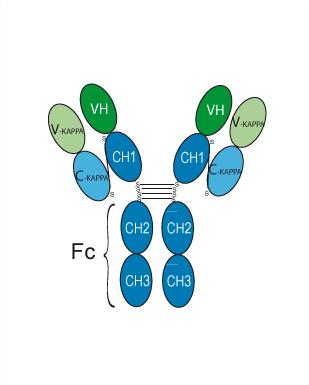
Human IgG2 kappa
アプリケーション
ELISA, FACS, Functional assay
Verified Bioactivity
-
 Flow Cytometry analysis of Raji cells labelling CD40 (red) with Selicrelumab (anti-CD40) (HY-P99046). Goat Anti-Human IgG (Alexa Fluor 488) (HY-P83776) at a dilution of 1/1000 was used as the secondary antibody. Blue-Human IgG2 kappa (HY-P99002). Black-Unlabelled control, cells without incubation with primary antibody.
 -
 Immobilized CD40 Protein, Human can bind Selicrelumab. The EC50 for this effect is 22.34 ng/mL.


化学情報
-
CAS 番号 1622140-49-1
-
性状 Liquid
-
分子量 146.2 kDa
-
Color Colorless to light yellow
-
SMILES
[Selicrelumab]
-
別名
CP-870893; RG-7876
-
輸送条件
Shipping with dry ice.
-
Formulation
Please refer to the lot-specific COA for specific buffer information.
-
保管条件
Please store the product under the recommended conditions in the Certificate of Analysis.

プロトコル
-
Multiplex immunofluorescence IHC
Multiplex immunofluorescence IHC detects multiple protein biomarkers in one tissue section by sequential antibody staining, HRP-mediated tyramide fluorophore deposition, heat-mediated antibody stripping, nuclear counterstaining, multispectral imaging, spectral unmixing, and digital cell phenotyping; TSA deposits fluorophore near the antigen so the fluorescence signal remains after primary and secondary antibodies are removed, enabling repeated staining cycles, including with antibodies from the same host species. Classic FFPE tumor immune-profiling applications use panels such as CD3, CD8, CD68/CD163, FOXP3, PD-1, PD-L1, pancytokeratin, Ki67, and DAPI to identify tumor cells, immune-cell subsets, checkpoint-marker expression, co-expression phenotypes, cell density, and spatial relationships in the tumor microenvironment.
-
Multiplex immunohistochemistry
Multiplex immunohistochemistry (mIHC), also known as tyramide dignal amplification (TSA), is an enzymatic detection method that uses horseradish peroxidase (HRP) to perform high-density in-situ labeling of target proteins or nucleic acids.
-
Research Protocol for Cancer Immunology
Cancer immunology studies how the immune system recognizes, suppresses, edits, or fails to eliminate malignant cells through tumor antigen release, antigen presentation, T-cell priming, immune trafficking, tumor-cell killing, and feedback inhibition in the tumor microenvironment. The cancer-immunity cycle links tumor antigenicity, dendritic-cell priming, CD8+ T-cell infiltration, cytotoxic function, and immune-checkpoint regulation to tumor rejection or immune escape. Immune-checkpoint pathways such as PD-1/PD-L1 and CTLA-4 suppress antitumor T-cell activity and can be therapeutically blocked, but many tumors remain resistant because of poor antigen presentation, weak T-cell infiltration, suppressive myeloid cells, regulatory T cells, and tumor-intrinsic immune-exclusion programs. Unresolved questions include which immune-cell states predict response, how tumor-intrinsic pathways exclude immune cells, how myeloid suppression limits checkpoint blockade, and which combination strategies


純度とドキュメンテーション
-
データシート (259 KB)
-
SDS (251 KB)
- English - EN (251 KB)
- Français - FR (251 KB)
- Deutsch - DE (251 KB)
- Norwegian - NO (251 KB)
- Español - ES (251 KB)
- Swedish - SV (251 KB)
- Italian - IT (251 KB)
- Korean - KR (251 KB)
- Portuguese - PT (251 KB)
-
Inhibitory Antibodies User Guide (603 KB)
参考文献
[1]. Katelyn T Byrne, Neoadjuvant Selicrelumab, an Agonist CD40 Antibody, Induces Changes in the Tumor Microenvironment in Patients with Resectable Pancreatic Cancer. Clin Cancer Res. 2021 Aug 15;27(16):4574-4586. [Content Brief]
[2]. Delgado R, et al., Co-Stimulatory versus Cell Death Aspects of Agonistic CD40 Monoclonal Antibody Selicrelumab in Chronic Lymphocytic Leukemia. Cancers (Basel). 2021 Jun 21;13(12):3084. [Content Brief]

Calculators
濃度 (開始) × 体積 (開始) = 濃度 (終了) × 体積 (終了)


Selicrelumab 関連分類
HY-P99046 関連分類
 Powered by Bioz