



Virginiamycin Complex

Based on 1 Customer Validation
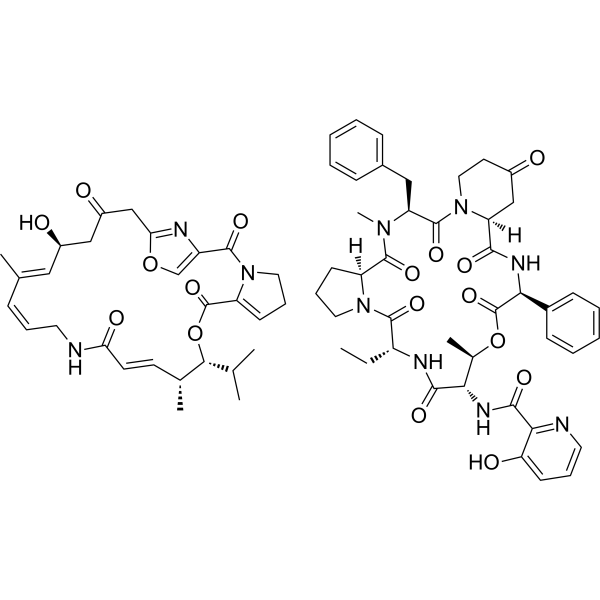
Virginiamycin Complex (Streptogramin) is an antibiotic containing two streptogramins, virginiamycin M (VM) and virginiamycin S (VS), which are produced by S. virginiae. As a complex, these two antibiotics in Virginiamycin Complex act synergistically. The action of VM is persistent and catalytic, and it can alter the affinity of ribosomes for VS. Virginiamycin Complex irreversibly inhibits protein synthesis in bacteria and has antibacterial activity.
商品は「研究用試薬」です。人や動物の医療用・臨床診断用・食品用の製品ではありません。
研究用途以外に使用した場合、当社は一切の責任を負いかねます。
- 純度 : 89.18%
- CAS 番号: 11006-76-1
- 分子式: C71H84N10O17
- 分子量:1349.48
-
保管条件:Powder -20°C, 3 years ; In solvent -80°C, 6 months , -20°C, 1 month

To place orders, for customer services and technical support, please contact: MedChemExpress USA
Tel: 609-228-6898 E-mail: [email protected] [email protected]


-
 生物活性
生物活性
-
化学情報
-
溶剤 & 溶解度
- プロトコル
- 純度とドキュメンテーション
- 参考文献
-
 Help & FAQs


-
HY-14654
AspirinCOX Inhibitor -
HY-N7452
Coumermycin A1JAK2 Signal Activator -
HY-13861
GW7647PPAR Agonist -
HY-13992
AP20187FKBP Dimerizer -
HY-126741
AzadirachtinInsecticide -
HY-106244
DOTATATEDOTA-Conjugated Peptide -
HY-117040
nor-Binaltorphimineκ-opioid receptor Antagonist -
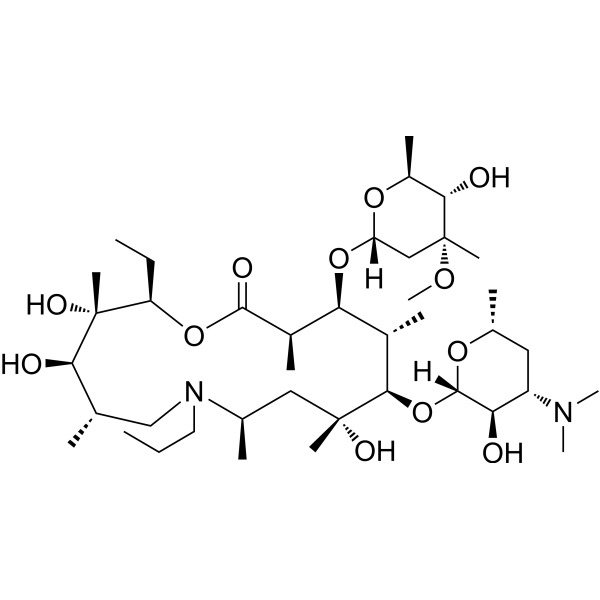
HY-108365
GamithromycinAntimicrobial Agent -
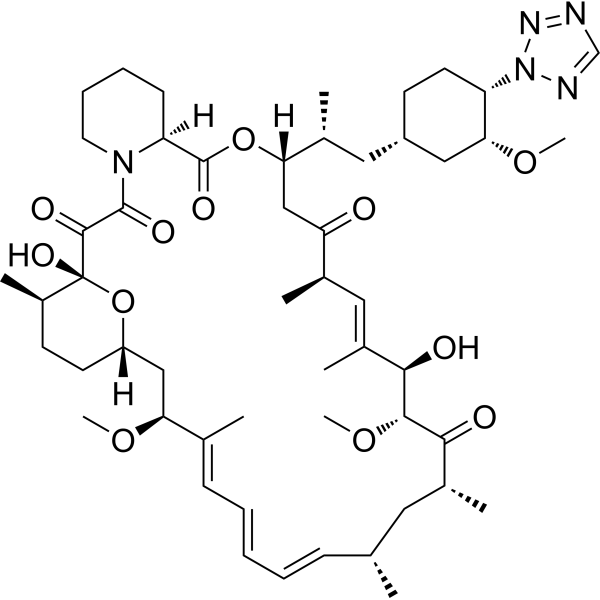
HY-12424A
42-(2-Tetrazolyl)rapamycinRapamycin Analog Prodrug -
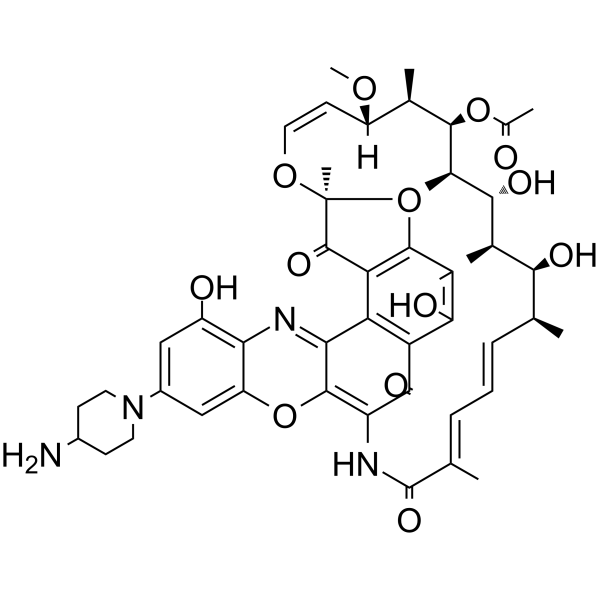
HY-128917
DNA31DNA/RNA Synthesis Inhibitor -
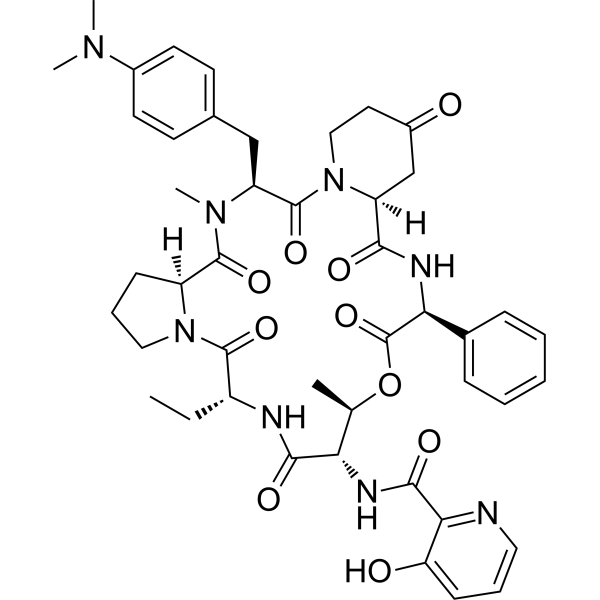
HY-A0279A
Pristinamycin IACycle-Peptidic Macrolactone -
HY-129208
ViridicatumtoxinAntibiotic
Antibiotic アイソフォーム固有の製品をすべて表示
More

生物活性
製品説明
体外実験
Virginiamycin Complex (5 μg/mL; 10 min) can inhibit the colony formation and protein synthesis of B. subtilis M1S1[1].
MedChemExpress (MCE) has not independently confirmed the accuracy of these methods. They are for reference only.


化学情報
-
CAS 番号 11006-76-1
-
性状 Solid
-
分子量 1349.48
-
分子式 C71H84N10O17
-
Color White to light yellow
-
SMILES
O=C1CCN([C@@]([H])(C1)C(N[C@H](C(O[C@@H]([C@@H](C(N[C@@H](C(N2CCC3)=O)CC)=O)NC(C4=NC=CC=C4O)=O)C)=O)C5=CC=CC=C5)=O)C([C@H](CC6=CC=CC=C6)N(C([C@@]23[H])=O)C)=O.O=C(NC/C=C\C(C)=C\[C@H](C7)O)/C=C/[C@H]([C@H](OC(C8=CCCN8C(C9=COC(CC7=O)=N9)=O)=O)C(C)C)C
-
別名
Streptogramin; Mikamycin; RP 7293
-
輸送条件
Room temperature in continental US; may vary elsewhere.
-
保管条件
Powder -20°C 3 years In solvent -80°C 6 months -20°C 1 month


溶剤 & 溶解度
体外:
DMSO : 100 mg/mL (74.10 mM; Need ultrasonic; Hygroscopic DMSO has a significant impact on the solubility of product, please use newly opened DMSO)
Please refer to the solubility information to select the appropriate solvent. Once prepared, please aliquot and store the solution to prevent product inactivation from repeated freeze-thaw cycles.
Storage method and period of stock solution: -80°C, 6 months; -20°C, 1 month. When stored at -80°C, please use it within 6 months. When stored at -20°C, please use it within 1 month.
Please refer to the solubility information to select the appropriate solvent. Once prepared, please aliquot and store the solution to prevent product inactivation from repeated freeze-thaw cycles.
Storage method and period of stock solution: -80°C, 6 months; -20°C, 1 month. When stored at -80°C, please use it within 6 months. When stored at -20°C, please use it within 1 month.
濃度 (開始) × 体積 (開始) = 濃度 (終了) × 体積 (終了)
体内:
Select the appropriate dissolution method based on your experimental animal and administration route.
- For the following dissolution methods, please ensure to first prepare a clear stock solution using an In Vitro approach and then sequentially add co-solvents:
- To ensure reliable experimental results, the clarified stock solution can be appropriately stored based on storage conditions. As for the working solution for In Vivo experiments, it is recommended to prepare freshly and use it on the same day.
- The percentages shown for the solvents indicate their volumetric ratio in the final prepared solution. If precipitation or phase separation occurs during preparation, heat and/or sonication can be used to aid dissolution.
Add each solvent one by one: 10% DMSO 40% PEG300 5% Tween-80 45% Saline
Solubility: ≥ 2.5 mg/mL (1.85 mM); Clear solution
This protocol yields a clear solution of ≥ 2.5 mg/mL (saturation unknown).
Taking 1 mL working solution as an example, add 100 μL DMSO stock solution (25.0 mg/mL) to 400 μL PEG300, and mix evenly; then add 50 μL Tween-80 and mix evenly; then add 450 μL Saline to adjust the volume to 1 mL.
Preparation of Saline: Dissolve 0.9 g sodium chloride in ddH₂O and dilute to 100 mL to obtain a clear Saline solution.
In Vivo Dissolution Calculator
Please enter the basic information of animal experiments:
-
-
-
-
Recommended: Prepare an additional quantity of animals to account for potential losses during experiments.
Please enter your animal formula composition:
-
%DMSO +
Recommended: Keep the proportion of DMSO in working solution below 2% if your animal is weak.
-
%+
-
+%Tween-80 + +
-
%Saline +
The co-solvents required include: DMSO, . All of co-solvents are available by MedChemExpress (MCE). , Tween 80. All of co-solvents are available by MedChemExpress (MCE).
Working solution concentration: 0.22 mg/mL
Method for preparing stock solution: mg drug dissolved in μL DMSO. Stock solution concentration: mg/mL.
1. Take μL DMSO stock solution;
2. Add μL .
μL , mix evenly;
3. Then add μL Tween 80, mix evenly;
4. Then add μL
Please ensure that the stock solution in the first step is dissolved to a clear state, and add co-solvents in sequence. You can use ultrasonic heating (ultrasonic cleaner, recommended frequency 20-40 kHz), vortexing, etc. to assist dissolution.


純度とドキュメンテーション
-
データシート (280 KB)
-
SDS (393 KB)
- English - EN (393 KB)
- Français - FR (393 KB)
- Deutsch - DE (393 KB)
- Norwegian - NO (393 KB)
- Español - ES (393 KB)
- Swedish - SV (393 KB)
- Italian - IT (393 KB)
- Korean - KR (393 KB)
- Portuguese - PT (393 KB)
-
取扱説明書 (2659 KB)
参考文献


Complete Stock Solution Preparation Table
Please refer to the solubility information to select the appropriate solvent. Once prepared, please aliquot and store the solution to prevent product inactivation from repeated freeze-thaw cycles.
Storage method and period of stock solution: -80°C, 6 months; -20°C, 1 month. When stored at -80°C, please use it within 6 months. When stored at -20°C, please use it within 1 month.
| Optional Solvent | Concentration Solvent Mass | 1 mg | 5 mg | 10 mg | 25 mg |
|---|---|---|---|---|---|
| DMSO | 1 mM | 0.7410 mL | 3.7051 mL | 7.4103 mL | 18.5257 mL |
| 5 mM | 0.1482 mL | 0.7410 mL | 1.4821 mL | 3.7051 mL | |
| 10 mM | 0.0741 mL | 0.3705 mL | 0.7410 mL | 1.8526 mL | |
| 15 mM | 0.0494 mL | 0.2470 mL | 0.4940 mL | 1.2350 mL | |
| 20 mM | 0.0371 mL | 0.1853 mL | 0.3705 mL | 0.9263 mL | |
| 25 mM | 0.0296 mL | 0.1482 mL | 0.2964 mL | 0.7410 mL | |
| 30 mM | 0.0247 mL | 0.1235 mL | 0.2470 mL | 0.6175 mL | |
| 40 mM | 0.0185 mL | 0.0926 mL | 0.1853 mL | 0.4631 mL | |
| 50 mM | 0.0148 mL | 0.0741 mL | 0.1482 mL | 0.3705 mL | |
| 60 mM | 0.0124 mL | 0.0618 mL | 0.1235 mL | 0.3088 mL |


Virginiamycin Complex 関連分類
HY-112665 関連分類
 Powered by Bioz