



XL01126
Based on 1 publication(s) in Google Scholar
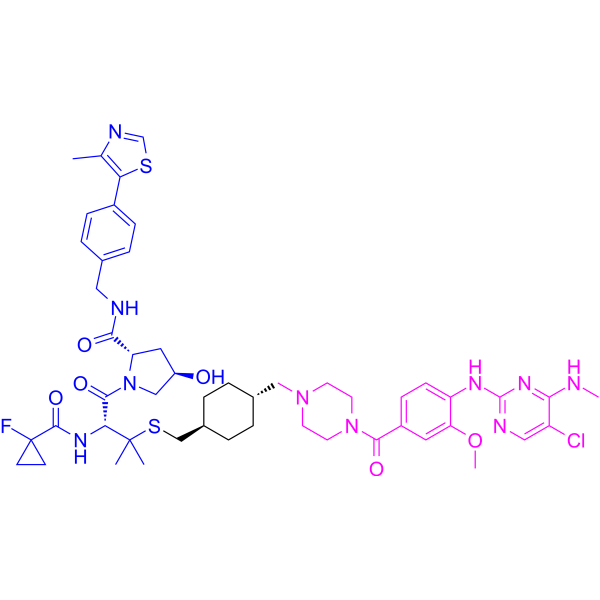
XL01126 is a blood-brain barrier-permeable, selective LRRK2 PROTAC degrader (DC50: 14 nM (G2019S LRRK2) and 32 nM (WT LRRK2)). XL01126 forms a positively cooperative ternary complex with VHL E3 ubiquitin ligase and LRRK2, mediating the polyubiquitination and proteasomal degradation of LRRK2. XL01126 induces Mitophagy. XL01126 is applicable to research related to Parkinson's disease.
(Pink: LRRK2 ligand (HY-13488); Blue: VHL ligand (HY-150802); Black: linker).
商品は「研究用試薬」です。人や動物の医療用・臨床診断用・食品用の製品ではありません。
研究用途以外に使用した場合、当社は一切の責任を負いかねます。
- 純度 : 98.90%
- CAS 番号: 3011029-58-3
- 分子式: C50H64ClFN10O6S2
- 分子量:1019.69
-
保管条件:Powder -20°C, 3 years , 4°C, 2 years ; In solvent -80°C, 6 months , -20°C, 1 month

To place orders, for customer services and technical support, please contact: MedChemExpress USA
Tel: 609-228-6898 E-mail: [email protected] [email protected]


-
 生物活性
生物活性
-
化学情報
-
溶剤 & 溶解度
- プロトコル
- 純度とドキュメンテーション
- 参考文献
-
 Help & FAQs


MedChemExpress(MCE)の使用を引用している文献 XL01126
MorePROTACs アイソフォーム固有の製品をすべて表示
More

生物活性
製品説明
IC50 & Target
[1]|
VHL |
体外実験
XL01126 (0-10000 nM; 4 h) potently degrades wild-type (WT) LRRK2 (DC50 = 32 nM, Dmax = 82%) and the LRRK2G2019S mutant (DC50 = 14 nM, Dmax = 90%) after a 4-h treatment in MEFs, while it also potently inhibits Rab10 phosphorylation (EC50 = 54 nM for WT, EC50 = 15 nM for G2019S)[1].
XL01126 (0-3000 nM; 4 h) potently degrades LRRK2 in mouse bone marrow-derived macrophages (BMDM) after 4 hours, with a DC50 of 55 nM and a Dmax of 83%[1].
XL01126 forms a positively cooperative ternary complex with VHL and LRRK2 in permeabilized HEK293 cells (α = 5.7), a property that supports its potent LRRK2 degradation activity[1].
XL01126 (10-100 nM; 24 h) induces mitophagy in immortalized Mito-QC mouse embryonic fibroblasts (MEFs) in a dose-dependent manner after 24 h of treatment at concentrations of 10, 30, and 100 nM[1].
XL01126 exhibits high stability in mouse plasma and hepatocytes[1].
XL01126 efficiently and selectively degrades LRRK2 in LRRK2R1441C mutant mouse embryonic fibroblasts, bone marrow-derived macrophages, and peripheral blood mononuclear cells, with a DC50 range of 15-72 nM, and forms a positively cooperative ternary complex with VHL and LRRK2[2].
MedChemExpress (MCE) has not independently confirmed the accuracy of these methods. They are for reference only. Further protocols information, click here.
-
Cell Line:wild-type (WT) mouse embryonic fibroblasts (MEFs), G2019S LRRK2 MEFs
-
Concentration:0-10000 nM
-
Incubation Time:4 h
-
Result:Dose-dependently degraded WT LRRK2 with a DC50 of 32 nM and a maximum degradation (Dₘₐₓ) of 82%.
Dose-dependently degraded G2019S LRRK2 with a DC50 of 14 nM and a Dₘₐₓ of 90%.
Dose-dependently inhibited Rab10 phosphorylation, with an EC50 of 54 nM in WT MEFs and 15 nM in G2019S LRRK2 MEFs.
Showed no "hook effect" at concentrations up to 10000 nM.
Parmacokinetics
| Species | Dose | Route | Tmax | Cmax | T1/2 | AUClast | AUCinf | F | CL | Vss | MRT |
|---|---|---|---|---|---|---|---|---|---|---|---|
| Mice[1] | 5 mg/kg | i.v. | / | / | 1.52 h | 23663 ng·h/mL | 23981 ng·h/mL | / | 0.208 L/h/kg | 0.511 L/kg | 2.45 h |
| Mice[1] | 30 mg/kg | i.p. | 0.25 h | 7700 ng/mL | 5.2 h | 41434 ng·h/mL | 64068 ng·h/mL | 29.2 % | / | / | / |
| Mice[1] | 30 mg/kg | p.o. | 2 h | 3620 ng/mL | 21.9 h | 21337 ng·h/mL | 109271 ng·h/mL | 15 % | / | / | / |
体内実験
MedChemExpress (MCE) has not independently confirmed the accuracy of these methods. They are for reference only.


化学情報
-
CAS 番号 3011029-58-3
-
性状 Solid
-
分子量 1019.69
-
分子式 C50H64ClFN10O6S2
-
Color White to off-white
-
SMILES
O=C([C@H]1N(C([C@@H](NC(C2(F)CC2)=O)C(C)(SC[C@@H]3CC[C@@H](CN4CCN(C(C5=CC=C(NC6=NC=C(Cl)C(NC)=N6)C(OC)=C5)=O)CC4)CC3)C)=O)C[C@H](O)C1)NCC7=CC=C(C8=C(C)N=CS8)C=C7
-
輸送条件
Room temperature in continental US; may vary elsewhere.
-
保管条件
Powder -20°C 3 years 4°C 2 years In solvent -80°C 6 months -20°C 1 month


Publications (1)
-
Journal Impact Factor
-
Most Recent


溶剤 & 溶解度
体外:
DMSO : ≥ 100 mg/mL (98.07 mM; Hygroscopic DMSO has a significant impact on the solubility of product, please use newly opened DMSO)
* "≥" means soluble, but saturation unknown.
Please refer to the solubility information to select the appropriate solvent. Once prepared, please aliquot and store the solution to prevent product inactivation from repeated freeze-thaw cycles.
Storage method and period of stock solution: -80°C, 6 months; -20°C, 1 month. When stored at -80°C, please use it within 6 months. When stored at -20°C, please use it within 1 month.
Please refer to the solubility information to select the appropriate solvent. Once prepared, please aliquot and store the solution to prevent product inactivation from repeated freeze-thaw cycles.
Storage method and period of stock solution: -80°C, 6 months; -20°C, 1 month. When stored at -80°C, please use it within 6 months. When stored at -20°C, please use it within 1 month.
濃度 (開始) × 体積 (開始) = 濃度 (終了) × 体積 (終了)

プロトコル
-
Human pluripotent stem cell midbrain dopaminergic neuron differentiation
Human pluripotent stem cells are directed toward midbrain dopaminergic neurons by first inducing a neural floor-plate-like progenitor state, then patterning cells with ventralizing SHH signaling and midbrain/WNT-FGF cues, and finally maturing progenitors into neurons expressing dopaminergic markers such as TH, NURR1/NR4A2, PITX3, DAT/SLC6A3, VMAT2/SLC18A2, GIRK2/KCNJ6, FOXA2, LMX1A, and EN1. The main readouts are loss of pluripotency, acquisition of FOXA2+/LMX1A+ midbrain floor-plate progenitors, emergence of βIII-tubulin+/MAP2+ neurons, and production of TH+ dopaminergic neurons with molecular, dopamine-release, and electrophysiological features of midbrain dopaminergic identity.
-
Mitophagy Solutions
Mitophagy is the selective autophagic degradation of mitochondria and functions as a mitochondrial quality-control pathway that removes damaged, depolarized, excess, or developmentally programmed mitochondria. The pathway links mitochondrial damage recognition, autophagosome recruitment, lysosomal delivery, and mitochondrial turnover to phenotypes such as mitochondrial homeostasis, oxidative-stress control, metabolic remodeling, differentiation, and neurodegeneration-related mitochondrial fidelity. The best-characterized damage-induced pathway is the PINK1-Parkin axis. Parkin is recruited selectively to impaired mitochondria and promotes their autophagic elimination, while mitochondrial depolarization stabilizes PINK1 on damaged mitochondria, recruits Parkin, and activates Parkin-dependent mitophagy. PINK1 also phosphorylates ubiquitin to activate Parkin E3 ubiquitin ligase activity, and PINK1-driven ubiquitin phosphorylation creates a feed-forward signal for recruiting autophagy machi


純度とドキュメンテーション
-
データシート (286 KB)
-
SDS (254 KB)
- English - EN (254 KB)
- Français - FR (254 KB)
- Deutsch - DE (254 KB)
- Norwegian - NO (254 KB)
- Español - ES (254 KB)
- Swedish - SV (254 KB)
- Italian - IT (254 KB)
- Korean - KR (254 KB)
- Portuguese - PT (254 KB)
-
取扱説明書 (2659 KB)
参考文献
[1]. Liu X, et al. Discovery of XL01126: A Potent, Fast, Cooperative, Selective, Orally Bioavailable, and Blood-Brain Barrier Penetrant PROTAC Degrader of Leucine-Rich Repeat Kinase 2. Journal of the American Chemical Society. 2022 Sep 21;144(37):16930-16952. [Content Brief]
[2]. Tang X, et al. The Development and Design Strategy of Leucine-Rich Repeat Kinase 2 Inhibitors: Promising Therapeutic Agents for Parkinson's Disease. Journal of medicinal chemistry. 2023 Feb 23;66(4):2282-2307. [Content Brief]
[3]. Li M, et al. Advancing Strategies for Proteolysis-Targeting Chimera Design. Journal of medicinal chemistry. 2023 Feb 23;66(4):2308-2329. [Content Brief]


Complete Stock Solution Preparation Table
Please refer to the solubility information to select the appropriate solvent. Once prepared, please aliquot and store the solution to prevent product inactivation from repeated freeze-thaw cycles.
Storage method and period of stock solution: -80°C, 6 months; -20°C, 1 month. When stored at -80°C, please use it within 6 months. When stored at -20°C, please use it within 1 month.
| Optional Solvent | Concentration Solvent Mass | 1 mg | 5 mg | 10 mg | 25 mg |
|---|---|---|---|---|---|
| DMSO | 1 mM | 0.9807 mL | 4.9035 mL | 9.8069 mL | 24.5173 mL |
| 5 mM | 0.1961 mL | 0.9807 mL | 1.9614 mL | 4.9035 mL | |
| 10 mM | 0.0981 mL | 0.4903 mL | 0.9807 mL | 2.4517 mL | |
| 15 mM | 0.0654 mL | 0.3269 mL | 0.6538 mL | 1.6345 mL | |
| 20 mM | 0.0490 mL | 0.2452 mL | 0.4903 mL | 1.2259 mL | |
| 25 mM | 0.0392 mL | 0.1961 mL | 0.3923 mL | 0.9807 mL | |
| 30 mM | 0.0327 mL | 0.1634 mL | 0.3269 mL | 0.8172 mL | |
| 40 mM | 0.0245 mL | 0.1226 mL | 0.2452 mL | 0.6129 mL | |
| 50 mM | 0.0196 mL | 0.0981 mL | 0.1961 mL | 0.4903 mL | |
| 60 mM | 0.0163 mL | 0.0817 mL | 0.1634 mL | 0.4086 mL | |
| 80 mM | 0.0123 mL | 0.0613 mL | 0.1226 mL | 0.3065 mL |


XL01126 関連分類
HY-148030 関連分類
 Powered by Bioz