



Eriocitrin (Standard)

Based on 1 Customer Validation
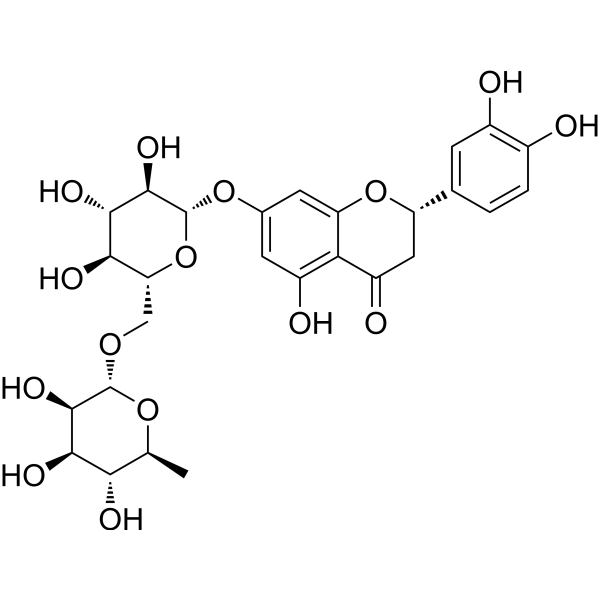
Eriocitrin (Standard) is the analytical standard of Eriocitrin. This product is intended for research and analytical applications. Eriocitrin is a flavonoid isolated from lemons that is a powerful antioxidant. Eriocitrin inhibits the proliferation of liver cancer cells by arresting the cell cycle in the S phase by upregulating p53, cyclin A, cyclin D3 and CDK6. Eriocitrin triggers apoptosis by activating intrinsic signaling pathways involving mitochondria.
연구목적의 판매만을 진행합니다. 환자를 대상으로 한 판매는 하지 않습니다.
- Purity : 99.94%
- CAS No.: 13463-28-0
- 화학식: C27H32O15
- 분자량:596.53
-
보관:
Please store the product under the recommended conditions in the Certificate of Analysis.


To place orders, for customer services and technical support, please contact: MedChemExpress USA
Tel: 609-228-6898 E-mail: [email protected] [email protected]


-
 Product Information
-
Chemical Information
- 순도&문서
-
 Help & FAQs




Product Information
Information
신청
The compound is the grade of analytical standard, which is the reference standard supplied assay. It is commonly used in qualitative, quantitative and methodological research experiments in HPLC, GC and MS.


Chemical Information
-
CAS No. 13463-28-0
-
Appearance Solid
-
분자량 596.53
-
화학식 C27H32O15
-
Color Light yellow to yellow
-
SMILES
O=C(C[C@@H](C1=CC(O)=C(O)C=C1)OC2=CC(O[C@@H]([C@@H]([C@@H](O)[C@@H]3O)O)O[C@@H]3CO[C@H](O[C@@H](C)[C@H](O)[C@H]4O)[C@@H]4O)=C5)C2=C5O
-
Synonyms
Eriodictyol 7-rutinoside (Standard); Eriodictyol 7-O-rutinoside (Standard)
-
Structure Classification
-
Initial Source
-
선적
Room temperature in continental US; may vary elsewhere.
-
보관
Please store the product under the recommended conditions in the Certificate of Analysis.


순도&문서
-
SDS (393 KB)
- English - EN (393 KB)
- Français - FR (393 KB)
- Deutsch - DE (393 KB)
- Norwegian - NO (393 KB)
- Español - ES (393 KB)
- Swedish - SV (393 KB)
- Italian - IT (393 KB)
- Korean - KR (393 KB)
- Portuguese - PT (393 KB)
-
Handling Instructions (2659 KB)
References
[1]. Wang Z, et al. Eriocitrin from lemon suppresses the proliferation of human hepatocellular carcinoma cells through inducing apoptosis and arresting cell cycle. Cancer Chemother Pharmacol. 2016 Dec;78(6):1143-1150. [Content Brief]
[2]. Xu J, et al. Eriocitrin attenuates ischemia reperfusion-induced oxidative stress and inflammation in rats with acute kidney injury by regulating the dual-specificity phosphatase 14 (DUSP14)-mediated Nrf2 and nuclear factor-κB (NF-κB) pathways. Ann Transl Med. 2021 Feb;9(4):350. [Content Brief]

Calculators
Concentration (start) × Volume (start) = Concentration (final) × Volume (final)


Eriocitrin (Standard) Related Classifications
HY-N0636R Related Classifications
 Powered by Bioz