



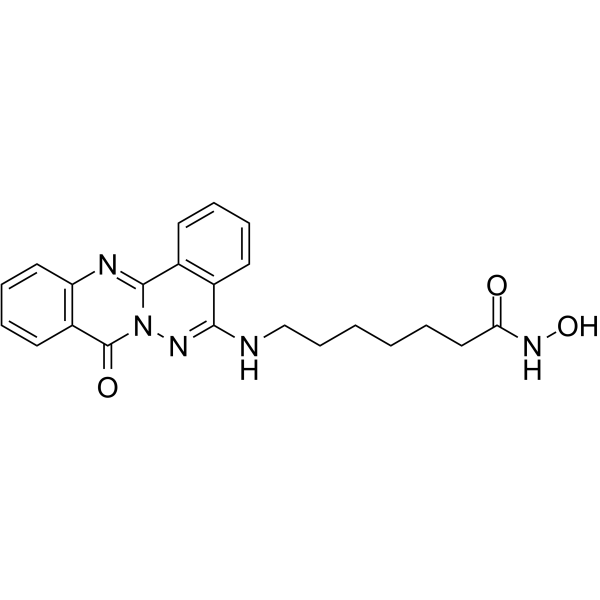
HDAC-IN-30
HDAC-IN-30 is a novel multi-target HDAC inhibitor, including HDAC1 (IC50=13.4 nM),HDAC2 (IC50=28.0 nM), HDAC3 (IC50=9.18 nM), HDAC6 (IC50=42.7 nM), HDAC8 (IC50=131 nM). HDAC-IN-30 exhibits potent antitumor efficacy.
연구목적의 판매만을 진행합니다. 환자를 대상으로 한 판매는 하지 않습니다.
- CAS No.: 2756809-34-2
- 화학식: C22H23N5O3
- 분자량:405.45
-
보관:
Please store the product under the recommended conditions in the Certificate of Analysis.

To place orders, for customer services and technical support, please contact: MedChemExpress USA
Tel: 609-228-6898 E-mail: [email protected] [email protected]


-
 Biological Activity
-
Chemical Information
- Protocol
- 순도&문서
- References
-
 Help & FAQs




Biological Activity
제품 설명
IC50 & Target
|
HDAC1 13.4 nM (IC50) |
HDAC2 28.0 nM (IC50) |
HDAC3 9.18 nM (IC50) |
HDAC6 42.7 nM (IC50) |
HDAC8 131 nM (IC50) |
Cellular Effect
|
Cell Line

|
Type | Value | Description | References |
|---|---|---|---|---|
| HCT-116 | IC50 |
0.0738 μM
Compound: 8h
|
Antiproliferative activity against human HCT-116 cells assessed as reduction in cell viability incubated for 72 hrs by MTT assay
Antiproliferative activity against human HCT-116 cells assessed as reduction in cell viability incubated for 72 hrs by MTT assay
|
[PMID: 34954595] |
| HepG2 | IC50 |
0.0822 μM
Compound: 8h
|
Antiproliferative activity against human HepG2 cells assessed as reduction in cell viability incubated for 72 hrs by MTT assay
Antiproliferative activity against human HepG2 cells assessed as reduction in cell viability incubated for 72 hrs by MTT assay
|
[PMID: 34954595] |
| HL-60 | IC50 |
0.677 μM
Compound: 8h
|
Antiproliferative activity against human HL-60 cells assessed as reduction in cell viability incubated for 72 hrs by MTT assay
Antiproliferative activity against human HL-60 cells assessed as reduction in cell viability incubated for 72 hrs by MTT assay
|
[PMID: 34954595] |
| HUVEC | IC50 |
1.91 μM
Compound: 8h
|
Antiproliferative activity against human HUVEC cells assessed as reduction in cell viability incubated for 72 hrs by MTT assay
Antiproliferative activity against human HUVEC cells assessed as reduction in cell viability incubated for 72 hrs by MTT assay
|
[PMID: 34954595] |
| K562 | IC50 |
0.719 μM
Compound: 8h
|
Antiproliferative activity against human K562 cells assessed as reduction in cell viability incubated for 72 hrs by MTT assay
Antiproliferative activity against human K562 cells assessed as reduction in cell viability incubated for 72 hrs by MTT assay
|
[PMID: 34954595] |
| L02 | IC50 |
1.96 μM
Compound: 8h
|
Antiproliferative activity against human L02 cells assessed as reduction in cell viability incubated for 72 hrs by MTT assay
Antiproliferative activity against human L02 cells assessed as reduction in cell viability incubated for 72 hrs by MTT assay
|
[PMID: 34954595] |
| MCF7 | IC50 |
0.256 μM
Compound: 8h
|
Antiproliferative activity against human MCF7 cells assessed as reduction in cell viability incubated for 72 hrs by MTT assay
Antiproliferative activity against human MCF7 cells assessed as reduction in cell viability incubated for 72 hrs by MTT assay
|
[PMID: 34954595] |
| PC-3 | IC50 |
0.921 μM
Compound: 8h
|
Antiproliferative activity against human PC-3 cells assessed as reduction in cell viability incubated for 72 hrs by MTT assay
Antiproliferative activity against human PC-3 cells assessed as reduction in cell viability incubated for 72 hrs by MTT assay
|
[PMID: 34954595] |
| RS4-11 | IC50 |
1.26 μM
Compound: 8h
|
Antiproliferative activity against human RS4-11 cells assessed as reduction in cell viability incubated for 72 hrs by MTT assay
Antiproliferative activity against human RS4-11 cells assessed as reduction in cell viability incubated for 72 hrs by MTT assay
|
[PMID: 34954595] |
In Vitro
HDAC-IN-30 (compound 8 h; 0.5, 1, 2 μM; 48 hours) can effectively activate the p53 pathway by promoting the phosphorylation of p53[1]. HDAC-IN-30 (0, 1, 2.5, 5 mM; 48 hours; HepG2 cells) induces cell cycle arrest at the G2 phase in a concentration-dependent manner[1]. HDAC-IN-30 (0, 1, 2.5, 5 mM; 48 hours) possesses prominent anticancer activity in HepG2 cells[1].
MedChemExpress (MCE) has not independently confirmed the accuracy of these methods. They are for reference only. Further protocols information, click here.
-
Cell Line:HepG2 cells
-
Concentration:0.5, 1, 2 μM
-
Incubation Time:24 hours
-
Result:Could effectively activate the p53 pathway by promoting the phosphorylation of p53
-
Cell Line:HepG2 cells
-
Concentration:0, 1, 2.5, 5 μM
-
Incubation Time:48 hours
-
Result:Cells were arrested at the G2 phase in a dose-dependent manner.
-
Cell Line:HepG2 cells
-
Concentration:0, 1, 2.5, 5 μM
-
Incubation Time:24 hours
-
Result:Possessed prominent anticancer activity in HepG2 cells.
In Vivo
MedChemExpress (MCE) has not independently confirmed the accuracy of these methods. They are for reference only.
-
Animal Model:HepG2 xenograft mouse model[1]
-
Dosage:12, 24 mg/kg
-
Administration:Intraperitoneal injection, every 2 days, 4 weeks
-
Result:Exhibited potent anticancer activity


Chemical Information
-
CAS No. 2756809-34-2
-
분자량 405.45
-
화학식 C22H23N5O3
-
선적
Room temperature in continental US; may vary elsewhere.
-
보관
Please store the product under the recommended conditions in the Certificate of Analysis.

Protocol
-
Cell Cytotoxicity Assay
Cytotoxicity assays are usually based on the assessment of cell membrane damage, which can also be indirectly detected by measuring cell viability. Detection methods include MTT assay, CKK-8 assay, LDH assay and ATP assay, etc.
-
Patient-Derived Xenograft (PDX)
Patient-derived xenograft (PDX) models are generated by engrafting primary human tumor tissue directly into immunodeficient mice, allowing in vivo propagation of patient tumor biology without initial in vitro adaptation. These models are used to preserve key histopathological and molecular characteristics of the original tumor and enable assessment of tumor growth dynamics and therapeutic response in a living organism. The biological readout is tumor engraftment and subsequent growth in the murine host, which reflects the ability of human tumor cells to survive, vascularize, and expand in an immunocompromised microenvironment.


순도&문서
References

Calculators
Concentration (start) × Volume (start) = Concentration (final) × Volume (final)


HDAC-IN-30 Related Classifications
HY-144292 Related Classifications
 Powered by Bioz