



TAS-114
Based on 3 publication(s) in Google Scholar
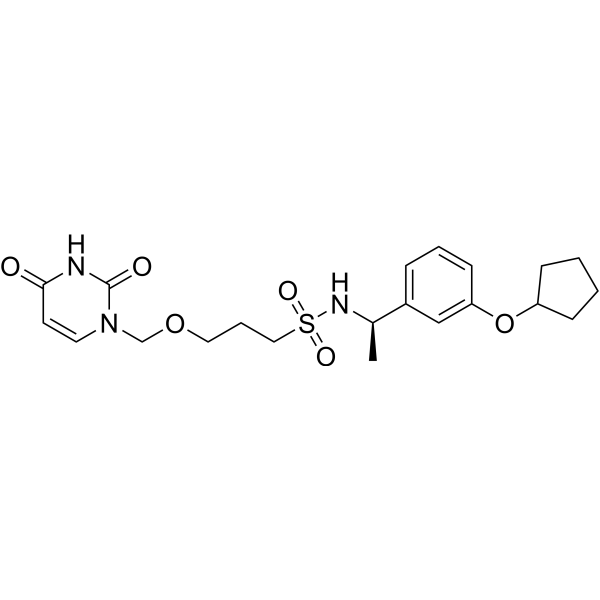
TAS-114 is an orally active dual dUTPase/dihydropyrimidine dehydrogenase (DPD) inhibitor, can improving the therapeutic efficacy of fluoropyrimidine.
연구목적의 판매만을 진행합니다. 환자를 대상으로 한 판매는 하지 않습니다.
- Purity: 99.89%
- CAS No.: 1198221-21-4
- 화학식: C21H29N3O6S
- 분자량:451.54
-
보관:
4°C, stored under nitrogen
* In solvent : -80°C, 6 months; -20°C, 1 month (stored under nitrogen)

To place orders, for customer services and technical support, please contact: MedChemExpress USA
Tel: 609-228-6898 E-mail: [email protected] [email protected]


-
 Biological Activity
-
Chemical Information
-
용액&용해도
- 순도&문서
- References
-
 Help & FAQs



Publications Citing Use of MedChemExpress (MCE) TAS-114
MoreAll DNA/RNA Synthesis Isoforms
More

Biological Activity
제품 설명
IC50 & Target
dUTPase, DPD
In Vitro
TAS-114 (1-10 μM; 72 hours) increases the cytotoxicity of 5-Fluorouracil (5-FU) and 5-FU,2′-deoxy-5-fluorouridine (FdUrd) against various cancer cell lines in dose-dependent manner[1].
MedChemExpress (MCE) has not independently confirmed the accuracy of these methods. They are for reference only.
-
Cell Line:HeLa, NUGC-4, NCI-H441, HT-29, CFPAC-1, and MCF-7 cell lines
-
Concentration:72 hours
-
Incubation Time:1 μM, 3 μM, and 10 μM
-
Result:Clearly increased the cytotoxicity of FdUrd and 5-FU against various cancer cell lines in dose-dependent manner.
In Vivo
MedChemExpress (MCE) has not independently confirmed the accuracy of these methods. They are for reference only.
-
Animal Model:BALB/c nude mice with MX-1 human breast cancer xenografts[1]
-
Dosage:37.5 to 1,200 mg/kg/day
-
Administration:Orally; daily; 1-14 days
-
Result:Decreased the tolerable doses of Capecitabine (539 mg/kg/day) in a dose-dependent manner in mice.
Clinical Trial
| NCT Number | Sponsor | Condition | Start Date |
Phase

|
|---|---|---|---|---|
| NCT01329991 | Plexxikon| | 2011-05 | PHASE1 |


Chemical Information
-
CAS No. 1198221-21-4
-
Appearance Solid
-
분자량 451.54
-
화학식 C21H29N3O6S
-
Color White to yellow
-
SMILES
O=S(CCCOCN(C(N1)=O)C=CC1=O)(N[C@@H](C2=CC=CC(OC3CCCC3)=C2)C)=O
-
선적
Room temperature in continental US; may vary elsewhere.
-
보관
4°C, stored under nitrogen
* In solvent : -80°C, 6 months; -20°C, 1 month (stored under nitrogen)


Publications (3)
-
Journal Impact Factor
-
Most Recent
-
Cell Metab
Malic enzyme 2 connects the Krebs cycle intermediate fumarate to mitochondrial biogenesis. [Abstract]2021 May 4;33(5):1027-1041.e8. PMID: 33770508 -
Mol Cell
Uracil processing by SMUG1 in the absence of UNG triggers homologous recombination and selectively kills BRCA1/2-deficient tumors. [Abstract]2025 Mar 20;85(6):1072-1084.e10. PMID: 40010343 -
Cancer Lett
Overexpression of nucleotide metabolic enzyme DUT in hepatocellular carcinoma potentiates a therapeutic opportunity through targeting its dUTPase activity. [Abstract]2022 Nov 1:548:215898. PMID: 36075487


용액&용해도
In Vitro:
DMSO : 100 mg/mL (221.46 mM; Need ultrasonic; Hygroscopic DMSO has a significant impact on the solubility of product, please use newly opened DMSO)
Please refer to the solubility information to select the appropriate solvent. Once prepared, please aliquot and store the solution to prevent product inactivation from repeated freeze-thaw cycles.
Storage method and period of stock solution: -80°C, 6 months; -20°C, 1 month (stored under nitrogen). When stored at -80°C, please use it within 6 months. When stored at -20°C, please use it within 1 month.
Please refer to the solubility information to select the appropriate solvent. Once prepared, please aliquot and store the solution to prevent product inactivation from repeated freeze-thaw cycles.
Storage method and period of stock solution: -80°C, 6 months; -20°C, 1 month (stored under nitrogen). When stored at -80°C, please use it within 6 months. When stored at -20°C, please use it within 1 month.
Concentration (start) × Volume (start) = Concentration (final) × Volume (final)
In Vivo:
Select the appropriate dissolution method based on your experimental animal and administration route.
- For the following dissolution methods, please ensure to first prepare a clear stock solution using an In Vitro approach and then sequentially add co-solvents:
- To ensure reliable experimental results, the clarified stock solution can be appropriately stored based on storage conditions. As for the working solution for In Vivo experiments, it is recommended to prepare freshly and use it on the same day.
- The percentages shown for the solvents indicate their volumetric ratio in the final prepared solution. If precipitation or phase separation occurs during preparation, heat and/or sonication can be used to aid dissolution.
Add each solvent one by one: 10% DMSO 40% PEG300 5% Tween-80 45% Saline
Solubility: ≥ 2.5 mg/mL (5.54 mM); Clear solution
This protocol yields a clear solution of ≥ 2.5 mg/mL (saturation unknown).
Taking 1 mL working solution as an example, add 100 μL DMSO stock solution (25.0 mg/mL) to 400 μL PEG300, and mix evenly; then add 50 μL Tween-80 and mix evenly; then add 450 μL Saline to adjust the volume to 1 mL.
Preparation of Saline: Dissolve 0.9 g sodium chloride in ddH₂O and dilute to 100 mL to obtain a clear Saline solution.
Add each solvent one by one: 10% DMSO 90% (20% SBE-β-CD in Saline)
Solubility: ≥ 2.5 mg/mL (5.54 mM); Clear solution
This protocol yields a clear solution of ≥ 2.5 mg/mL (saturation unknown).
Taking 1 mL working solution as an example, add 100 μL DMSO stock solution (25.0 mg/mL) to 900 μL 20% SBE-β-CD in Saline, and mix evenly.
Preparation of 20% SBE-β-CD in Saline (4°C, storage for one week): 2 g SBE-β-CD powder is dissolved in 10 mL Saline, completely dissolve until clear.
For the following dissolution methods, please prepare the working solution directly:
It is recommended to prepare fresh solutions and use them promptly within a short period of time.
The percentages shown for the solvents indicate their volumetric ratio in the final prepared solution. If precipitation or phase separation occurs during preparation, heat and/or sonication can be used to aid dissolution.
Add each solvent one by one: 50% PEG300 50% Saline
Solubility: 30.3 mg/mL (67.10 mM); Clear solution; Need ultrasonic
In Vivo Dissolution Calculator
Please enter the basic information of animal experiments:
-
-
-
-
Recommended: Prepare an additional quantity of animals to account for potential losses during experiments.
Please enter your animal formula composition:
-
%DMSO +
Recommended: Keep the proportion of DMSO in working solution below 2% if your animal is weak.
-
%+
-
+%Tween-80 + +
-
%Saline +
The co-solvents required include: DMSO, . All of co-solvents are available by MedChemExpress (MCE). , Tween 80. All of co-solvents are available by MedChemExpress (MCE).
Working solution concentration: 0.22 mg/mL
Method for preparing stock solution: mg drug dissolved in μL DMSO. Stock solution concentration: mg/mL. * In solvent : -80°C, 6 months; -20°C, 1 month (stored under nitrogen)
1. Take μL DMSO stock solution;
2. Add μL .
μL , mix evenly;
3. Then add μL Tween 80, mix evenly;
4. Then add μL
Please ensure that the stock solution in the first step is dissolved to a clear state, and add co-solvents in sequence. You can use ultrasonic heating (ultrasonic cleaner, recommended frequency 20-40 kHz), vortexing, etc. to assist dissolution.


순도&문서
-
Data Sheet (273 KB)
-
SDS (252 KB)
- English - EN (252 KB)
- Français - FR (252 KB)
- Deutsch - DE (252 KB)
- Norwegian - NO (252 KB)
- Español - ES (252 KB)
- Swedish - SV (252 KB)
- Italian - IT (252 KB)
- Korean - KR (252 KB)
- Portuguese - PT (252 KB)
-
Handling Instructions (2659 KB)
References


Complete Stock Solution Preparation Table
Please refer to the solubility information to select the appropriate solvent. Once prepared, please aliquot and store the solution to prevent product inactivation from repeated freeze-thaw cycles.
Storage method and period of stock solution: -80°C, 6 months; -20°C, 1 month (stored under nitrogen). When stored at -80°C, please use it within 6 months. When stored at -20°C, please use it within 1 month.
| Optional Solvent | Concentration Solvent Mass | 1 mg | 5 mg | 10 mg | 25 mg |
|---|---|---|---|---|---|
| DMSO | 1 mM | 2.2146 mL | 11.0732 mL | 22.1464 mL | 55.3661 mL |
| 5 mM | 0.4429 mL | 2.2146 mL | 4.4293 mL | 11.0732 mL | |
| 10 mM | 0.2215 mL | 1.1073 mL | 2.2146 mL | 5.5366 mL | |
| 15 mM | 0.1476 mL | 0.7382 mL | 1.4764 mL | 3.6911 mL | |
| 20 mM | 0.1107 mL | 0.5537 mL | 1.1073 mL | 2.7683 mL | |
| 25 mM | 0.0886 mL | 0.4429 mL | 0.8859 mL | 2.2146 mL | |
| 30 mM | 0.0738 mL | 0.3691 mL | 0.7382 mL | 1.8455 mL | |
| 40 mM | 0.0554 mL | 0.2768 mL | 0.5537 mL | 1.3842 mL | |
| 50 mM | 0.0443 mL | 0.2215 mL | 0.4429 mL | 1.1073 mL | |
| 60 mM | 0.0369 mL | 0.1846 mL | 0.3691 mL | 0.9228 mL | |
| 80 mM | 0.0277 mL | 0.1384 mL | 0.2768 mL | 0.6921 mL | |
| 100 mM | 0.0221 mL | 0.1107 mL | 0.2215 mL | 0.5537 mL |


TAS-114 Related Classifications
HY-124062 Related Classifications
 Powered by Bioz