



Tecarfarin

Based on 1 Customer Validation
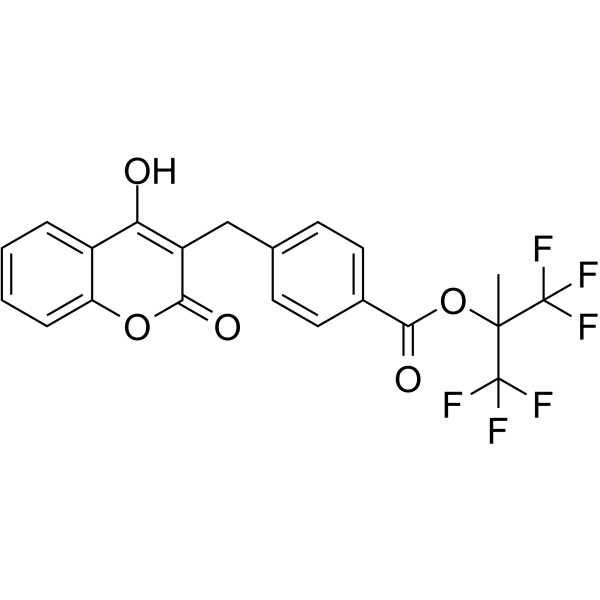
Tecarfarin (ATI-5923) is an orally active and non-competitive vitamin K epoxide reductase (VKOR) antagonist, and impairs the activation of the vitamin K-dependent clotting factors II, VII, IX and X. Tecarfarin has the antithrombotic activity .
연구목적의 판매만을 진행합니다. 환자를 대상으로 한 판매는 하지 않습니다.
- Purity : 98.65%
- CAS No.: 867257-26-9
- 화학식: C21H14F6O5
- 분자량:460.32
-
보관:Powder -20°C, 3 years , 4°C, 2 years ; In solvent -80°C, 2 years , -20°C, 1 year

To place orders, for customer services and technical support, please contact: MedChemExpress USA
Tel: 609-228-6898 E-mail: [email protected] [email protected]


-
 Biological Activity
-
Chemical Information
-
용액&용해도
- 순도&문서
- References
-
 Help & FAQs




Biological Activity
제품 설명
IC50 & Target
VKOR[1]
Clinical Trial
| NCT Number | Sponsor | Condition | Start Date |
Phase

|
|---|---|---|---|---|
| NCT01329991 | 2011-05 | PHASE1 |


Chemical Information
-
CAS No. 867257-26-9
-
Appearance Solid
-
분자량 460.32
-
화학식 C21H14F6O5
-
Color White to off-white
-
SMILES
O=C(OC(C(F)(F)F)(C)C(F)(F)F)C1=CC=C(CC2=C(O)C3=CC=CC=C3OC2=O)C=C1
-
Synonyms
ATI-5923
-
선적
Room temperature in continental US; may vary elsewhere.
-
보관
Powder -20°C 3 years 4°C 2 years In solvent -80°C 2 years -20°C 1 year


용액&용해도
In Vitro:
DMSO : 250 mg/mL (543.10 mM; Need ultrasonic; Hygroscopic DMSO has a significant impact on the solubility of product, please use newly opened DMSO)
Please refer to the solubility information to select the appropriate solvent. Once prepared, please aliquot and store the solution to prevent product inactivation from repeated freeze-thaw cycles.
Storage method and period of stock solution: -80°C, 2 years; -20°C, 1 year. When stored at -80°C, please use it within 2 years. When stored at -20°C, please use it within 1 year.
Please refer to the solubility information to select the appropriate solvent. Once prepared, please aliquot and store the solution to prevent product inactivation from repeated freeze-thaw cycles.
Storage method and period of stock solution: -80°C, 2 years; -20°C, 1 year. When stored at -80°C, please use it within 2 years. When stored at -20°C, please use it within 1 year.
Concentration (start) × Volume (start) = Concentration (final) × Volume (final)
In Vivo:
Select the appropriate dissolution method based on your experimental animal and administration route.
- For the following dissolution methods, please ensure to first prepare a clear stock solution using an In Vitro approach and then sequentially add co-solvents:
- To ensure reliable experimental results, the clarified stock solution can be appropriately stored based on storage conditions. As for the working solution for In Vivo experiments, it is recommended to prepare freshly and use it on the same day.
- The percentages shown for the solvents indicate their volumetric ratio in the final prepared solution. If precipitation or phase separation occurs during preparation, heat and/or sonication can be used to aid dissolution.
Add each solvent one by one: 10% DMSO 40% PEG300 5% Tween-80 45% Saline
Solubility: ≥ 2.08 mg/mL (4.52 mM); Clear solution
This protocol yields a clear solution of ≥ 2.08 mg/mL (saturation unknown).
Taking 1 mL working solution as an example, add 100 μL DMSO stock solution (20.8 mg/mL) to 400 μL PEG300, and mix evenly; then add 50 μL Tween-80 and mix evenly; then add 450 μL Saline to adjust the volume to 1 mL.
Preparation of Saline: Dissolve 0.9 g sodium chloride in ddH₂O and dilute to 100 mL to obtain a clear Saline solution.
In Vivo Dissolution Calculator
Please enter the basic information of animal experiments:
-
-
-
-
Recommended: Prepare an additional quantity of animals to account for potential losses during experiments.
Please enter your animal formula composition:
-
%DMSO +
Recommended: Keep the proportion of DMSO in working solution below 2% if your animal is weak.
-
%+
-
+%Tween-80 + +
-
%Saline +
The co-solvents required include: DMSO, . All of co-solvents are available by MedChemExpress (MCE). , Tween 80. All of co-solvents are available by MedChemExpress (MCE).
Working solution concentration: 0.22 mg/mL
Method for preparing stock solution: mg drug dissolved in μL DMSO. Stock solution concentration: mg/mL.
1. Take μL DMSO stock solution;
2. Add μL .
μL , mix evenly;
3. Then add μL Tween 80, mix evenly;
4. Then add μL
Please ensure that the stock solution in the first step is dissolved to a clear state, and add co-solvents in sequence. You can use ultrasonic heating (ultrasonic cleaner, recommended frequency 20-40 kHz), vortexing, etc. to assist dissolution.


순도&문서
-
Data Sheet (272 KB)
-
SDS (252 KB)
- English - EN (252 KB)
- Français - FR (252 KB)
- Deutsch - DE (252 KB)
- Norwegian - NO (252 KB)
- Español - ES (252 KB)
- Swedish - SV (252 KB)
- Italian - IT (252 KB)
- Korean - KR (252 KB)
- Portuguese - PT (252 KB)
-
Handling Instructions (2659 KB)
References
[1]. Hobl EL, et al. Tecarfarin: A Novel Vitamin K Antagonist. Thromb Haemost. 2017 Nov;117(11):2009-2011. [Content Brief]
[2]. Bowersox SS, et al. Antithrombotic activity of the novel oral anticoagulant, Tecarfarin [Sodium 3-[4-((1,1,1,3,3,3-hexafluoro-2-methylpropan-2-yloxy) carbonyl) benzyl]-2-oxo-2H-chromen-4-olate] in animal models. Thromb Res. 2010 Nov;126(5):e383-8. [Content Brief]


Complete Stock Solution Preparation Table
Please refer to the solubility information to select the appropriate solvent. Once prepared, please aliquot and store the solution to prevent product inactivation from repeated freeze-thaw cycles.
Storage method and period of stock solution: -80°C, 2 years; -20°C, 1 year. When stored at -80°C, please use it within 2 years. When stored at -20°C, please use it within 1 year.
| Optional Solvent | Concentration Solvent Mass | 1 mg | 5 mg | 10 mg | 25 mg |
|---|---|---|---|---|---|
| DMSO | 1 mM | 2.1724 mL | 10.8620 mL | 21.7240 mL | 54.3100 mL |
| 5 mM | 0.4345 mL | 2.1724 mL | 4.3448 mL | 10.8620 mL | |
| 10 mM | 0.2172 mL | 1.0862 mL | 2.1724 mL | 5.4310 mL | |
| 15 mM | 0.1448 mL | 0.7241 mL | 1.4483 mL | 3.6207 mL | |
| 20 mM | 0.1086 mL | 0.5431 mL | 1.0862 mL | 2.7155 mL | |
| 25 mM | 0.0869 mL | 0.4345 mL | 0.8690 mL | 2.1724 mL | |
| 30 mM | 0.0724 mL | 0.3621 mL | 0.7241 mL | 1.8103 mL | |
| 40 mM | 0.0543 mL | 0.2716 mL | 0.5431 mL | 1.3578 mL | |
| 50 mM | 0.0434 mL | 0.2172 mL | 0.4345 mL | 1.0862 mL | |
| 60 mM | 0.0362 mL | 0.1810 mL | 0.3621 mL | 0.9052 mL | |
| 80 mM | 0.0272 mL | 0.1358 mL | 0.2716 mL | 0.6789 mL | |
| 100 mM | 0.0217 mL | 0.1086 mL | 0.2172 mL | 0.5431 mL |


Tecarfarin Related Classifications
HY-14854 Related Classifications
 Powered by Bioz