



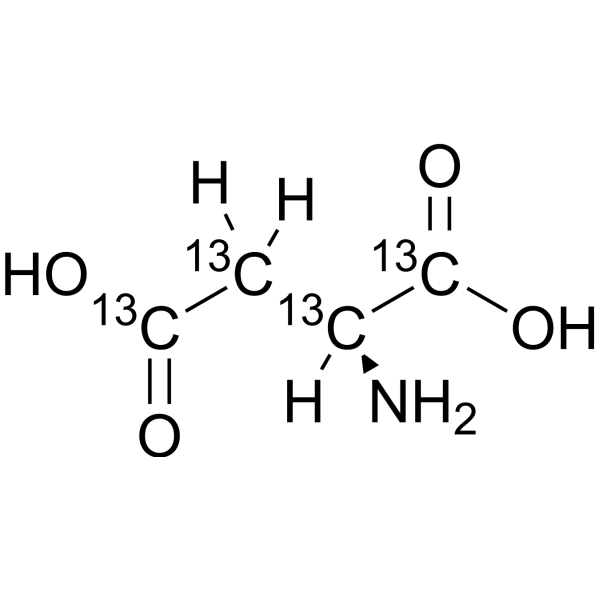
L-Aspartic acid-13C4
Based on 1 publication(s) in Google Scholar
L-Aspartic acid-13C4 is the 13C-labeled L-Aspartic acid (HY-N0666). L-Aspartic acid is a NMDA receptor agonist and acidic amino acid. L-Aspartic acid has no independent analgesic activity. L-Aspartic acid can antagonize the analgesic effects of D-Aspartic acid and Morphine. L-Aspartic acid regulates polymorph transformation, crystal growth/aggregation and nucleation processes of calcium carbonate, and can serve as a biomineralization template. L-Aspartic acid promotes burst firing of central neurons. L-Aspartic acid can be used in studies related to cerebral ischemia and epilepsy.
For research use only. We do not sell to patients.
- Purity : 99.88%
- CAS No.: 55443-54-4
- Formula: 13C4H7NO4
- Molecular Weight:137.07
-
Storage:Powder -20°C, 3 years ; In solvent -80°C, 6 months , -20°C, 1 month

To place orders, for customer services and technical support, please contact: MedChemExpress USA
Tel: 609-228-6898 E-mail: [email protected] [email protected]


-
 Biological Activity
-
Chemical Information
-
Solvent & Solubility
- Purity & Documentation
- References
-
 Help & FAQs


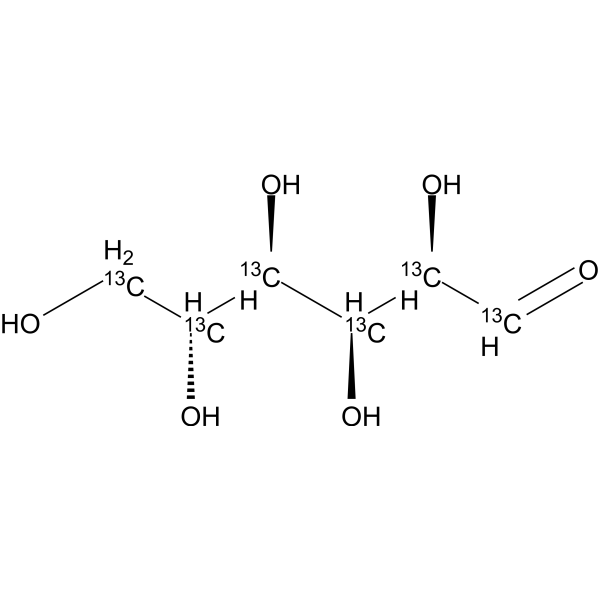
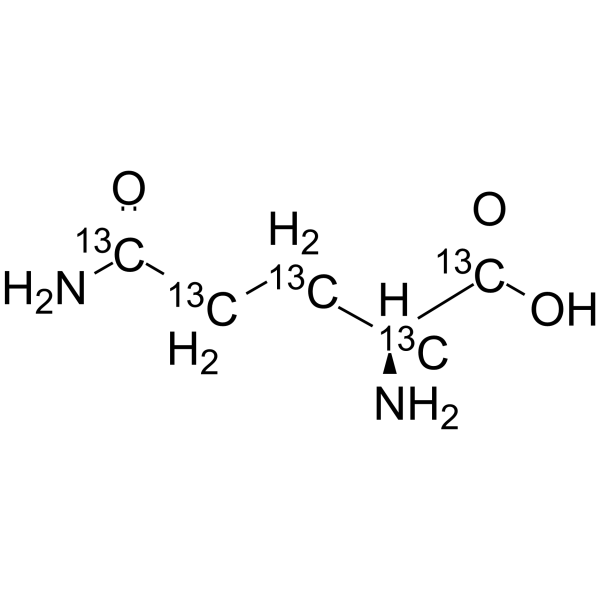
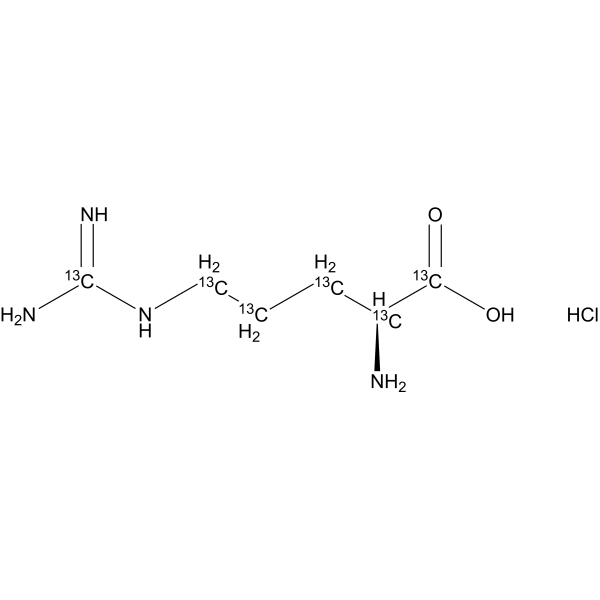
Publications Citing Use of MedChemExpress (MCE) L-Aspartic acid-13C4
MoreAll iGluR Isoforms
More

Biological Activity
Description
IC50 & Target
|
NMDA Receptor |
Cellular Effect
|
Cell Line

|
Type | Value | Description | References |
|---|---|---|---|---|
| HEK293 | EC50 |
15 μM
Compound: 5960
|
Substrate uptake by the Excitatory Amino Acid Transporter 1 (EAAT1, SLC1A3) as assessed by the fluorescent FLIPR membrane potential dye in HEK-293 JumpIN-SLC1A3 cells
Substrate uptake by the Excitatory Amino Acid Transporter 1 (EAAT1, SLC1A3) as assessed by the fluorescent FLIPR membrane potential dye in HEK-293 JumpIN-SLC1A3 cells
|
10.5281/zenodo.6782621 |
| HEK293 | EC50 |
398 μM
Compound: L-asp
|
Inhibition of the Excitatory Amino Acid Transporter 1 (EAAT1, SLC1A3) as assessed by a phenotypic impedance-based assay detecting changes in cell morphology by L-glutamate uptake in HEK-293 JumpIN-SLC1A3 cells
Inhibition of the Excitatory Amino Acid Transporter 1 (EAAT1, SLC1A3) as assessed by a phenotypic impedance-based assay detecting changes in cell morphology by L-glutamate uptake in HEK-293 JumpIN-SLC1A3 cells
|
[PMID: 35677430] |
In Vitro
Stable heavy isotopes of hydrogen, carbon, and other elements have been incorporated into drug molecules, largely as tracers for quantitation during the drug development process. Deuteration has gained attention because of its potential to affect the pharmacokinetic and metabolic profiles of drugs.
MedChemExpress (MCE) has not independently confirmed the accuracy of these methods. They are for reference only. .
Application
1. This compound can be used as a tracer
2. This compound can be used as an internal standard for quantitative analysis by NMR, GC-MS, or LC-MS.


Chemical Information
-
CAS No. 55443-54-4
-
Unlabeled CAS 56-84-8
-
Appearance Solid
-
Molecular Weight 137.07
-
Formula 13C4H7NO4
-
Color White to off-white
-
SMILES
O[13C]([13C@](N)([H])[13C]([H])([H])[13C](O)=O)=O
-
Shipping
Room temperature in continental US; may vary elsewhere.
-
Storage
Powder -20°C 3 years In solvent -80°C 6 months -20°C 1 month


Publications (1)
-
Journal Impact Factor
-
Most Recent
-
Nat Cell Biol
2026 May 27. PMID: 42203926


Solvent & Solubility
In Vitro:
1 M NaOH : 100 mg/mL (729.55 mM; adjust pH to 12 with 1 M NaOH)
H2O : 15 mg/mL (109.43 mM; Need ultrasonic)
Please refer to the solubility information to select the appropriate solvent. Once prepared, please aliquot and store the solution to prevent product inactivation from repeated freeze-thaw cycles.
Storage method and period of stock solution: -80°C, 6 months; -20°C, 1 month. When stored at -80°C, please use it within 6 months. When stored at -20°C, please use it within 1 month.
* Note: If you choose water as the stock solution, please dilute it to the working solution, then filter and sterilize it with a 0.22 μm filter before use.
Please refer to the solubility information to select the appropriate solvent. Once prepared, please aliquot and store the solution to prevent product inactivation from repeated freeze-thaw cycles.
Storage method and period of stock solution: -80°C, 6 months; -20°C, 1 month. When stored at -80°C, please use it within 6 months. When stored at -20°C, please use it within 1 month.
* Note: If you choose water as the stock solution, please dilute it to the working solution, then filter and sterilize it with a 0.22 μm filter before use.
Concentration (start) × Volume (start) = Concentration (final) × Volume (final)


Purity & Documentation
-
Data Sheet (275 KB)
-
SDS (252 KB)
- English - EN (252 KB)
- Français - FR (252 KB)
- Deutsch - DE (252 KB)
- Norwegian - NO (252 KB)
- Español - ES (252 KB)
- Swedish - SV (252 KB)
- Italian - IT (252 KB)
- Korean - KR (252 KB)
- Portuguese - PT (252 KB)
-
Handling Instructions (2659 KB)
References
[1]. Onat F, et al. Antinociceptive effect of D-aspartic acid in mice. Pharmacology, biochemistry, and behavior. 1995 Aug;51(4):715-9. [Content Brief]
[2]. Hosoya K, et al. Blood-brain barrier produces significant efflux of L-aspartic acid but not D-aspartic acid: in vivo evidence using the brain efflux index method. Journal of neurochemistry. 1999 Sep;73(3):1206-11. [Content Brief]
[3]. Tong H, et al. Control over the crystal phase, shape, size and aggregation of calcium carbonate via a L-aspartic acid inducing process. Biomaterials. 2004 Aug;25(17):3923-9. [Content Brief]
[4]. MacDonald JF, et al. L-Aspartic acid induces a region of negative slope conductance in the current-voltage relationship of cultured spinal cord neurons. Brain research. 1982 Apr 08;237(1):248-53. [Content Brief]


Complete Stock Solution Preparation Table
Please refer to the solubility information to select the appropriate solvent. Once prepared, please aliquot and store the solution to prevent product inactivation from repeated freeze-thaw cycles.
Storage method and period of stock solution: -80°C, 6 months; -20°C, 1 month. When stored at -80°C, please use it within 6 months. When stored at -20°C, please use it within 1 month.
| Optional Solvent | Concentration Solvent Mass | 1 mg | 5 mg | 10 mg | 25 mg |
|---|---|---|---|---|---|
| H2O / 1 M NaOH | 1 mM | 7.2955 mL | 36.4777 mL | 72.9554 mL | 182.3886 mL |
| 5 mM | 1.4591 mL | 7.2955 mL | 14.5911 mL | 36.4777 mL | |
| 10 mM | 0.7296 mL | 3.6478 mL | 7.2955 mL | 18.2389 mL | |
| 15 mM | 0.4864 mL | 2.4318 mL | 4.8637 mL | 12.1592 mL | |
| 20 mM | 0.3648 mL | 1.8239 mL | 3.6478 mL | 9.1194 mL | |
| 25 mM | 0.2918 mL | 1.4591 mL | 2.9182 mL | 7.2955 mL | |
| 30 mM | 0.2432 mL | 1.2159 mL | 2.4318 mL | 6.0796 mL | |
| 40 mM | 0.1824 mL | 0.9119 mL | 1.8239 mL | 4.5597 mL | |
| 50 mM | 0.1459 mL | 0.7296 mL | 1.4591 mL | 3.6478 mL | |
| 60 mM | 0.1216 mL | 0.6080 mL | 1.2159 mL | 3.0398 mL | |
| 80 mM | 0.0912 mL | 0.4560 mL | 0.9119 mL | 2.2799 mL | |
| 100 mM | 0.0730 mL | 0.3648 mL | 0.7296 mL | 1.8239 mL |
* Note: If you choose water as the stock solution, please dilute it to the working solution, then filter and sterilize it with a 0.22 μm filter before use.


L-Aspartic acid-13C4 Related Classifications
HY-N0666S4 Related Classifications
 Powered by Bioz