



ML345
Based on 1 publication(s) in Google Scholar
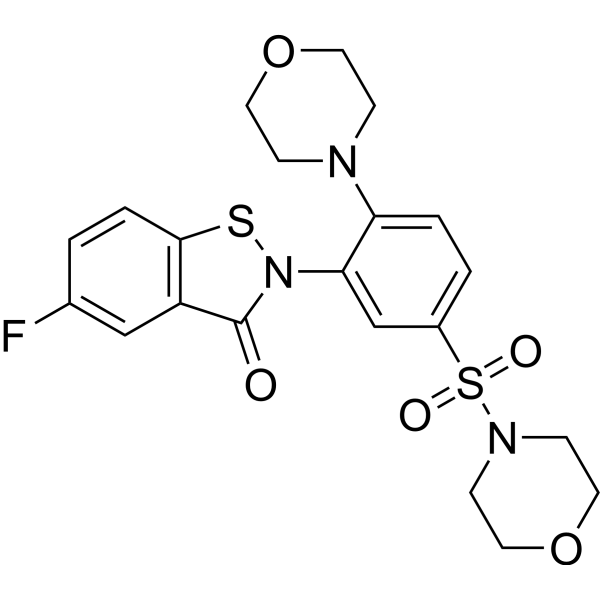
ML345 is a potent and selective inhibitor of insulin-degrading enzyme (IDE) and NLRP3, with an IC50 of 188 nM against IDE. ML345 targets the Cys819 residue of IDE to inhibit IDE. ML345 selectively binds to NLRP3 in a non-covalent manner. ML345 inhibits inflammatory cytokines (IL-1β, IL-6) and exhibits potent anti-inflammatory activity. ML345 exerts a protective effect against miscarriage.
Nur für Forschungszwecke. Wir verkaufen nicht an Patienten.
- Reinheit : 99.37%
- CAS. Nr.: 1632125-79-1
- Formel: C21H22FN3O5S2
- Molecular Weight:479.54
-
Speicherung:Powder -20°C, 3 years , 4°C, 2 years ; In solvent -80°C, 6 months , -20°C, 1 month

To place orders, for customer services and technical support, please contact: MedChemExpress USA
Tel: 609-228-6898 E-mail: [email protected] [email protected]


-
 Biologische Aktivität
-
Chemical Information
-
Lösungsmittel & Löslichkeit
- Protokoll
- Reinheit & Dokumentation
- Verweise
-
 Help & FAQs


Publications Citing Use of MedChemExpress (MCE) ML345
More

Biologische Aktivität
Beschreibung
IC50 & Target
[1]|
IL-6 |
IL-1β |
NLRP3 |
In Vitro
ML345 (0.25-1 μM; 30 min pre-incubation, 30 min nigericin stimulation) potently blocks nigericin-induced NLRP3 inflammasome activation in primary murine BMDMs with an IC50 of 197.7 nM, reducing inflammatory cytokine maturation, caspase-1 cleavage, and pyroptosis without altering IL-6 or TNF secretion[1].
MedChemExpress (MCE) has not independently confirmed the accuracy of these methods. They are for reference only.
In Vivo
ML345 (10 mg/kg; i.p.; administered three times during pregnancy) effectively ameliorates LPS-induced abortion, reduces the levels of inflammatory cytokines in maternal tissues, and inhibits the activation of NLRP3[1].
MedChemExpress (MCE) has not independently confirmed the accuracy of these methods. They are for reference only.
-
Animal Model:C57BL/6J (male, 8 weeks old)[1]
-
Dosage:10 mg/kg
-
Administration:i.p.; single dose (30 minutes prior to LPS challenge)
-
Result:Improved survival rates significantly compared to vehicle-treated LPS-challenged mice.
Reduced serum IL-1β levels.
Reduced serum IL-18 levels.
Left serum TNF levels minimally altered.


Chemical Information
-
CAS. Nr. 1632125-79-1
-
Appearance Solid
-
Molecular Weight 479.54
-
Formel C21H22FN3O5S2
-
Color White to off-white
-
SMILES
O=C1C2=C(SN1C3=CC(S(N4CCOCC4)(=O)=O)=CC=C3N5CCOCC5)C=CC(F)=C2
-
Versand
Room temperature in continental US; may vary elsewhere.
-
Speicherung
Powder -20°C 3 years 4°C 2 years In solvent -80°C 6 months -20°C 1 month


Publications (1)
-
Journal Impact Factor
-
Most Recent
-
Mol Biomed
ML345 is a potent and selective NLRP3 inflammasome inhibitor with anti-inflammatory activity. [Abstract]2025 Nov 13;6(1):108. PMID: 41231359


Lösungsmittel & Löslichkeit
In Vitro:
DMSO : 25 mg/mL (52.13 mM; Need ultrasonic; Hygroscopic DMSO has a significant impact on the solubility of product, please use newly opened DMSO)
Please refer to the solubility information to select the appropriate solvent. Once prepared, please aliquot and store the solution to prevent product inactivation from repeated freeze-thaw cycles.
Storage method and period of stock solution: -80°C, 6 months; -20°C, 1 month. When stored at -80°C, please use it within 6 months. When stored at -20°C, please use it within 1 month.
Please refer to the solubility information to select the appropriate solvent. Once prepared, please aliquot and store the solution to prevent product inactivation from repeated freeze-thaw cycles.
Storage method and period of stock solution: -80°C, 6 months; -20°C, 1 month. When stored at -80°C, please use it within 6 months. When stored at -20°C, please use it within 1 month.
Konzentration (Stammlösung) × Volumen (Stammlösung) = Konzentration (Ziellösung) × Volumen (Ziellösung)


Reinheit & Dokumentation
-
Data Sheet (279 KB)
-
SDS (393 KB)
- English - EN (393 KB)
- Français - FR (393 KB)
- Deutsch - DE (393 KB)
- Norwegian - NO (393 KB)
- Español - ES (393 KB)
- Swedish - SV (393 KB)
- Italian - IT (393 KB)
- Korean - KR (393 KB)
- Portuguese - PT (393 KB)
-
Handling Instructions (2659 KB)
Verweise
[1]. Lin H, et al. ML345 is a potent and selective NLRP3 inflammasome inhibitor with anti-inflammatory activity. Mol Biomed. 2025;6(1):108. Published 2025 Nov 13. [Content Brief]
[2]. Bannister TD, et al. ML345, A Small-Molecule Inhibitor of the Insulin-Degrading Enzyme (IDE). In: Probe Reports from the NIH Molecular Libraries Program. Bethesda (MD): National Center for Biotechnology Information (US); December 17, 2012. [Content Brief]


Complete Stock Solution Preparation Table
Please refer to the solubility information to select the appropriate solvent. Once prepared, please aliquot and store the solution to prevent product inactivation from repeated freeze-thaw cycles.
Storage method and period of stock solution: -80°C, 6 months; -20°C, 1 month. When stored at -80°C, please use it within 6 months. When stored at -20°C, please use it within 1 month.
| Optional Solvent | Concentration Solvent Mass | 1 mg | 5 mg | 10 mg | 25 mg |
|---|---|---|---|---|---|
| DMSO | 1 mM | 2.0853 mL | 10.4267 mL | 20.8533 mL | 52.1333 mL |
| 5 mM | 0.4171 mL | 2.0853 mL | 4.1707 mL | 10.4267 mL | |
| 10 mM | 0.2085 mL | 1.0427 mL | 2.0853 mL | 5.2133 mL | |
| 15 mM | 0.1390 mL | 0.6951 mL | 1.3902 mL | 3.4756 mL | |
| 20 mM | 0.1043 mL | 0.5213 mL | 1.0427 mL | 2.6067 mL | |
| 25 mM | 0.0834 mL | 0.4171 mL | 0.8341 mL | 2.0853 mL | |
| 30 mM | 0.0695 mL | 0.3476 mL | 0.6951 mL | 1.7378 mL | |
| 40 mM | 0.0521 mL | 0.2607 mL | 0.5213 mL | 1.3033 mL | |
| 50 mM | 0.0417 mL | 0.2085 mL | 0.4171 mL | 1.0427 mL |


ML345 Related Classifications
HY-117878 Related Classifications
 Powered by Bioz