



MR-2088

Based on 1 Customer Validation
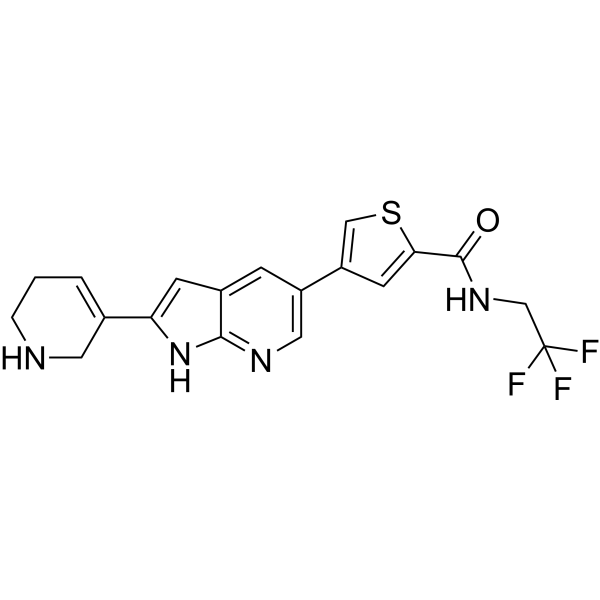
MR-2088 is a reversible, ATP-competitive, and selective ULK1/2 inhibitor with pEC50 values of 8.3 and 8.7 respectively. MR-2088 effectively inhibits autophagic flux and demonstrates a synergistic antiproliferative effect with Trametinib (HY-10999) (MEK inhibitor) in vitro. MR-2088 can be used for non-small lung cell cancer (NSCLC) research.
For research use only. We do not sell to patients.
- Purity : 99.50%
- CAS No.: 2922531-69-7
- Formula: C19H17F3N4OS
- Molecular Weight:406.42
-
Storage:Powder -20°C, 3 years ; In solvent -80°C, 6 months , -20°C, 1 month

To place orders, for customer services and technical support, please contact: MedChemExpress USA
Tel: 609-228-6898 E-mail: [email protected] [email protected]


-
 Biological Activity
-
Chemical Information
-
Solvent & Solubility
- Protocols
- Purity & Documentation
- References
-
 Help & FAQs




Biological Activity
Description
IC50 & Target
[1]|
ULK1 8.3 (pEC50) |
ULK2 8.7 (pEC50) |
Cellular Effect
|
Cell Line

|
Type | Value | Description | References |
|---|---|---|---|---|
| NCI-H2030 | EC50 |
36 nM
Compound: 43; MR-2088
|
Inhibition of autophagy in human NCI-H2030 cells assessed as inhibition of ATG13 phosphorylation at Ser318 residue incubated for 24 hrs in aminoacid starving medium by Western blot analysis
Inhibition of autophagy in human NCI-H2030 cells assessed as inhibition of ATG13 phosphorylation at Ser318 residue incubated for 24 hrs in aminoacid starving medium by Western blot analysis
|
[PMID: 38232465] |
| NCI-H2030 | EC50 |
48 nM
Compound: 43; MR-2088
|
Inhibition of autophagy in trametinib treated human NCI-H2030 cells assessed as inhibition of ATG13 phosphorylation at Ser318 residue incubated for 24 hrs by Western blot analysis
Inhibition of autophagy in trametinib treated human NCI-H2030 cells assessed as inhibition of ATG13 phosphorylation at Ser318 residue incubated for 24 hrs by Western blot analysis
|
[PMID: 38232465] |
| NCI-H2030 | IC50 |
3.2 μM
Compound: 43; MR-2088
|
Antiproliferative activity against human NCI-H2030 cells harboring KRAS G12C mutant assessed as inhibition of cell growth incubated for 72 hrs by celltiter-glo assay
Antiproliferative activity against human NCI-H2030 cells harboring KRAS G12C mutant assessed as inhibition of cell growth incubated for 72 hrs by celltiter-glo assay
|
[PMID: 38232465] |
In Vitro
MR-2088 (Compound 43) (0.005-5000 nM, 24 h) dose-dependently and specifically inhibits ULK1-mediated phosphorylation of the direct substrate ATG13 at Ser318, thereby preventing the degradation of autophagy markers p62 and LC3-II and effectively reversing starvation-induced activation of autophagic flux in H2030 cells[1].
MR-2088 (0-10 μM, 72 h) enhances the efficacy of Trametinib (HY-10999) (0-50 μM) by inhibiting ULK1/2 to block autophagy in H2030 cells (KRAS G12C mutant)[1].
MR-2088 inhibits enzymatic activity of ULK1 with a pIC50 value of 8.7 in HotSpot radioactive kinase assay and displays binding and enzymatic activity with a pIC50 value of 8.0 in NanoBRET assays in H2030 cells[1].
MR-2088 displays no significant inhibition of the hERG potassium channel (10 μM)[1].
MR-2088 (10 μM, 10 min) weakly inhibits CYP, including 1A2, 2C, 2D6, 3A4, CYP1A2, CYP2B6, CYP2C9, CYP2D6 and CYP3A4 with inhibition of 23%, 32%, 9%, 47%, 23.1%, 11.38%, 32.3%, 9.7%, 46.6%, respectively, in human liver microsomes[1].
MR-2088 displays good kinase selectivity inhibiting ULK2, ULK1, RET, AURKB, FLT3, ABL1 and CDK7 with pEC50 values of 8.7, 8.3, 6.7, 5.5, 5.3, <5 and <5, respectively, in NanoBRET assay[1].
MedChemExpress (MCE) has not independently confirmed the accuracy of these methods. They are for reference only.
-
Cell Line:H2030 cells
-
Concentration:0.005, 0.05, 0.5, 5, 50, 500 and 5000 nM
-
Incubation Time:24 h
-
Result:Inhibited the phosphorylation of ATG13 Ser 318.
Prevented the degradation of p62.
Inhibited the phosphorylation of the direct substrate of ULK1 while preventing the degradation of p62 and LC3.
-
Cell Line:H2030 cells (KRAS G12C mutant)
-
Concentration:0, 0.5, 1.5, 4.5, 1.3, 4.0, 120, 360, 1200, 3400 and 10000 nM
-
Incubation Time:72 h
-
Result:Observed potent antiproliferative synergy with the combination of Trametinib.
Inhibited H2030 cells (KRAS G12C mutant) antiproliferative activity with an IC50 value of 3.2 μM when not co-treated with Trametinib.
Strongly inhibited the proliferation of KRAS G12C-mutant H2030 cells when combination with Trametinib, with IC50 values of 196 µM (1:1), 3.6 µM (1:4), and 1.55 µM (4:1) for the respective molar ratios.
Parmacokinetics


Chemical Information
-
CAS No. 2922531-69-7
-
Appearance Solid
-
Molecular Weight 406.42
-
Formula C19H17F3N4OS
-
Color Off-white to light yellow
-
SMILES
O=C(NCC(F)(F)F)C1=CC(C2=CN=C3C(C=C(C4=CCCNC4)N3)=C2)=CS1
-
Shipping
Room temperature in continental US; may vary elsewhere.
-
Storage
Powder -20°C 3 years In solvent -80°C 6 months -20°C 1 month


Solvent & Solubility
In Vitro:
DMSO : 8.33 mg/mL (20.50 mM; ultrasonic and warming and heat to 60°C; Hygroscopic DMSO has a significant impact on the solubility of product, please use newly opened DMSO)
Please refer to the solubility information to select the appropriate solvent. Once prepared, please aliquot and store the solution to prevent product inactivation from repeated freeze-thaw cycles.
Storage method and period of stock solution: -80°C, 6 months; -20°C, 1 month. When stored at -80°C, please use it within 6 months. When stored at -20°C, please use it within 1 month.
Please refer to the solubility information to select the appropriate solvent. Once prepared, please aliquot and store the solution to prevent product inactivation from repeated freeze-thaw cycles.
Storage method and period of stock solution: -80°C, 6 months; -20°C, 1 month. When stored at -80°C, please use it within 6 months. When stored at -20°C, please use it within 1 month.
Concentration (start) × Volume (start) = Concentration (final) × Volume (final)


Purity & Documentation
-
Data Sheet (273 KB)
-
SDS (252 KB)
- English - EN (252 KB)
- Français - FR (252 KB)
- Deutsch - DE (252 KB)
- Norwegian - NO (252 KB)
- Español - ES (252 KB)
- Swedish - SV (252 KB)
- Italian - IT (252 KB)
- Korean - KR (252 KB)
- Portuguese - PT (252 KB)
-
Handling Instructions (2659 KB)
References


Complete Stock Solution Preparation Table
Please refer to the solubility information to select the appropriate solvent. Once prepared, please aliquot and store the solution to prevent product inactivation from repeated freeze-thaw cycles.
Storage method and period of stock solution: -80°C, 6 months; -20°C, 1 month. When stored at -80°C, please use it within 6 months. When stored at -20°C, please use it within 1 month.
| Optional Solvent | Concentration Solvent Mass | 1 mg | 5 mg | 10 mg | 25 mg |
|---|---|---|---|---|---|
| DMSO | 1 mM | 2.4605 mL | 12.3025 mL | 24.6051 mL | 61.5127 mL |
| 5 mM | 0.4921 mL | 2.4605 mL | 4.9210 mL | 12.3025 mL | |
| 10 mM | 0.2461 mL | 1.2303 mL | 2.4605 mL | 6.1513 mL | |
| 15 mM | 0.1640 mL | 0.8202 mL | 1.6403 mL | 4.1008 mL | |
| 20 mM | 0.1230 mL | 0.6151 mL | 1.2303 mL | 3.0756 mL |


MR-2088 Related Classifications
HY-162100 Related Classifications
 Powered by Bioz