



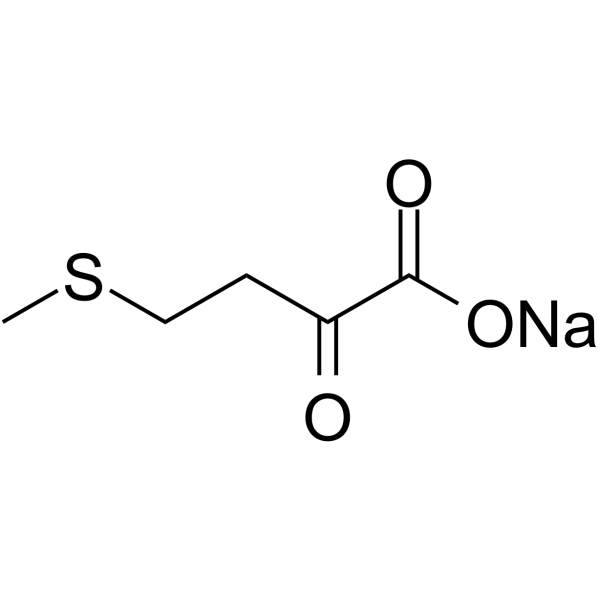
MTOB sodium
Based on 2 publication(s) in Google Scholar
MTOB sodium is a potent C-terminal binding protein (CtBP) inhibitor. MTOB sodium attenuates repetitive head injury-elicited neurologic dysfunction and neuroinflammation via inhibition of the transactivation activity of CtBP1 and CtBP2. MTOB sodium antagonizes the transcriptional regulatory activity of CtBP1 and CtBP2 by eviction from their target promoters in breast cancer cell lines.
연구목적의 판매만을 진행합니다. 환자를 대상으로 한 판매는 하지 않습니다.
- Purity : 97.02%
- CAS No.: 51828-97-8
- 화학식: C5H7NaO3S
- 분자량:170.16
-
보관:
4°C, sealed storage, away from moisture
* In solvent : -80°C, 6 months; -20°C, 1 month (sealed storage, away from moisture)

To place orders, for customer services and technical support, please contact: MedChemExpress USA
Tel: 609-228-6898 E-mail: [email protected] [email protected]


-
 Biological Activity
-
Chemical Information
-
용액&용해도
- Protocol
- 순도&문서
- References
-
 Help & FAQs



Publications Citing Use of MedChemExpress (MCE) MTOB sodium
MoreAll DNA/RNA Synthesis Isoforms
More

Biological Activity
제품 설명
IC50 & Target
CtBP[1]
In Vitro
MTOB sodium (10 mM) causes significant derepression (P<0.05) of 40% of CtBP target genes (including FGF9, CTNNB1, CEBPB, et al.) in MCF-7 and 46% in MBA-MD-231; increases the pro-epithelial E-cadherin/Vimentin ratio while reducing the pro-mesenchymal CD44/CD24 ratio, with a more significant trend (P<0.05) in MCF-7[2].
MedChemExpress (MCE) has not independently confirmed the accuracy of these methods. They are for reference only.
In Vivo
MedChemExpress (MCE) has not independently confirmed the accuracy of these methods. They are for reference only.
-
Animal Model:C57BL/6 mice (traumatic brain injury)[1]
-
Dosage:860 mg/kg
-
Administration:IP, at 1 h and 18 h after the first injury
-
Result:Effectively suppressed the increased duration of righting reflex, and significantly decreased NSS scores.


Chemical Information
-
CAS No. 51828-97-8
-
Appearance Solid
-
분자량 170.16
-
화학식 C5H7NaO3S
-
Color White to off-white
-
SMILES
O=C(O[Na])C(CCSC)=O
-
선적
Room temperature in continental US; may vary elsewhere.
-
보관
4°C, sealed storage, away from moisture
* In solvent : -80°C, 6 months; -20°C, 1 month (sealed storage, away from moisture)


Publications (2)
-
Journal Impact Factor
-
Most Recent
-
Biol Direct
PNSC928, a plant-derived compound, specifically disrupts CtBP2-p300 interaction and reduces inflammation in mice with acute respiratory distress syndrome. [Abstract]2024 Jun 21;19(1):48. PMID: 38902802 -
Cytokine
Suppression of DNMT2/3 by proinflammatory cytokines inhibits CtBP1/2-dependent genes to promote the occurrence of atrophic nonunion. [Abstract]2024 Jan:173:156436. PMID: 37979214


용액&용해도
In Vitro:
H2O : 200 mg/mL (1175.36 mM; Need ultrasonic)
Please refer to the solubility information to select the appropriate solvent. Once prepared, please aliquot and store the solution to prevent product inactivation from repeated freeze-thaw cycles.
Storage method and period of stock solution: -80°C, 6 months; -20°C, 1 month (sealed storage, away from moisture). When stored at -80°C, please use it within 6 months. When stored at -20°C, please use it within 1 month.
* Note: If you choose water as the stock solution, please dilute it to the working solution, then filter and sterilize it with a 0.22 μm filter before use.
Please refer to the solubility information to select the appropriate solvent. Once prepared, please aliquot and store the solution to prevent product inactivation from repeated freeze-thaw cycles.
Storage method and period of stock solution: -80°C, 6 months; -20°C, 1 month (sealed storage, away from moisture). When stored at -80°C, please use it within 6 months. When stored at -20°C, please use it within 1 month.
* Note: If you choose water as the stock solution, please dilute it to the working solution, then filter and sterilize it with a 0.22 μm filter before use.
Concentration (start) × Volume (start) = Concentration (final) × Volume (final)


순도&문서
-
Data Sheet (272 KB)
-
SDS (453 KB)
- English - EN (453 KB)
- Français - FR (453 KB)
- Deutsch - DE (453 KB)
- Norwegian - NO (453 KB)
- Español - ES (453 KB)
- Swedish - SV (453 KB)
- Italian - IT (453 KB)
- Korean - KR (453 KB)
- Portuguese - PT (453 KB)
-
Handling Instructions (2659 KB)
References
[1]. Li H, et al. C-terminal binding proteins 1 and 2 in traumatic brain injury-induced inflammation and their inhibition as an approach for anti-inflammatory treatment. Int J Biol Sci. 2020 Feb 4;16(7):1107-1120. [Content Brief]
[2]. Di LJ, et al. Genome-wide profiles of CtBP link metabolism with genome stability and epithelial reprogramming in breast cancer. Nat Commun. 2013;4:1449. [Content Brief]


Complete Stock Solution Preparation Table
Please refer to the solubility information to select the appropriate solvent. Once prepared, please aliquot and store the solution to prevent product inactivation from repeated freeze-thaw cycles.
Storage method and period of stock solution: -80°C, 6 months; -20°C, 1 month (sealed storage, away from moisture). When stored at -80°C, please use it within 6 months. When stored at -20°C, please use it within 1 month.
| Optional Solvent | Concentration Solvent Mass | 1 mg | 5 mg | 10 mg | 25 mg |
|---|---|---|---|---|---|
| H2O | 1 mM | 5.8768 mL | 29.3841 mL | 58.7682 mL | 146.9205 mL |
| 5 mM | 1.1754 mL | 5.8768 mL | 11.7536 mL | 29.3841 mL | |
| 10 mM | 0.5877 mL | 2.9384 mL | 5.8768 mL | 14.6921 mL | |
| 15 mM | 0.3918 mL | 1.9589 mL | 3.9179 mL | 9.7947 mL | |
| 20 mM | 0.2938 mL | 1.4692 mL | 2.9384 mL | 7.3460 mL | |
| 25 mM | 0.2351 mL | 1.1754 mL | 2.3507 mL | 5.8768 mL | |
| 30 mM | 0.1959 mL | 0.9795 mL | 1.9589 mL | 4.8974 mL | |
| 40 mM | 0.1469 mL | 0.7346 mL | 1.4692 mL | 3.6730 mL | |
| 50 mM | 0.1175 mL | 0.5877 mL | 1.1754 mL | 2.9384 mL | |
| 60 mM | 0.0979 mL | 0.4897 mL | 0.9795 mL | 2.4487 mL | |
| 80 mM | 0.0735 mL | 0.3673 mL | 0.7346 mL | 1.8365 mL | |
| 100 mM | 0.0588 mL | 0.2938 mL | 0.5877 mL | 1.4692 mL |
* Note: If you choose water as the stock solution, please dilute it to the working solution, then filter and sterilize it with a 0.22 μm filter before use.


MTOB sodium Related Classifications
HY-135046 Related Classifications
 Powered by Bioz