



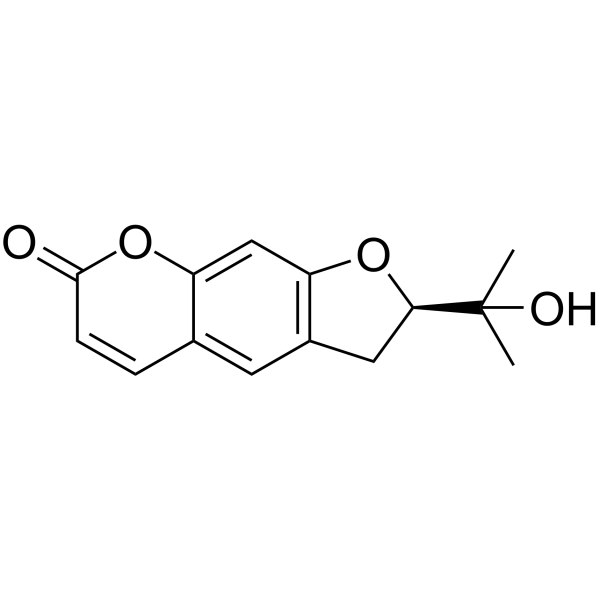
Nodakenetin

Based on 1 Customer Validation
Nodakenetin is an orally active Wnt/β-catenin pathway activator. Nodakenetin reduces the level of DKK1, and upregulates c-Myc, cyclin D1 and survivin. Nodakenetin induces osteoprogenitor cell differentiation, upregulates bone formation biomarkers and prevents bone microstructure degeneration. Nodakenetin induces irritant skin reactions. Nodakenetin improves bone microstructure and histomorphometric parameters in osteoporotic mouse models. Nodakenetin can be used for osteoporosis-related research.
For research use only. We do not sell to patients.
- Purity : 99.66%
- CAS No.: 495-32-9
- Formula: C14H14O4
- Molecular Weight:246.26
-
Storage:
4°C, sealed storage, away from moisture and light
* In solvent : -80°C, 6 months; -20°C, 1 month (sealed storage, away from moisture and light)

To place orders, for customer services and technical support, please contact: MedChemExpress USA
Tel: 609-228-6898 E-mail: [email protected] [email protected]


-
 Biological Activity
-
Chemical Information
-
Solvent & Solubility
- Protocols
- Purity & Documentation
- References
-
 Help & FAQs




Biological Activity
Description
In Vitro
Nodakenetin (0-100 μM; 12-72 h) activates the Wnt/β-catenin pathway in MC3T3-E1 preosteoblasts by downregulating DKK1 and β-catenin degradation, upregulating downstream target proteins, and increasing β-catenin mRNA levels in a concentration-dependent manner; it shows no cytotoxicity at concentrations up to 100 μM[1].
Nodakenetin (0-100 μM; 24-72 h) selectively activates β-catenin/TCF-responsive transcriptional activity in HEK293 cells in a concentration-dependent manner (up to 50 μM) in vitro, and does not induce cytotoxicity at concentrations up to 100 μM[1].
Nodakenetin (25-100 μM; 6-10 days) promotes osteoblastic differentiation and maturation of MC3T3-E1 cells by increasing extracellular matrix mineralization levels and alkaline phosphatase (ALP) activity in both differentiated and undifferentiated cells in a concentration-dependent manner[1].
Nodakenetin (Compound 6) (2.5-200 mg/mL; 24 h) exhibits low cytotoxicity against Artemia salina nauplii, with an LC50 of 249.289 mg/mL after 24 h of incubation[2].
MedChemExpress (MCE) has not independently confirmed the accuracy of these methods. They are for reference only.
-
Cell Line:human embryonic kidney HEK293 cells
-
Concentration:0, 12.5, 25, 50, 100 μM
-
Incubation Time:24 h
-
Result:Decreased DKK1 protein levels and p-β-catenin (Ser45) levels in a concentration-dependent manner.
Increased total β-catenin protein levels in a concentration-dependent manner.
Increased p-GSK3β (Tyr216) levels and decreased p-GSK3α (Ser21) and p-GSK3β (Ser9) levels, with no significant effect on total GSK3β levels.
Increased the expression of Wnt target genes c-Myc, cyclin D1, and survivin in a concentration-dependent manner.
In Vivo
Nodakenetin (50-100 mg/kg; p.o.; daily; 12 weeks) dose-dependently improves bone microstructure and histomorphometric parameters in ovariectomized (OVX)-induced osteoporotic mice[1].
MedChemExpress (MCE) has not independently confirmed the accuracy of these methods. They are for reference only.
-
Animal Model:ICR (female, 8 weeks old, 18-20 g at study initiation, bilaterally ovariectomized)[1]
-
Dosage:50 mg/kg; 100 mg/kg
-
Administration:p.o.; daily; 12 weeks
-
Result:Reversed increased body weight in OVX mice over 12 weeks.
Increased bone mineral density to ~0.09 g/cm3, bone volume/tissue volume to ~9%, and trabecular number to ~0.9 /mm, while reducing trabecular separation compared to the OVX control group at 50 mg/kg.
Increased bone mineral density to ~0.11 g/cm3, bone volume/tissue volume to ~11%, and trabecular number to ~1.1 /mm, while reducing trabecular separation to ~0.7 mm at 100 mg/kg, with effects comparable to positive control 17β-estradiol.
Dose-dependently restored trabecular bone architecture damaged by ovariectomy.
-
Animal Model:Albino mice (15-20 g, mixed gender, topical application to ear to induce inflammatory reaction)[2]
-
Dosage:0.0390625-5 μg/5 μL
-
Administration:topical application to mouse ear; single dose
-
Result:Induced irritant reactions (erythema, scaling, oedema) in mouse ears.
Reached an ID50 of 0.1874 μg/μL.
Showed peak irritant reaction 4 hours post-application.
Recorded chronic irritant units (IU) of 10 at 24 hours, 10 at 48 hours, and 10 at 72 hours.


Chemical Information
-
CAS No. 495-32-9
-
Appearance Solid
-
Molecular Weight 246.26
-
Formula C14H14O4
-
Color White to off-white
-
SMILES
O=C1C=CC2=CC3=C(O[C@@H](C(C)(O)C)C3)C=C2O1
-
Structure Classification
-
Shipping
Room temperature in continental US; may vary elsewhere.
-
Storage
4°C, sealed storage, away from moisture and light
* In solvent : -80°C, 6 months; -20°C, 1 month (sealed storage, away from moisture and light)


Solvent & Solubility
In Vitro:
DMSO : 100 mg/mL (406.07 mM; Need ultrasonic; Hygroscopic DMSO has a significant impact on the solubility of product, please use newly opened DMSO)
Please refer to the solubility information to select the appropriate solvent. Once prepared, please aliquot and store the solution to prevent product inactivation from repeated freeze-thaw cycles.
Storage method and period of stock solution: -80°C, 6 months; -20°C, 1 month (sealed storage, away from moisture and light). When stored at -80°C, please use it within 6 months. When stored at -20°C, please use it within 1 month.
Please refer to the solubility information to select the appropriate solvent. Once prepared, please aliquot and store the solution to prevent product inactivation from repeated freeze-thaw cycles.
Storage method and period of stock solution: -80°C, 6 months; -20°C, 1 month (sealed storage, away from moisture and light). When stored at -80°C, please use it within 6 months. When stored at -20°C, please use it within 1 month.
Concentration (start) × Volume (start) = Concentration (final) × Volume (final)
In Vivo:
Select the appropriate dissolution method based on your experimental animal and administration route.
- For the following dissolution methods, please ensure to first prepare a clear stock solution using an In Vitro approach and then sequentially add co-solvents:
- To ensure reliable experimental results, the clarified stock solution can be appropriately stored based on storage conditions. As for the working solution for In Vivo experiments, it is recommended to prepare freshly and use it on the same day.
- The percentages shown for the solvents indicate their volumetric ratio in the final prepared solution. If precipitation or phase separation occurs during preparation, heat and/or sonication can be used to aid dissolution.
Add each solvent one by one: 10% DMSO 40% PEG300 5% Tween-80 45% Saline
Solubility: ≥ 2.5 mg/mL (10.15 mM); Clear solution
This protocol yields a clear solution of ≥ 2.5 mg/mL (saturation unknown).
Taking 1 mL working solution as an example, add 100 μL DMSO stock solution (25.0 mg/mL) to 400 μL PEG300, and mix evenly; then add 50 μL Tween-80 and mix evenly; then add 450 μL Saline to adjust the volume to 1 mL.
Preparation of Saline: Dissolve 0.9 g sodium chloride in ddH₂O and dilute to 100 mL to obtain a clear Saline solution.
Add each solvent one by one: 10% DMSO 90% (20% SBE-β-CD in Saline)
Solubility: ≥ 2.5 mg/mL (10.15 mM); Clear solution
This protocol yields a clear solution of ≥ 2.5 mg/mL (saturation unknown).
Taking 1 mL working solution as an example, add 100 μL DMSO stock solution (25.0 mg/mL) to 900 μL 20% SBE-β-CD in Saline, and mix evenly.
Preparation of 20% SBE-β-CD in Saline (4°C, storage for one week): 2 g SBE-β-CD powder is dissolved in 10 mL Saline, completely dissolve until clear.
In Vivo Dissolution Calculator
Please enter the basic information of animal experiments:
-
-
-
-
Recommended: Prepare an additional quantity of animals to account for potential losses during experiments.
Please enter your animal formula composition:
-
%DMSO +
Recommended: Keep the proportion of DMSO in working solution below 2% if your animal is weak.
-
%+
-
+%Tween-80 + +
-
%Saline +
The co-solvents required include: DMSO, . All of co-solvents are available by MedChemExpress (MCE). , Tween 80. All of co-solvents are available by MedChemExpress (MCE).
Working solution concentration: 0.22 mg/mL
Method for preparing stock solution: mg drug dissolved in μL DMSO. Stock solution concentration: mg/mL. * In solvent : -80°C, 6 months; -20°C, 1 month (sealed storage, away from moisture and light)
1. Take μL DMSO stock solution;
2. Add μL .
μL , mix evenly;
3. Then add μL Tween 80, mix evenly;
4. Then add μL
Please ensure that the stock solution in the first step is dissolved to a clear state, and add co-solvents in sequence. You can use ultrasonic heating (ultrasonic cleaner, recommended frequency 20-40 kHz), vortexing, etc. to assist dissolution.


Purity & Documentation
-
Data Sheet (287 KB)
-
SDS (394 KB)
- English - EN (394 KB)
- Français - FR (394 KB)
- Deutsch - DE (394 KB)
- Norwegian - NO (394 KB)
- Español - ES (394 KB)
- Swedish - SV (394 KB)
- Italian - IT (394 KB)
- Korean - KR (394 KB)
- Portuguese - PT (394 KB)
-
Handling Instructions (2659 KB)
References
[1]. Jeong EJ, et al. Antiosteoporotic activity of nodakenetin, a coumarin compound from Angelica decursiva, by activation of the Wnt/β-catenin signaling pathway. J Tradit Complement Med. 2024 Nov 5;15(7):736-744. [Content Brief]
[2]. Saeed MA, et al. Irritant and cytotoxic coumarins from Angelica glauca Edgew roots. J Asian Nat Prod Res. 2008 Jan-Feb;10(1-2):49-58. [Content Brief]
[3]. Zhao D, et al. In vitro antioxidant and anti-inflammatory activities of Angelica decursiva. Archives of pharmacal research. 2012 Jan;35(1):179-92. [Content Brief]


Complete Stock Solution Preparation Table
Please refer to the solubility information to select the appropriate solvent. Once prepared, please aliquot and store the solution to prevent product inactivation from repeated freeze-thaw cycles.
Storage method and period of stock solution: -80°C, 6 months; -20°C, 1 month (sealed storage, away from moisture and light). When stored at -80°C, please use it within 6 months. When stored at -20°C, please use it within 1 month.
| Optional Solvent | Concentration Solvent Mass | 1 mg | 5 mg | 10 mg | 25 mg |
|---|---|---|---|---|---|
| DMSO | 1 mM | 4.0607 mL | 20.3037 mL | 40.6075 mL | 101.5187 mL |
| 5 mM | 0.8121 mL | 4.0607 mL | 8.1215 mL | 20.3037 mL | |
| 10 mM | 0.4061 mL | 2.0304 mL | 4.0607 mL | 10.1519 mL | |
| 15 mM | 0.2707 mL | 1.3536 mL | 2.7072 mL | 6.7679 mL | |
| 20 mM | 0.2030 mL | 1.0152 mL | 2.0304 mL | 5.0759 mL | |
| 25 mM | 0.1624 mL | 0.8121 mL | 1.6243 mL | 4.0607 mL | |
| 30 mM | 0.1354 mL | 0.6768 mL | 1.3536 mL | 3.3840 mL | |
| 40 mM | 0.1015 mL | 0.5076 mL | 1.0152 mL | 2.5380 mL | |
| 50 mM | 0.0812 mL | 0.4061 mL | 0.8121 mL | 2.0304 mL | |
| 60 mM | 0.0677 mL | 0.3384 mL | 0.6768 mL | 1.6920 mL | |
| 80 mM | 0.0508 mL | 0.2538 mL | 0.5076 mL | 1.2690 mL | |
| 100 mM | 0.0406 mL | 0.2030 mL | 0.4061 mL | 1.0152 mL |


Nodakenetin Related Classifications
HY-N2276 Related Classifications
 Powered by Bioz