



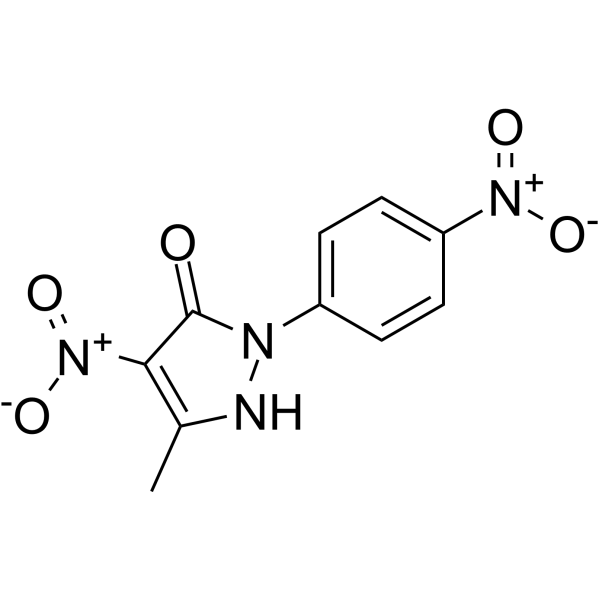
Picrolonic acid

Based on 1 Customer Validation
Picrolonic acid is a nematode hatching agent and bacterial frameshift mutagen. Picrolonic acid induces egg hatching in various nematodes. Picrolonic acid induces frameshift mutations in Salmonella. Picrolonic acid preferentially inhibits the growth of DNA polymerase-deficient E. coli . Picrolonic acid also serves as an analytical reagent for the determination of calcium, magnesium, lead, strontium, and thorium, and for the analysis of alkaloids, tryptophan, and phenylalanine. Picrolonic acid is used in research related to bacterial and parasitic infections.
For research use only. We do not sell to patients.
- Purity : 99.29%
- CAS No.: 550-74-3
- Formula: C10H8N4O5
- Molecular Weight:264.19
-
Storage:
4°C, protect from light
* In solvent : -80°C, 6 months; -20°C, 1 month (protect from light)

To place orders, for customer services and technical support, please contact: MedChemExpress USA
Tel: 609-228-6898 E-mail: [email protected] [email protected]


-
 Biological Activity
-
Chemical Information
-
Solvent & Solubility
- Purity & Documentation
- References
-
 Help & FAQs


All Parasite Isoforms
More

Biological Activity
Description
In Vitro
Picrolonic acid (0.4-4 mM) effectively hatches eggs of Heterodera rostochiensis with a hatch rating of 102, comparable to potato root diffusate[1].
Picrolonic acid hatches many eggs of Heterodera glycines and some eggs of Heterodera tabacum[1].
Picrolonic acid (25-1250 μg) is a frameshift mutagen, inducing mutations in Salmonella typhimurium strains TA1537 and TA1538[2].
Picrolonic acid (25 μg; 12 h) preferentially inhibits the growth of DNA polymerase-deficient E. coli[2].
MedChemExpress (MCE) has not independently confirmed the accuracy of these methods. They are for reference only.
-
Cell Line:E. coli pol A+ and pol A1-
-
Concentration:25 μg
-
Incubation Time:12 h
-
Result:Induced a zone of inhibition of 8.0 mm for Pol A+ and 10.8 mm for Pol A1-.


Chemical Information
-
CAS No. 550-74-3
-
Appearance Solid
-
Molecular Weight 264.19
-
Formula C10H8N4O5
-
Color Off-white to yellow
-
SMILES
CC1=C(C(=O)N(C2=CC=C(C=C2)[N+](=O)[O-])N1)[N+](=O)[O-]
-
Shipping
Room temperature in continental US; may vary elsewhere.
-
Storage
4°C, protect from light
* In solvent : -80°C, 6 months; -20°C, 1 month (protect from light)


Solvent & Solubility
In Vitro:
DMSO : 50 mg/mL (189.26 mM; Need ultrasonic; Hygroscopic DMSO has a significant impact on the solubility of product, please use newly opened DMSO)
Please refer to the solubility information to select the appropriate solvent. Once prepared, please aliquot and store the solution to prevent product inactivation from repeated freeze-thaw cycles.
Storage method and period of stock solution: -80°C, 6 months; -20°C, 1 month (protect from light). When stored at -80°C, please use it within 6 months. When stored at -20°C, please use it within 1 month.
Please refer to the solubility information to select the appropriate solvent. Once prepared, please aliquot and store the solution to prevent product inactivation from repeated freeze-thaw cycles.
Storage method and period of stock solution: -80°C, 6 months; -20°C, 1 month (protect from light). When stored at -80°C, please use it within 6 months. When stored at -20°C, please use it within 1 month.
Concentration (start) × Volume (start) = Concentration (final) × Volume (final)


Purity & Documentation
-
Data Sheet (274 KB)
-
SDS (768 KB)
- English - EN (768 KB)
- Français - FR (768 KB)
- Deutsch - DE (768 KB)
- Norwegian - NO (768 KB)
- Español - ES (768 KB)
- Swedish - SV (768 KB)
- Italian - IT (768 KB)
- Korean - KR (768 KB)
- Portuguese - PT (768 KB)
-
Handling Instructions (2659 KB)
References


Complete Stock Solution Preparation Table
Please refer to the solubility information to select the appropriate solvent. Once prepared, please aliquot and store the solution to prevent product inactivation from repeated freeze-thaw cycles.
Storage method and period of stock solution: -80°C, 6 months; -20°C, 1 month (protect from light). When stored at -80°C, please use it within 6 months. When stored at -20°C, please use it within 1 month.
| Optional Solvent | Concentration Solvent Mass | 1 mg | 5 mg | 10 mg | 25 mg |
|---|---|---|---|---|---|
| DMSO | 1 mM | 3.7852 mL | 18.9258 mL | 37.8515 mL | 94.6289 mL |
| 5 mM | 0.7570 mL | 3.7852 mL | 7.5703 mL | 18.9258 mL | |
| 10 mM | 0.3785 mL | 1.8926 mL | 3.7852 mL | 9.4629 mL | |
| 15 mM | 0.2523 mL | 1.2617 mL | 2.5234 mL | 6.3086 mL | |
| 20 mM | 0.1893 mL | 0.9463 mL | 1.8926 mL | 4.7314 mL | |
| 25 mM | 0.1514 mL | 0.7570 mL | 1.5141 mL | 3.7852 mL | |
| 30 mM | 0.1262 mL | 0.6309 mL | 1.2617 mL | 3.1543 mL | |
| 40 mM | 0.0946 mL | 0.4731 mL | 0.9463 mL | 2.3657 mL | |
| 50 mM | 0.0757 mL | 0.3785 mL | 0.7570 mL | 1.8926 mL | |
| 60 mM | 0.0631 mL | 0.3154 mL | 0.6309 mL | 1.5771 mL | |
| 80 mM | 0.0473 mL | 0.2366 mL | 0.4731 mL | 1.1829 mL | |
| 100 mM | 0.0379 mL | 0.1893 mL | 0.3785 mL | 0.9463 mL |


Picrolonic acid Related Classifications
HY-W127746 Related Classifications
 Powered by Bioz
Keywords
- Picrolonic acid
- 550-74-3
- Parasite
- Bacterial
- Biochemical Assay Reagents
- Salmonella typhimurium strains TA1537 and TA1538
- Salmonella typhimurium
- Heterodera glycines
- Heterodera tabacum
- egg hatching
- DNA-modifying effect
- DNA polymerase-deficient E. coli
- frameshift mutagenesis
- Heterodera rostochiensis
- Inhibitor
- inhibitor
- inhibit