



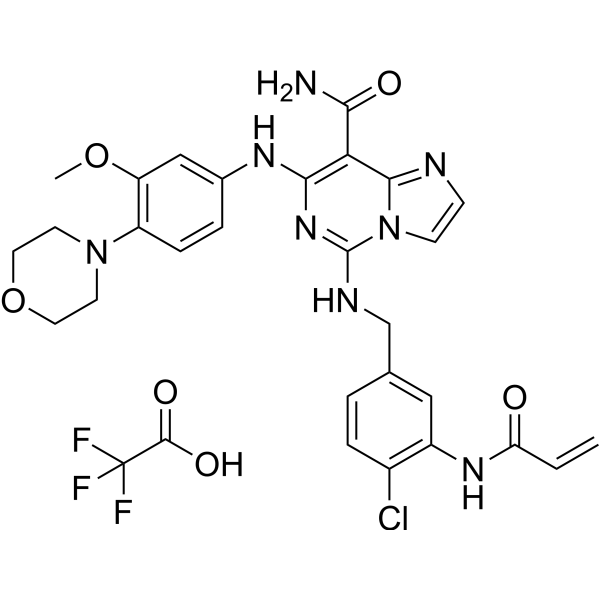
RDN2150 TFA
Based on 1 publication(s) in Google Scholar
RDN2150 TFA is a ZAP-70 inhibitor with an IC50 of 14.6 nM, and it exhibits selectivity for Syk over other kinases. RDN2150 TFA inhibits signal transduction and activation of T cells/CAR-T cells, reduces the phosphorylation level of Erk1/2, suppresses the induction of CD69 and IL-2, and downregulates phosphotyrosine signaling pathways including hnRNP sites in T cells. RDN2150 TFA can be used for psoriasis-related research.
For research use only. We do not sell to patients.
- Purity : 99.80%
- Formula: C30H30ClF3N8O6
- Molecular Weight:691.06
-
Storage:
-20°C, sealed storage, away from moisture
* In solvent : -80°C, 6 months; -20°C, 1 month (sealed storage, away from moisture)

To place orders, for customer services and technical support, please contact: MedChemExpress USA
Tel: 609-228-6898 E-mail: [email protected] [email protected]


-
 Biological Activity
-
Chemical Information
-
Solvent & Solubility
- Protocols
- Purity & Documentation
- References
-
 Help & FAQs


Publications Citing Use of MedChemExpress (MCE) RDN2150 TFA
More

Biological Activity
Description
IC50 & Target
IC50: 14.6 nM (ZAP-70)[1]
In Vitro
RDN2150 (0.1-10 μM; 3 h) TFA blocks LAT Y220 phosphorylation, disrupts the LAT/SLP76 signalosome, and inhibits downstream Erk1/2 and PLCγ1 activation in Jurkat T cells[2].
RDN2150 (0.1-10 μM; 25 h) TFA inhibits T cell activation markers in Jurkat T cells. In soluble antibody, APC-pMHC/TCR and CD19-CAR/Raji stimulation models, concentrations of 0.1-10 μM reduce CD69 expression and IL-2 secretion, while a concentration of 10 μM completely abrogates soluble antibody-induced CD69 expression[2].
MedChemExpress (MCE) has not independently confirmed the accuracy of these methods. They are for reference only.
-
Cell Line:Jurkat T cells (JOT1 and CD19-CAR Jurkat sublines)
-
Concentration:0.1 μM; 1 μM; 10 μM; 100 nM
-
Incubation Time:3 h
-
Result:Reduced basal Erk1/2 phosphorylation at 100 nM.
Impaired phosphorylation of LATY220 across all three stimulation methods at 10 μM.
Left phosphorylation of LckY394 unaffected at any concentration.
Significantly reduced phosphorylation of Erk1T202Y204/Erk2T185Y187 at 1 μM and 10 μM after 2.5 min of stimulation across all activation models.
Significantly enhanced PLCγ1Y783 induction after soluble antibody stimulation at low concentrations (0.1 μM, 1 μM).
In Vivo
MedChemExpress (MCE) has not independently confirmed the accuracy of these methods. They are for reference only.
-
Animal Model:BALB/c (female, 6-8 weeks old, 18-20 g, Imiquimod-induced psoriasis-like dermatitis)[1]
-
Dosage:2% (62.5 mg per application)
-
Administration:topical; once daily; 7 days
-
Result:Significantly reduced cumulative psoriasis severity total score (0-12 scale) compared to vehicle/ointment base controls, with statistically significant differences observed from day 2 onward.
Significantly decreased individual scores for scales, skin thickness, and erythema (0-4 scales each) with statistically significant differences from day 2 onward.
Significantly reduced splenomegaly, resulting in a lower spleen index (spleen weight/body weight) compared to the vehicle group.


Chemical Information
-
Appearance Solid
-
Molecular Weight 691.06
-
Formula C30H30ClF3N8O6
-
Color White to light yellow
-
SMILES
O=C(C1=C(N=C(N2C1=NC=C2)NCC3=CC(NC(C=C)=O)=C(C=C3)Cl)NC4=CC(OC)=C(C=C4)N5CCOCC5)N.OC(C(F)(F)F)=O
-
Shipping
Room temperature in continental US; may vary elsewhere.
-
Storage
-20°C, sealed storage, away from moisture
* In solvent : -80°C, 6 months; -20°C, 1 month (sealed storage, away from moisture)


Publications (1)
-
Journal Impact Factor
-
Most Recent


Solvent & Solubility
In Vitro:
DMSO : 125 mg/mL (180.88 mM; Need ultrasonic; Hygroscopic DMSO has a significant impact on the solubility of product, please use newly opened DMSO)
Please refer to the solubility information to select the appropriate solvent. Once prepared, please aliquot and store the solution to prevent product inactivation from repeated freeze-thaw cycles.
Storage method and period of stock solution: -80°C, 6 months; -20°C, 1 month (sealed storage, away from moisture). When stored at -80°C, please use it within 6 months. When stored at -20°C, please use it within 1 month.
Please refer to the solubility information to select the appropriate solvent. Once prepared, please aliquot and store the solution to prevent product inactivation from repeated freeze-thaw cycles.
Storage method and period of stock solution: -80°C, 6 months; -20°C, 1 month (sealed storage, away from moisture). When stored at -80°C, please use it within 6 months. When stored at -20°C, please use it within 1 month.
Concentration (start) × Volume (start) = Concentration (final) × Volume (final)


Purity & Documentation
-
Data Sheet (281 KB)
-
SDS (251 KB)
- English - EN (251 KB)
- Français - FR (251 KB)
- Deutsch - DE (251 KB)
- Norwegian - NO (251 KB)
- Español - ES (251 KB)
- Swedish - SV (251 KB)
- Italian - IT (251 KB)
- Korean - KR (251 KB)
- Portuguese - PT (251 KB)
-
Handling Instructions (2659 KB)
References
[1]. Rao D, et al. Discovery and Structural Optimization of Covalent ZAP-70 Kinase Inhibitors against Psoriasis. J Med Chem. 2023;66(17):12018-12032. [Content Brief]
[2]. Callahan A, et al. Phosphotyrosine proteomics reveals novel Zap70 and Itk pathway targets downstream of TCR and CAR in Jurkat T cells. Sci Rep. 2026;16(1):16482. Published 2026 Apr 6. [Content Brief]


Complete Stock Solution Preparation Table
Please refer to the solubility information to select the appropriate solvent. Once prepared, please aliquot and store the solution to prevent product inactivation from repeated freeze-thaw cycles.
Storage method and period of stock solution: -80°C, 6 months; -20°C, 1 month (sealed storage, away from moisture). When stored at -80°C, please use it within 6 months. When stored at -20°C, please use it within 1 month.
| Optional Solvent | Concentration Solvent Mass | 1 mg | 5 mg | 10 mg | 25 mg |
|---|---|---|---|---|---|
| DMSO | 1 mM | 1.4471 mL | 7.2353 mL | 14.4705 mL | 36.1763 mL |
| 5 mM | 0.2894 mL | 1.4471 mL | 2.8941 mL | 7.2353 mL | |
| 10 mM | 0.1447 mL | 0.7235 mL | 1.4471 mL | 3.6176 mL | |
| 15 mM | 0.0965 mL | 0.4824 mL | 0.9647 mL | 2.4118 mL | |
| 20 mM | 0.0724 mL | 0.3618 mL | 0.7235 mL | 1.8088 mL | |
| 25 mM | 0.0579 mL | 0.2894 mL | 0.5788 mL | 1.4471 mL | |
| 30 mM | 0.0482 mL | 0.2412 mL | 0.4824 mL | 1.2059 mL | |
| 40 mM | 0.0362 mL | 0.1809 mL | 0.3618 mL | 0.9044 mL | |
| 50 mM | 0.0289 mL | 0.1447 mL | 0.2894 mL | 0.7235 mL | |
| 60 mM | 0.0241 mL | 0.1206 mL | 0.2412 mL | 0.6029 mL | |
| 80 mM | 0.0181 mL | 0.0904 mL | 0.1809 mL | 0.4522 mL | |
| 100 mM | 0.0145 mL | 0.0724 mL | 0.1447 mL | 0.3618 mL |


RDN2150 TFA Related Classifications
HY-155978A Related Classifications
 Powered by Bioz