



PROTAC RIPK2 Degrader-1
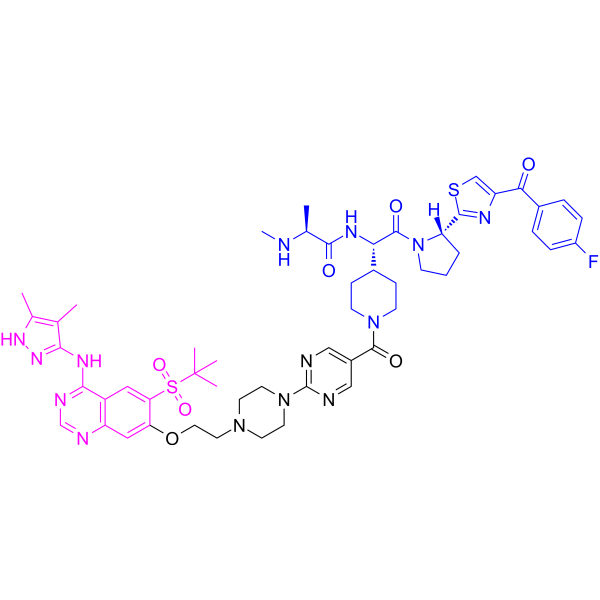
RIPK2-IN-2 (example 25) is a RIP2 kinase PROTAC inhibitor. RIPK2-IN-2 can block RIP2-dependent proinflammatory signaling, regulated RIP2 kinase activity in auto inflammatory diseases.
Nur für Forschungszwecke. Wir verkaufen nicht an Patienten.
- CAS. Nr.: 2143956-20-9
- Formel: C53H65FN14O7S2
- Molecular Weight:1093.30
-
Speicherung:
Please store the product under the recommended conditions in the Certificate of Analysis.

To place orders, for customer services and technical support, please contact: MedChemExpress USA
Tel: 609-228-6898 E-mail: [email protected] [email protected]


-
 Biologische Aktivität
-
Chemical Information
- Protokoll
- Reinheit & Dokumentation
- Verweise
-
 Help & FAQs


Alle PROTACs Isoform-spezifische Produkte anzeigen
More

Biologische Aktivität
Beschreibung
IC50 & Target
|
RIPK2 |
In Vitro
RIPK2-IN-2 (example 25) can simultaneously bind RIP2 kinase and an E3 ubiquitin ligase (VHL), which promotes ubiquitination of RIP2 Kinase and leads to RIP2 kinase degradation by the proteasome. through proteolysis targeting chimeric molecules PROTACs technology, RIPK2-IN-2 (example 25) can promotes ubiquitination of RIP2 Kinaseand degrade RIP2 kinase with the concentrations of RIPK2-IN-2﹤1 μM[1].
MedChemExpress (MCE) has not independently confirmed the accuracy of these methods. They are for reference only.
-
Cell Line:THP1 cells
-
Concentration:﹤1 μM
-
Incubation Time:12 h
-
Result:Displayed > 80% degradation of RIP2 at concentrations ﹤1 μM.


Chemical Information
-
CAS. Nr. 2143956-20-9
-
Molecular Weight 1093.30
-
Formel C53H65FN14O7S2
-
SMILES
O=C(N1CCC(CC1)[C@H](NC([C@H](C)NC)=O)C(N2[C@@](C3=NC(C(C4=CC=C(C=C4)F)=O)=CS3)([H])CCC2)=O)C5=CN=C(N=C5)N(CC6)CCN6CCOC(C(S(C(C)(C)C)(=O)=O)=C7)=CC8=C7C(NC9=NNC(C)=C9C)=NC=N8
-
Versand
Room temperature in continental US; may vary elsewhere.
-
Speicherung
Please store the product under the recommended conditions in the Certificate of Analysis.


Reinheit & Dokumentation
Verweise

Calculators
Konzentration (Stammlösung) × Volumen (Stammlösung) = Konzentration (Ziellösung) × Volumen (Ziellösung)


PROTAC RIPK2 Degrader-1 Related Classifications
HY-147235 Related Classifications
 Powered by Bioz