



KB-141
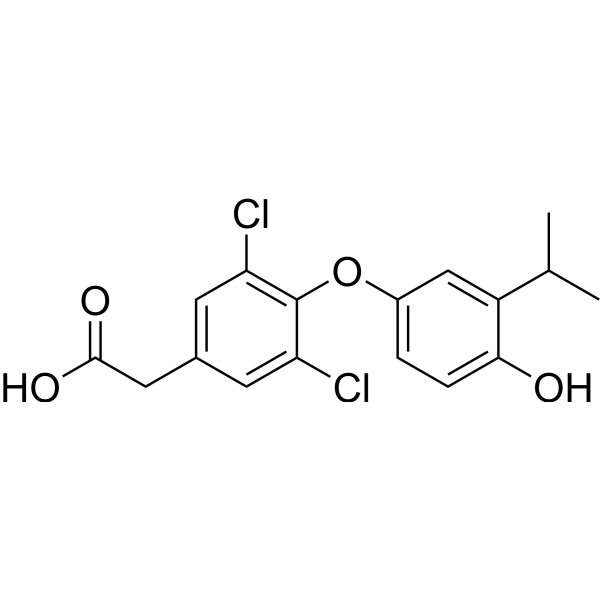
KB-141 is an orally active and selective thyroid hormone receptor β (TRβ1) agonist, with EC50 values of 11.2 nM and 3.4 nM for hTRα1 and hTRβ1 agonism, respectively, and binding IC50 values of 23.9 nM and 1.1 nM, respectively. KB-141 has the effects of lowering cholesterol and lipoproteins as well as reducing body weight. KB-141 selectively binds to and activates TRβ, thereby promoting energy expenditure and upregulating hepatic LDL receptors to lower cholesterol while avoiding significant tachycardia. KB-141 can be used for research on obesity and metabolic syndrome.
For research use only. We do not sell to patients.
- CAS No.: 219691-94-8
- Formula: C17H16Cl2O4
- Molecular Weight:355.21
-
Storage:
Please store the product under the recommended conditions in the Certificate of Analysis.

To place orders, for customer services and technical support, please contact: MedChemExpress USA
Tel: 609-228-6898 E-mail: [email protected] [email protected]


-
 Biological Activity
-
Chemical Information
- Protocols
- Purity & Documentation
- References
-
 Help & FAQs





Biological Activity
Description
IC50 & Target
[1]|
hTRβ1 3.4 nM (EC50, |
hTRβ1 1.1 nM (EC50) |
hTRα1 11.2 nM (IC50) |
hTRα1 23.9 nM (IC50) |
Cellular Effect
|
Cell Line

|
Type | Value | Description | References |
|---|---|---|---|---|
| CHO-K1 | EC50 |
11.2 nM
|
Agonist activity against CHO K1 TRAF-α cells assessed as hTRα1-mediated secreted alkaline phosphatase reporter activation by chemiluminescent assay.
Agonist activity against CHO K1 TRAF-α cells assessed as hTRα1-mediated secreted alkaline phosphatase reporter activation by chemiluminescent assay.
|
16007230 |
| CHO-K1 | EC50 |
3.4 nM
|
Agonist activity against CHO K1 TRAF-β1 cells assessed as hTRβ1-mediated secreted alkaline phosphatase reporter activation by chemiluminescent assay.
Agonist activity against CHO K1 TRAF-β1 cells assessed as hTRβ1-mediated secreted alkaline phosphatase reporter activation by chemiluminescent assay.
|
16007230 |
In Vitro
KB-141 is a full agonist in TRAF-α and TRAF-β1 reporter cells, with EC50 3.4 nM at hTRβ1 and 11.2 nM at hTRα1 and 8.3-fold normalized TRβ/TRα transactivation selectivity[1].
MedChemExpress (MCE) has not independently confirmed the accuracy of these methods. They are for reference only.
In Vivo
KB-141 (154-924 nmol/kg/day; p.o.; once daily; 7 days) significantly lowers plasma cholesterol, reduces the independent cardiovascular risk factor Lp (a) by up to 50%, and significantly reduces body weight in the short term in cynomolgus monkeys on a normal diet, with no tachycardia observed in any dose group[1].
KB-141 (0.00547-0.547 mg/kg; i.g.; once daily; 21 days) significantly reduces body weight and body fat percentage in the Zucker fa/fa obese rat model of non-diabetic obesity (fed a high-cholesterol diet) and does not cause an increase in heart rate at effective doses[2].
KB-141 (0.547 mg/kg/day; i.g.; once daily; 7 days) reduces serum and liver lipid levels and decreases body weight in cholesterol-fed ob/ob mice without affecting heart rate[2].
MedChemExpress (MCE) has not independently confirmed the accuracy of these methods. They are for reference only.
-
Animal Model:Cynomolgus monkeys[1]
-
Dosage:154, 462, and 924 nmol/kg/day
-
Administration:p.o.; once daily; 7 days
-
Result:Plasma cholesterol was reduced dose-dependently, by approximately 35% at 924 nmol/kg/day.
Body weight was reduced by 2% at 154 nmol/kg/day, 5% at 462 nmol/kg/day, and 7% at 924 nmol/kg/day compared with pretreatment values.
Lp(a) was reduced by approximately 50% at 462 and 924 nmol/kg/day.
No tachycardia occurred at any dose, and no effect on blood pressure was observed.
-
Animal Model:Zucker fa/fa (female, 425-450 g)[2]
-
Dosage:0.00547 mg/kg/day, 0.0547 mg/kg/day, and 0.547 mg/kg/day (dose-response); 0.164 mg/kg/day (separate group)
-
Administration:i.g.; once daily; 21 days
-
Result:Post-administration body weights were 572 g (vehicle), 540 g (0.00547 mg/kg/day), 543 g (0.0547 mg/kg/day), and 527 g (0.547 mg/kg/day); body-weight reductions were 5.7% at 0.0547 mg/kg/day and 9.4% at 0.547 mg/kg/day.
Serum cholesterol was 256 mg/dL (vehicle), 267 mg/dL (0.00547 mg/kg/day), 240 mg/dL (0.0547 mg/kg/day), and 218 mg/dL (0.547 mg/kg/day), with a 14.8% reduction at the highest dose.
Heart rates were 340 BPM, 330 BPM, 327 BPM, and 355 BPM, respectively.
In the 0.164 mg/kg/day group, percent adiposity was 62.1% (vehicle) versus 58.7%; body weight was 507 g versus 478 g; TSH was 2.4 ng/mL versus 0.6 ng/mL; heart rate was 397 versus 398 BPM.
No loss of lean body mass was detected.
-
Animal Model:ob/ob (female, 37-43 g)[2]
-
Dosage:0.547 mg/kg/day
-
Administration:i.g.; once daily; 7 days
-
Result:Serum cholesterol was 506 mg/dL (vehicle) versus 336 mg/dL; serum triacylglycerols were 447 mg/dL versus 323 mg/dL; liver cholesterol was 113 mg/g versus 119 mg/g; liver triacylglycerols were 42 mg/g versus 25 mg/g; serum NEFA was 5.1 mM versus 4.2 mM.
Reductions were 36% in total cholesterol, 28% in triacylglycerols, 30% in liver triacylglycerols, and 18% in NEFA.
Post-administration body weight was 38.6 g (vehicle) versus 35.3 g, approximately a 9% reduction.
No effect on heart rate was observed.
-
Animal Model:ob/ob (female, 42-46 g)[2]
-
Dosage:0.0547 mg/kg/day or 0.328 mg/kg/day
-
Administration:i.g.; once daily; 14 days
-
Result:IPGTT AUC was reduced by 33% at 0.0547 mg/kg/day and 47% at 0.328 mg/kg/day versus vehicle.
IPITT AUC was reduced by 54% and 67%, respectively.
At 0.0547 mg/kg/day, post-administration body weight was 47.7 g (vehicle) versus 43.1 g, approximately 8% lower; at 0.328 mg/kg/day, body weight was 18% lower than vehicle.
No change in heart rate was observed.


Chemical Information
-
CAS No. 219691-94-8
-
Molecular Weight 355.21
-
Formula C17H16Cl2O4
-
SMILES
O=C(CC1=CC(Cl)=C(C(Cl)=C1)OC2=CC=C(C(C(C)C)=C2)O)O
-
Shipping
Room temperature in continental US; may vary elsewhere.
-
Storage
Please store the product under the recommended conditions in the Certificate of Analysis.


Purity & Documentation


References

Calculators
Concentration (start) × Volume (start) = Concentration (final) × Volume (final)


KB-141 Related Classifications
HY-117167 Related Classifications
 Powered by Bioz