302 Results for "

IL-6 expression

" in MedChemExpress (MCE) Product Catalog:
Products (302)

302 Results for "IL-6 expression" in MCE Product Catalog:

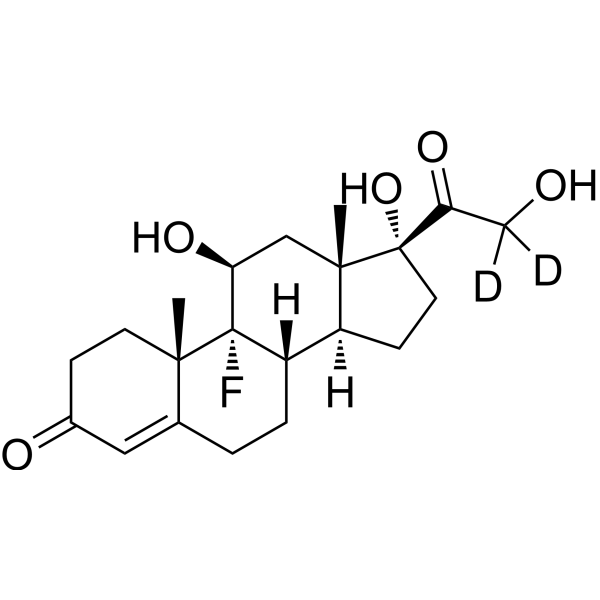
Cat. No.: HY-B1203S1
Synonyms: 9α-Fludrocortisone-d2; 9α-Fluorcortisol-d2
Fludrocortisone-d2 (9α-Fludrocortisone-d2) is the deuterium labeled Fludrocortisone (HY-B1203). Fludrocortisone is an orally active mineralocorticoid and glucocorticoid receptor agonist. Fludrocortisone suppresses pro-inflammatory cytokine expression, reduces CCL2, IL-6, IL-8 levels, upregulates mineralocorticoid receptor (MR) expression, induces PI3K/Akt, GSK-3β, CREB, ERK1/2, mTOR phosphorylation, blocks Tau hyperphosphorylation, prevents apoptosis, promotes survival and proliferation, enhances renal sodium and water transport, increases plasma volume and blood pressure, reduces plasma potassium and renin activity, stimulates erythropoietin expression, modulates uterine receptivity genes, and reverses PP242-induced MUC1 upregulation. Fludrocortisone can be used for the research of congenital adrenal hyperplasia, postural hypotension, and adrenal insufficiency.
loading...
    loading...
Cat. No.: HY-N18667
CAS No.: 84696-21-9
Centella asiatica extract is an orally active herbal extract. Centella asiatica extract scavenges free radicals, increases stratum corneum hydration, improves epidermal barrier function, and reduces skin redness and skin pH. Centella asiatica extract inhibits pro-inflammatory cytokines, suppresses p38 MAPK phosphorylation, reduces mast cell infiltration, and decreases the expression of TNF-α, IL-4, IL-5, IL-6, IL-17, CXCL9, iNOS and COX-2. Centella asiatica extract upregulates the expression of BDNF and downregulates the expression of VGLUT1, and exhibits neuroprotective effects under hypoxic conditions. Centella asiatica extract inhibits pro-inflammatory M1 macrophage polarization and prevents adipose tissue senescence. Centella asiatica extract can be used in studies related to hypoxia-induced neurological dysfunction, atopic dermatitis, and obesity-induced insulin resistance .
loading...
    loading...
Cat. No.: HY-12642AR
CAS No.: 90-89-1
Diethylcarbamazine (Standard) is the analytical standard of Diethylcarbamazine (HY-12642A). This product is intended for research and analytical applications. Diethylcarbamazine is an orally active microfilaricidal agent used originally in onchocerciasis and lymphatic filiariasis. Diethylcarbamazine reduces eosinophil trafficking to the lung tissue and exerts anti-allergic effects. Diethylcarbamazine reduces serum levels of leptin, TNF-α, IL-6, MCP-1, glucose, insulin, and triglycerides, and ameliorates insulin resistance without altering body, liver, or adipose tissue weights. Diethylcarbamazine enhances reactive oxygen intermediate expression by polymorphonuclear neutrophils, increases lymphocyte proliferation, and inhibits actinomycetoma lesion development. Diethylcarbamazine can be used for the researches of bronchial asthma, insulin resistance and infection .
loading...
    loading...
Cat. No.: HY-138834
CAS No.: 1042673-20-0
JH-I-25 is an orally active IRAK1 and IRAK4 inhibitor. JH-I-25 inhibits LPS-induced IRAK4 phosphorylation, IRAK1 degradation, MAPK activation, and the expression of proinflammatory cytokines TNF-α and IL-6 in lung tissues. JH-I-25 improves the survival rate of LPS-induced septic mice and serves as an IRAK4 recruiter in the design of proteolysis-targeting chimeric molecules. JH-I-25 can be used in research related to diffuse large B-cell lymphoma, Waldenström's macroglobulinemia, septic shock, rheumatoid arthritis, atherosclerosis, Alzheimer's disease, acute lung injury, sepsis, and psoriasis .
loading...
    loading...
Cat. No.: HY-147141B
HS-276 formic is an orally active, potent and highly selective TAK1 inhibitor, with a Ki of 2.5 nM. HS-276 formic shows significant inhibition of TAK1, CLK2, GCK, ULK2, MAP4K5, IRAK1, NUAK, CSNK1G2, CAMKKβ-1, and MLK1, with IC50 values of 8.25, 29, 33, 63, 125, 264, 270, 810, 1280, and 5585 nM, respectively. HS-276 formic reduces the expression of TNF, IL-6, and IL-1β. HS-276 formic can be used for rheumatoid arthritis (RA) research .
loading...
    loading...
Cat. No.: HY-175026
CAS No.: 3036254-29-9
RIPK2-IN-8 is an orally active and highly selective RIPK2 inhibitor (IC50 = 11 nM). RIPK2-IN-8 is highly selective for RIPK2 over RIPK1 (IC50 > 30,000 nM) and has a moderate inhibitory effect on RIPK3 (IC50 = 44.61 nM). RIPK2-IN-8 inhibits the NOD2-RIPK2 signaling pathway and the expression of the inflammatory cytokines IL-6 and TNFα, thereby exerting anti-inflammatory effects. RIPK2-IN-8 has demonstrated anti-inflammatory and hepatoprotective effects in an acute liver injury (ALI) model and can be used in ALI research .
loading...
    loading...
Cat. No.: HY-178950
CAS No.: 3115216-60-6
Hck-IN-3 (compound 2D) is an orally effective inhibitor targeting HCK (KD = 3.92 μM). Hck-IN-3 can inhibit the release of NO. Hck-IN-3 has an IC50 of 6.52 μM in RAW264.7 cells. Hck-IN-3 can inhibit the release of TNF-α, IL-6, and IL-1β in a concentration dependent manner. Hck-IN-3 downregulates the protein expression of NLRP3, ASC, pro-caspase-1, and pro-IL-1β in a concentration dependent manner. Hck-IN-3 can be used for research on acute non traumatic inflammatory conditions .
loading...
    loading...
Cat. No.: HY-182282
PI3K/AKT-IN-6 is an orally effective PI3K/AKT signaling pathway inhibitor and anti-inflammatory agent. PI3K/AKT-IN-6 inhibits the production of pro-inflammatory cytokines TNF-α and IL-6, and downregulates the expression of inflammatory mediators COX-2 and iNOS. PI3K/AKT-IN-6 improves related symptoms in colitis mice. PI3K/AKT-IN-6 can be used for the research of inflammatory diseases such as colitis .
loading...
    loading...
Cat. No.: HY-187220
CAS No.: 3119216-05-3
β5i-IN-2 is a potent, selective, and orally active inhibitor of the immunoproteasome β5i subunit, with an IC50 of 0.08 μM against human β5i. β5i-IN-2 inhibits LPS (HY-D1056)- and IFN-γ-induced expression of IL-1β, IL-6, and TNF-α, and suppresses the JNK, ERK, and NF-κB signaling pathways. β5i-IN-2 can be used in research related to rheumatoid arthritis and ulcerative colitis .
loading...
    loading...
Cat. No.: HY-P5523
CAS No.: 592520-07-5
iE-DAP is a Nod1 agonist. iE-DAP activates NOD1, which in turn activates the NF-κB signaling pathway and MLCK signaling pathway, inducing cellular inflammatory responses and tight junction disruption. iE-DAP downregulates the expression of ZO-1 and Occludin genes. iE-DAP increases the secretion of IL-6, GRO-α, MCP-1, IL-8 and MIP-1β in term human trophoblast cell cultures. iE-DAP triggers preterm birth in pregnant mice, reduces fetal body weight, and induces fetal inflammation. iE-DAP is applicable to research related to mastitis and preterm birth .
loading...
    loading...
Cat. No.: HY-P5523A
iE-DAP dihydrochloride is a Nod1 agonist. iE-DAP dihydrochloride activates NOD1, which in turn activates the NF-κB signaling pathway and MLCK signaling pathway, inducing cellular inflammatory responses and tight junction disruption. iE-DAP dihydrochloride downregulates the expression of ZO-1 and Occludin genes. iE-DAP dihydrochloride increases the secretion of IL-6, GRO-α, MCP-1, IL-8 and MIP-1β in term human trophoblast cell cultures. iE-DAP dihydrochloride triggers preterm birth in pregnant mice, reduces fetal body weight, and induces fetal inflammation. iE-DAP dihydrochloride can be used in studies related to mastitis and preterm birth .
loading...
    loading...
Cat. No.: HY-W041608
CAS No.: 26172-55-4
Methylchloroisothiazolinone is a widely used fungicide and also an aquatic pollutant with pro-inflammatory activity and neurotoxicity. Methylchloroisothiazolinone induces the production of pro-inflammatory cytokines (such as IL-1β, TNF-α, IL-6) by activating the NF-κB signaling pathway and upregulating TLR4 expression, thereby triggering allergic contact dermatitis. Methylchloroisothiazolinone reduces cholinesterase activity and exacerbates oxidative stress by impairing catalase activity and disrupting redox balance. Methylchloroisothiazolinone poses significant harm to Mediterranean mussels, reducing the viability of hemocytes and digestive gland cells, inhibiting immune phagocytic function, and disrupting osmoregulatory capacity. Methylchloroisothiazolinone is used in studies on allergic contact dermatitis and related immunotoxicity mechanisms .
loading...
    loading...
Cat. No.: HY-184736
STAT3/NF-κB-IN-3 is an orally active STAT3/NF-κB inhibitor with anti-inflammatory and antioxidant activities, which specifically blocks the phosphorylation of NF-κB and STAT3 proteins. STAT3/NF-κB-IN-3 downregulates the expression of iNOS and NOX-2 in macrophages, reduces intracellular levels of ROS and MDA, and upregulates the expression of antioxidant genes at the same time. In a mouse model of acute liver failure induced by LPS/D-GalN, STAT3/NF-κB-IN-3 alleviates liver necrosis and inflammatory cell infiltration, and reduces the release of pro-inflammatory cytokines such as IL-6 and IL-12 via the TLR4 pathway. STAT3/NF-κB-IN-3 can be used in studies related to acute liver failure .
loading...
    loading...
Cat. No.: HY-187097
SARS-CoV-2 3CLpro-IN-40 is a SARS-CoV-2 3CL pro inhibitor with an IC50 of 2.041 μM. SARS-CoV-2 3CLpro-IN-40 reduces the expression level of viral nucleocapsid protein and the expression levels of proinflammatory cytokines (IL-6, TNF-α and IFN-β). SARS-CoV-2 3CLpro-IN-40 decreases the RNA level of infectious bronchitis virus. SARS-CoV-2 3CLpro-IN-40 inhibits SARS-CoV-2 infection. SARS-CoV-2 3CLpro-IN-40 reduces the replication level of HCoV-OC43. SARS-CoV-2 3CLpro-IN-40 is applicable to research related to coronavirus infection .
loading...
    loading...
Cat. No.: HY-12642R
CAS No.: 1642-54-2
Diethylcarbamazine citrate (Standard) is the analytical standard of Diethylcarbamazine citrate (HY-12642). This product is intended for research and analytical applications. Diethylcarbamazine citrate is an orally active microfilaricidal agent used originally in onchocerciasis and lymphatic filiariasis. Diethylcarbamazine citrate reduces eosinophil trafficking to the lung tissue and exerts anti-allergic effects. Diethylcarbamazine citrate reduces serum levels of leptin, TNF-α, IL-6, MCP-1, glucose, insulin, and triglycerides, and ameliorates insulin resistance without altering body, liver, or adipose tissue weights. Diethylcarbamazine citrate enhances reactive oxygen intermediate expression by polymorphonuclear neutrophils, increases lymphocyte proliferation, and inhibits actinomycetoma lesion development. Diethylcarbamazine citrate can be used for the researches of bronchial asthma, insulin resistance and infection .
loading...
    loading...
Cat. No.: HY-160844
CAS No.: 2417155-47-4
CT-133 is a selective and potent CRTH2 Receptor antagonist, with a Ki value of 2.2 nM. The Ki value for the DP1 receptor is greater than 3800 nM. CT-133 inhibits neutrophil migration induced by PGD2 (HY-101988). CT-133 significantly alleviates lung inflammation and improves lung function impairment in a mouse model of acute lung injury (ALI) induced by cigarette smoke. CT-133 effectively inhibits the excessive expression of pro-inflammatory cytokines (TNF-α, IL-1β, and IL-6) and chemokines (KC), and reverses the inhibition of the anti-inflammatory factor IL-10. CT-133 can be used for the study of ALI .
loading...
    loading...
Cat. No.: HY-167939
CAS No.: 788821-30-7
Target:  

Adrenergic Receptor

Research Areas:  

Inflammation/Immunology

(R)-Bambuterol is a β2-receptor agonist with anti-asthmatic and colitis-improving activity. (R)-Bambuterol is indicated for the treatment of asthma and chronic obstructive pulmonary disease and has the advantage of a once-daily dosing and a favorable side effect profile. (R)-Bambuterol significantly reduced disease severity in a mouse model of colitis, more effectively than (RS)-Bambuterol or (S)-Bambuterol. (R)-Bambuterol can significantly reduce the levels of inflammatory cytokines and reduce the infiltration of macrophages in mice with colitis. (R)-Bambuterol also increases β2-adrenoceptor levels and reduces the expression of IL-6, IL-17 and other related proteins in colon tissue in a dose-dependent manner .
loading...
    loading...
Cat. No.: HY-178041
CAS No.: 3106588-54-6
BRD4-BD1/2-IN-3 (Compound B6) is a selective BRD4 BD2 inhibitor with an IC50 of 0.41  nM for BRD4 BD2 over BRD4 BD1. BRD4-BD1/2-IN-3 significantly inhibits the LPS (HY-D1056)-induced expression of IL-6. BRD4-BD1/2-IN-3 shows anti-inflammatory activities by modulating the TNF and NF-κB signaling pathway. BRD4-BD1/2-IN-3 can be used for inflammatory diseases research .
loading...
    loading...
Cat. No.: HY-178761
CAS No.: 3093312-81-0
PGK1-IN-1 (Compound 6e) is a potent and selective PGK1 inhibitor (IC50: 33 nM). PGK1-IN-1 inhibits PGK1-mediated glycolytic metabolism and reduces glucose consumption/lactate production. PGK1-IN-1 enhances Nrf2 accumulation and HO-1 expression, and suppresses the transcription and protein levels of the inflammatory cytokines IL-1β and IL-6. PGK1-IN-1 ameliorates Dextran sulfate sodium (DSS) (HY-116282C)-induced experimental colitis in mice. PGK1-IN-1 can be used for research of inflammatory bowel disease (IBD) .
loading...
    loading...
Cat. No.: HY-182064
Research Areas:  

Cancer

EGFR-IN-206 is an orally active EGFR inhibitor. EGFR-IN-206 inhibits the phosphorylation of the key tumor growth protein EGFR, and suppresses the proliferation, migration and invasion of EGFR triple-mutant tumor cell lines. EGFR-IN-206 downregulates the expression of inflammation-related proteins iNOS, COX-2 and NF-κB (p65). EGFR-IN-206 promotes the secretion of NO. EGFR-IN-206 reduces the secretion of IL-6. EGFR-IN-206 induces apoptosis (apoptosis) of EGFR triple-mutant tumor cells. EGFR-IN-206 exerts antitumor activity in EGFR triple-mutant mice. EGFR-IN-206 is applicable to the research of non-small cell lung cancer .
loading...
    loading...

