37 Results for "

monoamine uptake

" in MedChemExpress (MCE) Product Catalog:
Products (37)

37 Results for "monoamine uptake" in MCE Product Catalog:

Cat. No.: HY-108256R
CAS No.: 10563-70-9
Research Areas:  

Neurological Disease

Melitracen (hydrochloride) (Standard) is the analytical standard of Melitracen (hydrochloride). This product is intended for research and analytical applications. Melitracen hydrochloride is an orally active biphasic antidepressant and antianxiety agent. Melitracen hydrochloride can inhibit the uptake of Norepinephrine and 5-HT (serotonin) through the presynaptic membrane inducing the increase of monoamine transmitters in synaptic space .
loading...
    loading...
Cat. No.: HY-B0590R
CAS No.: 58-46-8
Synonyms: Ro 1-9569 (Standard)
Tetrabenazine (Standard) is the analytical standard of Tetrabenazine (HY-B0590). This product is intended for research and analytical applications. Tetrabenazine (Ro 1-9569) is a brain-penetrant and orally active VMAT2-selective ligand with human VMAT2 Ki 100 nM. Tetrabenazine binds VMAT2 to block monoamine uptake into synaptic vesicles, potentiates cytoplasmic monoamine degradation. Tetrabenazine weakly blocks dopamine D2 receptors, and increases dopamine turnover via elevated cerebrospinal fluid homovanillic acid. Tetrabenazine can be used for the research of Huntington’s disease, tardive dyskinesia, and Tourette’s syndrome .
loading...
    loading...
Cat. No.: HY-116062
CAS No.: 109085-56-5
JNJ-7925476 (hydrochloride) is a triple monoamine uptake inhibitor with the ability to regulate neurotransmitter levels and antidepressant activity. JNJ-7925476 (hydrochloride) can be rapidly absorbed into the plasma in rats, with a higher concentration in the brain than in plasma. It can induce an increase in the levels of extracellular serotonin, dopamine, and norepinephrine in the rat cerebral cortex, and exhibits antidepressant activity in the mouse tail suspension test.
loading...
    loading...
Cat. No.: HY-B0590S3
CAS No.: 2701977-99-1
Synonyms: TBZ-d7-d7; Ro 1-9569-d7
Tetrabenazine-d7 (TBZ-d7-d7) is deuterium labeled Tetrabenazine (HY-B0590). Tetrabenazine (Ro 1-9569) is a brain-penetrant and orally active VMAT2-selective ligand with human VMAT2 Ki 100 nM. Tetrabenazine binds VMAT2 to block monoamine uptake into synaptic vesicles, potentiates cytoplasmic monoamine degradation. Tetrabenazine weakly blocks dopamine D2 receptors, and increases dopamine turnover via elevated cerebrospinal fluid homovanillic acid. Tetrabenazine can be used for the research of Huntington’s disease, tardive dyskinesia, and Tourette’s syndrome .
loading...
    loading...
Cat. No.: HY-W001601A
CAS No.: 63661-61-0
Target:  

iGluR

Research Areas:  

Neurological Disease

Budipine hydrochloride is an anti-parkinson agent. Budipine hydrochloride also is a substrate of P-glycoprotein (P-gp), is mediated the uptake into the brain by P-gp. Budipine hydrochloride also is N-methyl-d-aspartate (NMDA) antagonist, and has indirect dopaminergic effects through an improved dopamine release, the inhibition of monoamine oxidase type B (MAO-B). Budipine hydrochloride can be used for the research of CNS disorders include Parkinson disease .
loading...
    loading...
Cat. No.: HY-18610R
CAS No.: 34041-84-4
Synonyms: Ro 8-4650 hydrochloride (Standard)
Diclofensine (Ro 8-4650) hydrochloride (Standard) is the analytical standard of Diclofensine hydrochloride. This product is intended for research and analytical applications. Diclofensine hydrochloride is an orally active neuronal monoamine uptake inhibitor. Diclofensine hydrochloride blocks the uptake of dopamine, noradrenaline, and serotonin by rat brain synaptosomes with IC50 values of 0.74, 2.3 and 3.7 nM, respectively. Diclofensine hydrochloride potentiates norepinephrine-induced hypertension and attenuates Tyramine (HY-W007606)-induced hypertension. Diclofensine hydrochloride produces psychostimulant and mood-elevating effects without causing sudden disappearance or withdrawal reactions. Diclofensine hydrochloride can be used in the research of moderate to severe depression.
loading...
    loading...
Cat. No.: HY-18610S
CAS No.: 1794780-41-8
Diclofensine-d3 (Ro-8-4650-d3) hydrochloride is the deuterium labeled Diclofensine hydrochloride. Diclofensine hydrochloride is an orally active neuronal monoamine uptake inhibitor. Diclofensine hydrochloride blocks the uptake of dopamine, noradrenaline, and serotonin by rat brain synaptosomes with IC50 values of 0.74, 2.3 and 3.7 nM, respectively. Diclofensine hydrochloride potentiates norepinephrine-induced hypertension and attenuates Tyramine (HY-W007606)-induced hypertension. Diclofensine hydrochloride produces psychostimulant and mood-elevating effects without causing sudden disappearance or withdrawal reactions. Diclofensine hydrochloride can be used in the research of moderate to severe depression.
loading...
    loading...
Cat. No.: HY-B0528AS
CAS No.: 1219803-62-9
Synonyms: (±)-p-Octopamine-d4 hydrochloride
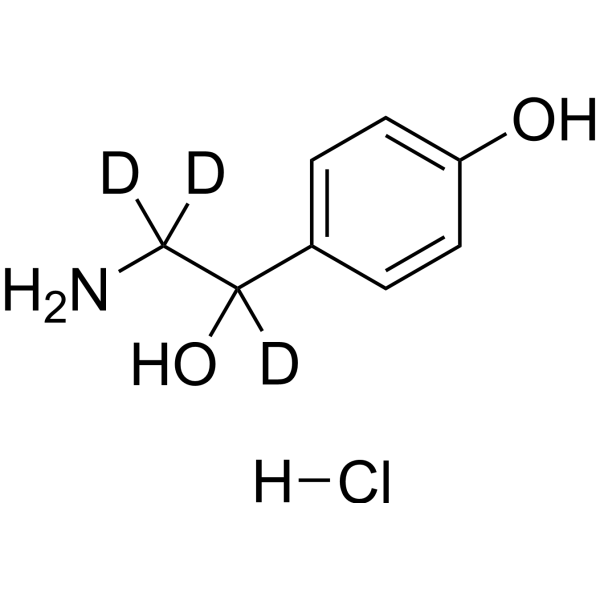
Octopamine-d4 (hydrochloride) is the deuterium labeled Octopamine hydrochloride. Octopamine ((±)-p-Octopamine) hydrochloride, a biogenic monoamine structurally related to noradrenaline, acts as a neurohormone, a neuromodulator and a neurotransmitter in invertebrates. Octopamine hydrochloride can stimulate alpha2-adrenoceptors (ARs) in Chinese hamster ovary cells transfected with human alpha2-ARs. Octopamine hydrochloride increased glycogenolysis, glycolysis, oxygen uptake, gluconeogenesis and the portal perfusion pressure .
loading...
    loading...
Cat. No.: HY-117542
CAS No.: 16740-29-7
Research Areas:  

Neurological Disease

D595 is a phenylethylamine calcium channel blocker with potent negative inotropic activity. D595 has shown significant efficacy in its corresponding pharmacological studies, especially in inhibiting the uptake of monoamine neurotransmitters. D595 has high affinity in binding to the dopamine transporter (DAT), serotonin transporter (SERT), and norepinephrine transporter (NET). Structural adjustments of D595, especially changes in the hydroxyl stereochemistry, significantly affect its interaction with the transporters, showing a specific preference for stereoisomers .
loading...
    loading...
Cat. No.: HY-W001601R
CAS No.: 57982-78-2
Research Areas:  

Neurological Disease

Budipine (Standard) is the analytical standard of Budipine. This product is intended for research and analytical applications. Budipine is an anti-parkinson agent. Budipine also is a substrate of P-glycoprotein (P-gp), is mediated the uptake into the brain by P-gp. Budipine also is N-methyl-d-aspartate (NMDA) antagonist, and has indirect dopaminergic effects through an improved dopamine release, the inhibition of monoamine oxidase type B (MAO-B). Budipine can be used for the research of CNS disorders include Parkinson disease .
loading...
    loading...
Cat. No.: HY-14197AR
CAS No.: 17780-75-5
Synonyms: M&B 9302 hydrochloride (Standard)
Clorgyline hydrochloride (Standard) (M&B 9302 hydrochloride (Standard)) is the analytical standard of Clorgyline hydrochloride (HY-14197A). This product is intended for research and analytical applications. Clorgyline hydrochloride (M&B 9302 hydrochloride) is a selective, irreversible monoamine oxidase A (MAO-A) inhibitor that can cross the blood-brain barrier and exhibits activity against the 5-HT Receptor at very high doses. Clorgyline hydrochloride regulates monoamine neurotransmitter levels, the release of dopamine and acetylcholine, the uptake and effects of Tyramine (HY-W007606), noradrenergic function, circadian locomotor activity rhythms, feeding behavior, and body weight. Clorgyline hydrochloride induces tumor-suppressive transcriptional programs, secretory differentiation, androgen signaling regulation, Bcl-2 expression, and radioprotective effects in non-malignant cells. Clorgyline hydrochloride is used in the research of high-grade prostate cancer, Huntington's disease, major affective disorder, radiation-induced normal tissue toxicity, and obesity .
loading...
    loading...
Cat. No.: HY-135030
CAS No.: 199672-06-5
Target:  

Drug Derivative

Research Areas:  

Neurological Disease

4-Fluoro BZP hydrochloride is a benzylpiperazines (BZP) derivative. Benzylpiperazines are stimulant agents which inhibit monoamine uptake.
loading...
    loading...
Cat. No.: HY-W367959
CAS No.: 50366-32-0
Target:  

Monoamine Transporter

Research Areas:  

Neurological Disease

Flunamine is a broad-spectrum monoamine transporter inhibitor that inhibits the uptake of dopamine (DA), 5-hydroxytryptamine (5-HT), and noradrenaline (NA) in rat brain synaptosomes. The IC50 values of Flunamine for DA and 5-HT uptake in rat striatal synaptosomes are 0.26 μM and 0.17 μM, respectively, and the IC50 values for 5-HT and NA uptake in hypothalamic synaptosomes are 0.24 μM and 0.092 μM, respectively. Flunamine acts through broad-spectrum inhibition of dopaminergic, serotonergic, and noradrenergic monoamine reuptake and is used in research related to depression and Parkinson's disease .
loading...
    loading...
Cat. No.: HY-187661
CAS No.: 42408-79-7
Target:  

5-HT Receptor

Research Areas:  

Neurological Disease

Pirandamine free base is a selective serotonin (5-HT) (HY-B1473A) uptake inhibitor with an IC50 of 250 nM. It exerts antidepressant-like effects by enhancing central serotonergic function, does not inhibit norepinephrine (HY-13715) uptake, and exhibits no central anticholinergic or monoamine oxidase inhibitory activity. Pirandamine free base is used in the study of depression .
loading...
    loading...
Cat. No.: HY-182484
CAS No.: 372198-80-6
Target:  

GlyT

Research Areas:  

Neurological Disease

Org 24461 is a selective and brain-penetrant GlyT-1 inhibitor. Org 24461 blocks glycine uptake, reuptake, reverse operation, [ 3H]glycine efflux and release. Org 24461 enhances NMDA receptor function, modulates striatal monoamine/glutamate levels, and reverses PCP-induced behavioral and electrographic abnormalities. Org 24461 can be used for the research of retinal hypoxia/ischemia, and schizophrenia .
loading...
    loading...
Cat. No.: HY-14472S
Synonyms: NS-2330-d5
Tesofensine-d5 (NS-2330-d5) is the deuterium labeled Tesofensine (HY-14472). Tesofensine (NS-2330) is a triple monoamine reuptake inhibitor inducing a potent inhibition of the re-uptake process in the synaptic cleft of the neurotransmitters dopamine (DA; IC50=6.5 nM), norepinephrine (NE;IC50=1.7 nM), and serotonin (5-HT;IC50=11 nM), and with potentials as an anti-obesity agent. Tesofensine is a CNS acting anti-obesity agent.
loading...
    loading...
Cat. No.: HY-14472S1
Synonyms: NS-2330-13C,d3
Tesofensine- 13C,d3 (NS-2330- 13C,d3) is the deuterium and 13C-labeled Tesofensine (HY-14472). Tesofensine (NS-2330) is a triple monoamine reuptake inhibitor inducing a potent inhibition of the re-uptake process in the synaptic cleft of the neurotransmitters dopamine (DA; IC50=6.5 nM), norepinephrine (NE;IC50=1.7 nM), and serotonin (5-HT;IC50=11 nM), and with potentials as an anti-obesity agent . Tesofensine is a CNS acting anti-obesity agent .
loading...
    loading...

