113 Results for "

ER dilation

" in MedChemExpress (MCE) Product Catalog:
Products (113)

113 Results for "ER dilation" in MCE Product Catalog:

Cat. No.: HY-117618
CAS No.: 134186-26-8
Target:  

Drug Derivative

Research Areas:  

Cardiovascular Disease

KF-14124, an orally active organic nitrate, a long-acting vasodilator with highly selective venous dilating action. KF-14124 is used in the study for angina pectoris. KF-14124 shows good oral inhibition of lysine-vasopressin induced coronary vasospasm with a potency .
loading...
    loading...
Cat. No.: HY-129445
CAS No.: 83440-03-3
Target:  

Potassium Channel

Research Areas:  

Cardiovascular Disease

SG-209 is a Nicorandil (HY-B0341) derivative that produces relaxation through potassium channel activation, while this action contributes to the vasodilating action of Nicorandil (HY-B0341) at higher concentrations. SG-209 dilates tracheal smooth muscle and increases tracheal blood flow in anesthetized dogs .
loading...
    loading...
Cat. No.: HY-14915A
CAS No.: 194785-31-4
Synonyms: MN-221; KUR-1246
Target:  

Adrenergic Receptor

Research Areas:  

Inflammation/Immunology

Bedoradrine (MN-221) sulfate is a highly selective β2-adrenergic receptor agonist. Bedoradrine sulfate can effectively relieve airway spasm, dilate airway smooth muscle cells, reduce airway inflammation, and thus improve respiratory function. Bedoradrine sulfate can be used in research on asthma .
loading...
    loading...
Cat. No.: HY-112076R
CAS No.: 2870-71-5
Synonyms: Methylatropine bromide (Standard)
Research Areas:  

Neurological Disease

Atropine methyl bromide (Standard) is the analytical standard of Atropine methyl bromide. This product is intended for research and analytical applications. Atropine methyl bromide (Methylatropine bromide), an antagonist of muscarinic acetylcholine receptors (mAChR), is a quaternary ammonium salt of atropine and a mydriatic for dilation of the pupil during ophthalmic examination. It is introduced for relieving pyloric spasm in infants for its highly polar nature. It penetrates less readily into the central nervous system than atropine .
loading...
    loading...
Cat. No.: HY-17360R
CAS No.: 136310-93-5
Synonyms: BA679 BR (Standard)
Research Areas:  

Neurological Disease

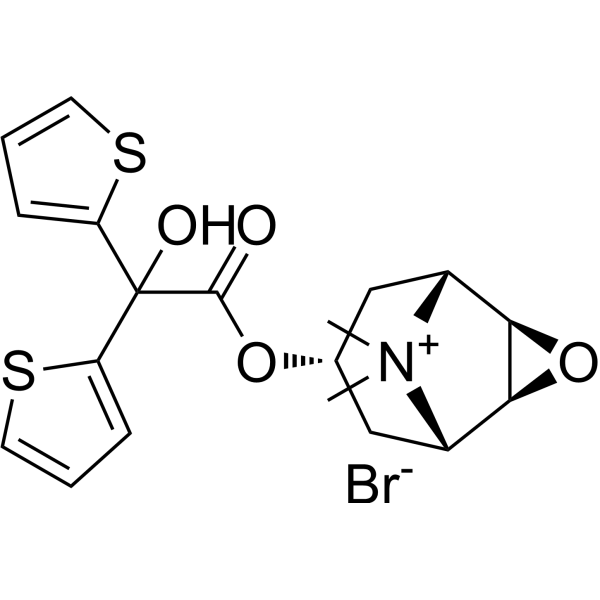
Tiotropium (Bromide) (Standard) is the analytical standard of Tiotropium (Bromide). This product is intended for research and analytical applications. Tiotropium bromide (BA-679 BR) is a long-acting anticholinergic bronchodilator. Tiotropium bromide blocks the action of acetylcholine at muscarinic M1, M2, and M3 receptors, prevents bronchoconstriction, and dilates bronchial airways. Tiotropium bromide is applicable to research related to chronic obstructive pulmonary disease and asthma .
loading...
    loading...
Cat. No.: HY-170774
Hypoxia inducer-1 (Compound N6) is an orally active hypoxia activated nitric oxide (NO) donor compound. Hypoxia inducer-1 exhibits highly selective NO release under hypoxic conditions and inhibits hypoxia-induced apoptosis, necrosis, and the increase in ROS levels. Hypoxia inducer-1 regulates vascular dilation and has a protective effect in a mouse model of myocardial hypoxia injury. Hypoxia inducer-1 can be used in the research of coronary heart disease .
loading...
    loading...
Cat. No.: HY-121185A
CAS No.: 32266-10-7
Hexoprenaline sulfate is an orally active and selective β-adrenergic receptor agonist. Hexoprenaline sulfate can dilate the bronchi. Hexoprenaline sulfate can activate adenylate cyclase and increases 14C-Aminopyrine uptake. Hexoprenaline sulfate exhibits anti-infection and anti-inflammmation effect. Hexoprenaline sulfate can increase placental weight and blood flow. Hexoprenaline sulfate can be used for the researches of inflammation, immunology, infection, endocrinology and neurological disease, such as asthma, chronic bronchitis, sepsis and intoxication of organophosphorus compounds .
loading...
    loading...
Cat. No.: HY-127004
CAS No.: 140944-30-5
Synonyms: RGH-5002
Target:  

Sodium Channel

Research Areas:  

Others

Silperisone hydrochloride is an organosilicone compound similar to tolperisone that has centrally acting muscle relaxant properties. Silperisone (hydrochloride) is a sodium channel protein type 2 alpha channel blocker that blocks sodium and calcium channels in cells, reduces muscle cell excitability and contraction, reduces peripheral tone, and acts as a muscle relaxant and peripheral vascular dilator. Silperisone (hydrochloride) is used to study recurrent painful myoclonus due to spinal cord injury, abnormal hypertonia due to cerebrovascular disease, myotonia symptoms, pyramidal tonia syndrome, multiple sclerosis myospasm, and myelitis .
loading...
    loading...
Cat. No.: HY-17582R
CAS No.: 3733-63-9
Synonyms: UCB-1402 (Standard); NSC289116 (Standard)
Decloxizine (UCB-1402; NSC289116) (Standard) is the analytical standard of Decloxizine. This product is intended for research and analytical applications.Decloxizine is an orally active bronchodilator that can penetrate the blood-brain barrier. Decloxizine is a piperazine-type H1 histamine receptor antagonist. Decloxizine selectively blocks H1 histamine receptors, inhibiting histamine-induced capillary dilation, edema, and itching. Decloxizine has some 5-HT2 receptor antagonistic activity. Decloxizine can be used in studies of urticaria, allergic rhinitis, and bronchial asthma.
loading...
    loading...
Cat. No.: HY-B0347R
CAS No.: 103890-78-4
Lacidipine (Standard) is the analytical standard of Lacidipine. This product is intended for research and analytical applications. Lacidipine is an orally active and highly selective L-type calcium channel blocker that acts on smooth muscle calcium channels, primarily dilates peripheral arteries, reduces peripheral resistance, and has long-lasting anti-hypertensive activity. Lacidipine protects HKCs from apoptosis induced by ATP depletion and recovery by modulating the caspase-3 pathway. Lacidipine can be used in studies of hypertension, atherosclerosis and acute kidney injury (AKI) .
loading...
    loading...
Cat. No.: HY-B0347S3
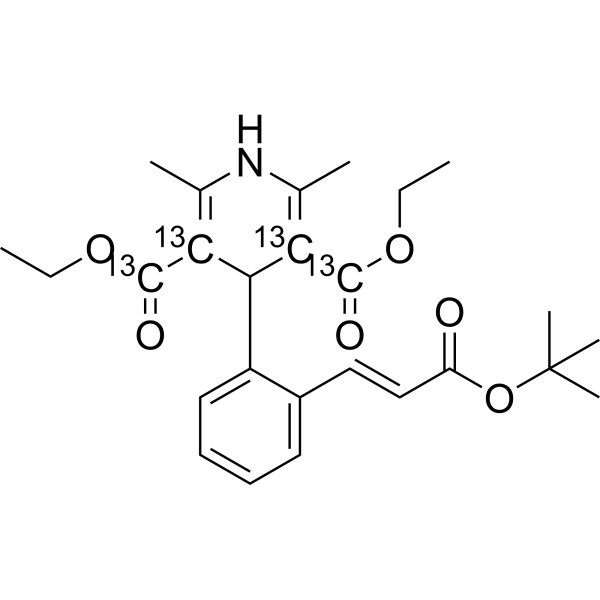
Lacidipine- 13C4 is 13C labeled Lacidipine (HY-B0347). Lacidipine is an orally active and highly selective L-type calcium channel blocker that acts on smooth muscle calcium channels, primarily dilates peripheral arteries, reduces peripheral resistance, and has long-lasting anti-hypertensive activity. Lacidipine protects HKCs from apoptosis induced by ATP depletion and recovery by modulating the caspase-3 pathway. Lacidipine can be used in studies of hypertension, atherosclerosis and acute kidney injury (AKI) .
loading...
    loading...
Cat. No.: HY-118264
CAS No.: 142695-08-7
MDL-100240 is a dual-acting angiotensin-converting enzyme (ACE) and neutral endopeptidase (NEP) inhibitor. MDL-100240 can significantly lower blood pressure, reverse left ventricular hypertrophy, and effectively prevent hypertrophy and dilatation of the aorta and resistance arteries, with an effect comparable to that of ramipril (HY-B0279). In addition, MDL-100240 can also reduce aldosterone levels, but has no significant effect on atrial natriuretic peptide and cGMP. In 3-month-old transgenic rats, MDL-100240 can reduce adrenomedullin concentrations, prevent and reverse severe hypertension and cardiovascular damage, and enhance bradykinin effects.
loading...
    loading...
Cat. No.: HY-178030
CAXII-IN-3 is an effective carbonic anhydrase (CA XII) inhibitor with a Ki of 53 nM. CAXII-IN-3 exhibits selective inhibition against multiple human CA subtypes with Kis of 5.3 μM, 75 nM, 1.9 μM, > 10 μM against CA I, CA II, CA IV and CA IX. CAXII-IN-3 mainly inhibits CA II and XII, and reduces aqueous humor production. CAXII-IN-3 exhibits β3-AR agonistic activity, can dilate retinal blood vessels, and improve optic nerve perfusion. CAXII-IN-3 can be used in the research of ocular disorders such as glaucoma .
loading...
    loading...
Cat. No.: HY-B1337S2
CAS No.: 3035513-80-2
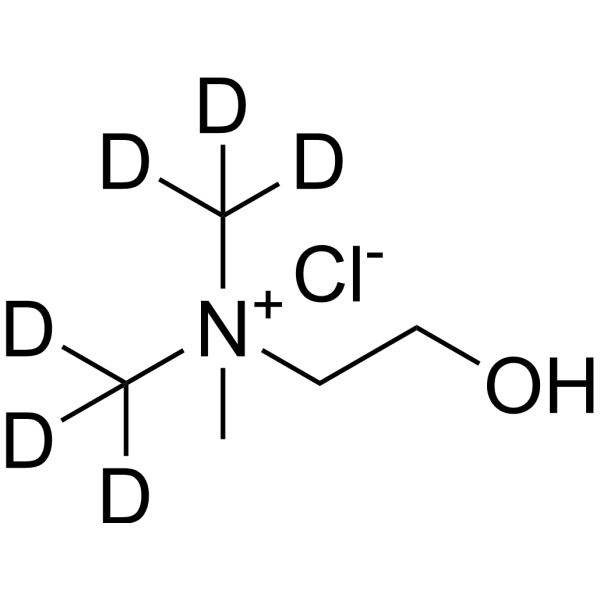
Choline-d6 chloride is the d6-labeled Choline chloride (HY-B1337). Choline chloride is an orally active methylxanthine derivative. Choline chloride exhibits weak antihistaminic and anticholinergic activities and potentiates the effects of histamine and acetylcholine. Choline chloride relaxes bronchial smooth muscle, dilates coronary and peripheral blood vessels, increases urine output and electrolyte excretion, stimulates locomotor activity in the central nervous system, and induces transient hypotension following a pressor phase. Choline chloride modulates sleep architecture by increasing wakefulness time and reducing slow-wave sleep, without altering the frequency or severity of nocturnal hypoxemia, apnea, or hypopnea events. Choline chloride is used in studies of bronchospasm, nocturnal asthma, and chronic asthma .
loading...
    loading...
Cat. No.: HY-B1098B
CAS No.: 876-26-6
Synonyms: 4-Hydroxyamphetamine hydrochloride
Target:  

Drug Derivative

Research Areas:  

Neurological Disease

Hydroxyamphetamine (4-Hydroxyamphetamine) hydrochloride is a sympathomimetic agent, stimulates the sympathetic nervous system. Hydroxyamphetamine hydrochloride can be used in eye drops to dilate the pupil .
loading...
    loading...
Cat. No.: HY-N0165R
CAS No.: 11013-97-1
Methyl-Hesperidin (Standard) is the analytical standard of Methyl-Hesperidin (HY-N0165). This product is intended for research and analytical applications. Methyl-Hesperidin is a glycoside compound. Methyl-Hesperidin has hypotensive, coronary dilating, smooth muscle relaxing, capillary stabilizing, choleretic, and anti-ulcer activities. Methyl-Hesperidin act as a competitive substrate to inhibit HIV-1 reverse transcriptase activity. Methyl-Hesperidin potentiates coronary dilating actions of adenine nucleotides and 3'-AMP, enhances depressant action on isolated atria, and prolongs adenosine- and ATP-induced heart block in guinea pigs .
loading...
    loading...
Cat. No.: HY-P11846
Target:  

ADAMTS

Research Areas:  

Cardiovascular Disease

ADA2 is an ADAMTS4-binding peptide and imaging agent with a human ADAMTS4 Ka of 5.3 nM and reduced renal uptake compared to related tracers. ADA2 accumulates in dilated aortic regions in aortic aneurysm mouse models. ADA2 exhibits an in vivo safety profile. ADA2 can be used for the research of aortic aneurysm .
loading...
    loading...
Cat. No.: HY-119708A
CAS No.: 3098314-20-3
Synonyms: RPL-554 tosylate
Research Areas:  

Inflammation/Immunology

Ensifentrine (RPL-554) tosylate is an inhaled dual inhibitor of PDE3 and PDE4 with IC50s of 0.4 nM and 1479 nM, respectively. Ensifentrine tosylate blocks PDE3 and PDE4 enzymes, thereby increasing the levels of cyclic adenosine monophosphate (cAMP) and cyclic guanosine monophosphate (cGMP) in lung cells, dilating the bronchi, and inhibiting the activation and migration of inflammatory cells. Ensifentrine tosylate can be used in the research of chronic obstructive pulmonary disease (COPD) .
loading...
    loading...
Cat. No.: HY-126939
CAS No.: 1835197-63-1
MN-05 is a dual neuroprotective and vasodilatory NMDA receptor inhibitor.MN-05 blocks calcium influx, reduces free radical production, and maintains mitochondrial membrane potential in cortical neurons exposed to glutamate.MN-05 dilates aortic rings against phenylephrine-induced contraction.MN-05 protects neurons against glutamate-induced injury in vitro.MN-05 can be used for the research of neurodegenerative diseases .
loading...
    loading...
Cat. No.: HY-A0075R
CAS No.: 13073-96-6
Synonyms: UCB 1402 dihydrochloride (Standard); NSC289116 dihydrochloride (Standard)
Decloxizine (UCB-1402; NSC289116) dihydrochloride (Standard) is the analytical standard of Decloxizine dihydrochloride. This product is intended for research and analytical applications. Decloxizine dihydrochloride is an orally active bronchodilator that can penetrate the blood-brain barrier. Decloxizine dihydrochloride is a piperazine-type H1 histamine receptor antagonist. Decloxizine dihydrochloride selectively blocks H1 histamine receptors, inhibiting histamine-induced capillary dilation, edema, and itching. Decloxizine dihydrochloride has some 5-HT2 receptor antagonistic activity. Decloxizine dihydrochloride can be used in studies of urticaria, allergic rhinitis, and bronchial asthma.
loading...
    loading...

