100 Results for "

tetrapeptide

" in MedChemExpress (MCE) Product Catalog:
Products (100)

100 Results for "tetrapeptide" in MCE Product Catalog:

Cat. No.: HY-P3882
Research Areas:  

Neurological Disease

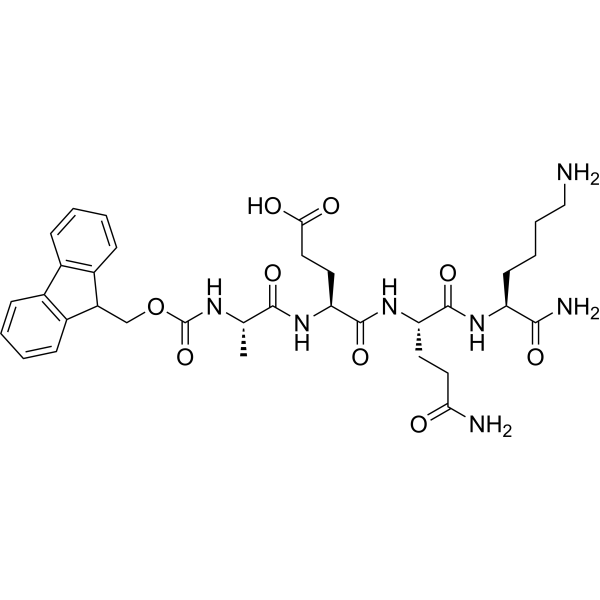
Fmoc-Ala-Glu-Gln-Lys-NH2 (AEQK) is a tetrapeptide. Fmoc-Ala-Glu-Gln-Lys-NH2 is the inactive control for Fmoc-Ala-Glu-Asn-Lys-NH2 (AENK) peptide inhibitor. AENK blocks proteolysis of UNC5C protein .
loading...
    loading...
Cat. No.: HY-106154
CAS No.: 274912-87-7
Research Areas:  

Cancer

DTS-201 (CPI-0004) is a peptidic prodrug of Doxorubicin (HY-15142A). DTS-201, comprising the tetrapeptide portion, is cleaved by endopeptidases in the tumor environment to produce metabolites that subsequently enter the cell and are converted to active Doxorubicin. DTS-201 shows antitumoral efficacy in tumor xenograft models of prostate, breast, and lung cancer .
loading...
    loading...
Cat. No.: HY-P10007
CAS No.: 159659-05-9
Synonyms: Z-GPFL-CHO
Target:  

Proteasome

Research Areas:  

Cancer

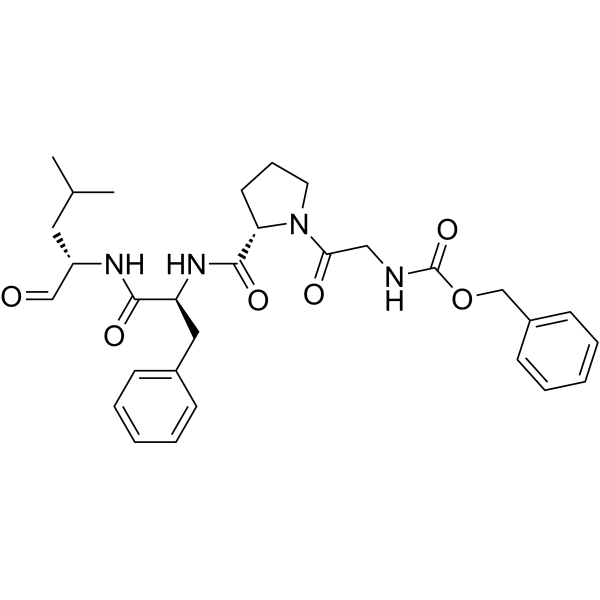
Z-Gly-Pro-Phe-Leu-CHO (Z-GPFL-CHO) is a tetrapeptide aldehyde that acts as a highly selective and potent proteasomal inhibitor (Ki = 1.5 µM for branched chain amino acid preferring, 2.3 µM for small neutral amino acid preferring, and 40.5 µM for chymotrypsin-like activities; IC50 = 3.1 µM for peptidyl-glutamyl peptide hydrolyzing activity) .
loading...
    loading...
Cat. No.: HY-178720
CAS No.: 2168573-03-1
Target:  

Opioid Receptor

Research Areas:  

Neurological Disease

SHR0687 is a selective tetrapeptide kappa opioid receptor (KOR) agonist with an EC50 of 0.53 pM. SHR0687 displays high potency and selectivity over MOR and DOR, with negligible blood-brain barrier penetration. SHR0687 activates KOR specifically, leading to potential modulation of neurological pathways without significant central nervous system effects. SHR0687 can be used for the research of pain .
loading...
    loading...
Cat. No.: HY-P10555
CAS No.: 90549-86-3
Target:  

Opioid Receptor

Research Areas:  

Neurological Disease

(D-Arg2, Sar 4)-Dermorphin (1-4) is a tetrapeptide derivative of the peptide Dermorphin (HY-P0244) found in amphibian skin. (D-Arg2, Sar 4)-Dermorphin (1-4) has significant analgesic effects by binding to the μ-opioid receptor (MOR) in the body. (D-Arg2, Sar 4)-Dermorphin (1-4) can be used in the development of analgesic drugs .
loading...
    loading...
Cat. No.: HY-129516
CAS No.: 131449-37-1
Research Areas:  

Metabolic Disease

A-70874 is a tyrosine-free tetrapeptide analog of cholecystokinin (30-33) (CCK-4). A-70874 is an agonist that stimulates pancreatic amylase release and a partial agonist that stimulates pancreatic phosphoinositide decomposition. A-70874 has an IC50 of 4.9 nM for the guinea pig pancreatic CCK receptor. Cholecystokinin (CCK) receptors are divided into CCK-A (digestive tract) and CCK-B (brain). A-70874 has an affinity of 1.6 μM for the CCK-B/gastrin receptor .
loading...
    loading...
Cat. No.: HY-P12110
Research Areas:  

Others

Oxytocin N-terminal tetrapeptide dimer is a dimer derivative of Oxytocin (HY-17571).
loading...
    loading...
Cat. No.: HY-P11427
CAS No.: 259176-74-4
Target:  

Fluorescent Dye MALT1

Research Areas:  

Inflammation/Immunology Cancer

Ac-LVSR-AMC is a tetrapeptide fluorescent substrate that can be used for in vitro quantitative detection of the specific activity of the Malt1 protease .
loading...
    loading...
Cat. No.: HY-175395
Onychocin B is a cyclic tetrapeptide isolated from Onychocola sclerotica. Onychocin B is a calcium channel blocker with an IC50 of 7.1 μM for Cav1.2 .
loading...
    loading...
Cat. No.: HY-P2674
CAS No.: 113516-56-6
Target:  

MHC

Research Areas:  

Inflammation/Immunology Cancer

KDEL is a tetrapeptide serving as an endoplasmic reticulum (ER) retrieval/retention signal. KDEL can target and deliver exogenous antigen peptides to the ER, significantly enhance and prolong MHC class I molecule presentation, and effectively boost anti-tumor immune responses .
loading...
    loading...
Cat. No.: HY-N6717S1
Tentoxin- 13C22 is the 13C-labeled Tentoxin (HY-N6717). Tentoxin is a cyclic tetrapeptide isolated from Alternaria tenuis, acts as a herbicide, causes seedling chlorosis, inhibits cyclic photophosphorylation and functions as an energy transfer inhibitor .
loading...
    loading...
Cat. No.: HY-P2111
CAS No.: 121912-19-4
Target:  

Inhibitory Antibodies

Research Areas:  

Neurological Disease

Achatin I is a neuroexcitatory tetrapeptide. Achatin I can be derived from Achatina fulica férussac. Achatin-I induces a voltage-dependent inward current. Achatin-I shows marked excitatory effects on the three Achatina giant neurones, PON, TAN and V-RCDN .
loading...
    loading...
Cat. No.: HY-182326
CAS No.: 86402-37-1
Synonyms: FR900261
Target:  

Antibiotic Fungal

Research Areas:  

Cancer

WF-3161 (FR900261) is a cyclic tetrapeptide antibiotic isolated from the fungus Petriella guttulata with anti-tumor activity. WF-3161 inhibits the growth of Trichophyton asteroides with an MIC of 3 μg/mL. WF-3161 is applicable to research related to P-388 leukemia .
loading...
    loading...
Cat. No.: HY-P11416
CAS No.: 122207-62-9
Target:  

Integrin

Research Areas:  

Cardiovascular Disease

Ac-RGDS-NH2, a tetrapeptide, is an integrin antagonist. Ac-RGDS-NH2 competitively binds to the GPIIb/IIIa receptor (Ki = 4.2 μM), inhibiting the binding of fibrinogen to platelets and thereby effectively suppressing platelet aggregation. Ac-RGDS-NH2 can be used for research on thrombosis .
loading...
    loading...
Cat. No.: HY-P992166
Synonyms: ADCE-D01 Antibody

Target:  

ADC Antibodies Collagen

Research Areas:  

Cancer

AB-004 is a humanized monoclonal antibody and ADC targeting uPARAP. AB-004 can be conjugated with the topoisomerase-1 inhibitor P1021 via a protease-cleavable tetrapeptide linker to form the ADC ADCE-D01. AB-004 binds to tumor cells expressing uPARAP, triggering the endocytosis of the ADC. AB-004 is applicable for cancer research .
loading...
    loading...
Cat. No.: HY-185832
Research Areas:  

Cancer

SYS6010 is an antibody-drug conjugate (ADC) targeting epidermal growth factor receptor (EGFR), which is formed by conjugating the anti-EGFR humanized IgG1 monoclonal antibody Becotatug (HY-P990049) with the topoisomerase I inhibitor JS-1 (HY-178217) via a cleavable tetrapeptide linker. SYS6010 can be used in the research of advanced solid tumors such as non-small cell lung cancer .
loading...
    loading...
Cat. No.: HY-187118
CAS No.: 174308-47-5
Target:  

Bacterial Fungal

Research Areas:  

Infection

Gly (Boc)-GGG is a tetrapeptide that can be used to inhibit bacterial or fungal activity. Gly (Boc)-GGG acts synergistically with Fluconazole (HY-B0101) to inhibit fungal growth. Gly (Boc)-GGG acts synergistically with Erythromycin (HY-B0220) to inhibit bacterial growth. Gly (Boc)-GGG itself has no significant antifungal or antibacterial activity. Gly (Boc)-GGG can be used in the research of bacterial and fungal infections .
loading...
    loading...
Cat. No.: HY-P2661A
Research Areas:  

Infection

FA-Leu-Gly-Pro-Ala-OH TFA is a furylacryloyl-terminal tetrapeptide that serves as a substrate for bacterial collagenase and spirochete metalloendopeptidase. FA-Leu-Gly-Pro-Ala-OH TFA is specifically hydrolyzed by spirochete collagenase only at the Leu-Gly bond. FA-Leu-Gly-Pro-Ala-OH TFA can be used to determine the equilibrium constant of peptide bond hydrolysis, and also to detect collagenase-mediated cleavage reactions via turbidimetry based on absorbance reduction .
loading...
    loading...
Cat. No.: HY-185833
Research Areas:  

Cancer

ADC Control Human IgG1-JSSW-001 is the isotype control for ADC SYS6010 (HY-185832). SYS6010 is an antibody-drug conjugate (ADC) targeting epidermal growth factor receptor (EGFR), which is formed by conjugating the anti-EGFR humanized IgG1 monoclonal antibody Becotatug (HY-P990049) with the topoisomerase I inhibitor JS-1 (HY-178217) via a cleavable tetrapeptide linker. SYS6010 can be used in the research of advanced solid tumors such as non-small cell lung cancer .
loading...
    loading...
Cat. No.: HY-P11904
LADW is a tetrapeptide derived from the hydrolysate of tuna skeletal muscle myosin, with dual inhibitory activities against angiotensin-converting enzyme 1 (ACE1) and α-glucosidase. The IC50 value of LADW against ACE1 is 28.02 μM, while its IC50 value against Saccharomyces cerevisiae α-glucosidase is 4.40 mM. LADW binds competitively to the active site of ACE1, stabilizes the enzyme conformation, and blocks substrate binding. LADW binds to α-glucosidase to inhibit carbohydrate hydrolysis and can also alter starch structure. LADW can be used in studies related to hypertension and diabetes .
loading...
    loading...

